A Midsummer Night's Dream
Part One · Trouble in Athens
In ancient Athens, Duke Theseus was preparing to marry Hippolyta, queen of the Amazons, and the whole city was buzzing with preparations for the celebration, which would take place in four days. Into this happy palace stormed an angry old man named Egeus, dragging his daughter Hermia and two young gentlemen behind him. Egeus had chosen one of them, Demetrius, as Hermia's husband, but Hermia was in love with the other, Lysander, and she absolutely refused to obey. According to the harsh old law of Athens, the duke reminded her, a daughter who disobeyed her father must either be put to death or be shut away in a convent for the rest of her life. He granted her until his wedding day to decide. Lysander sighed and observed that "the course of true love never did run smooth," which has been true for the four hundred years since Shakespeare wrote it.
So Lysander and Hermia devised a desperate scheme: the following night they would meet in the forest outside the city and run away together to his aunt's house, far beyond the reach of Athenian law. Unfortunately, they confided their secret to Hermia's oldest friend, Helena, who had complications of her own. She was hopelessly in love with Demetrius, who had once adored her but who now pursued Hermia instead, and who treated Helena as though she were a puddle he had stepped in. Hoping to earn a little gratitude, Helena revealed the elopement to Demetrius, who immediately rushed off to the forest to stop it, and Helena, of course, rushed after him. By midnight, four confused young Athenians were wandering through the dark wood, none of them in love with the right person, and none of them aware of who else was out there in the moonlight.
Meanwhile, in a humble cottage in Athens, six working men were organizing a surprise for the duke's wedding. Led by a carpenter named Peter Quince, they intended to perform a play called "The Most Lamentable Comedy and Most Cruel Death of Pyramus and Thisbe," which they hoped would earn them a generous reward, although not one of them had ever acted before. The most enthusiastic member of the company was a weaver named Nick Bottom, who was cast as the hero, Pyramus, but who also wished to play the heroine, the lion, and every other part. He promised that he would roar so gently that he would not frighten the ladies, and roar so magnificently that the duke would demand, "Let him roar again!" Quince persuaded him that only Bottom was handsome enough to play Pyramus, and they agreed to rehearse secretly in the forest, by moonlight.
Part Two · The Fairy Flower
That particular forest, however, belonged to the fairies, and the fairies were quarreling, because Oberon, the king of the fairies, and Titania, his queen, were having such a ferocious argument that their fury had scrambled the weather of the whole world, flooding the rivers and spoiling the harvests. The quarrel concerned a little orphan boy whom Titania was raising, and whom Oberon wanted as a page for himself. Titania refused to surrender him, so Oberon determined to teach her a lesson, and he summoned his servant Puck, also called Robin Goodfellow, the most mischievous spirit in fairyland, who spent his time curdling milk, misleading travelers at night, and pulling stools from under gossiping old women. Oberon sent him to fetch a little purple flower called love-in-idleness. Its juice, squeezed onto the eyelids of a sleeper, would make that person fall madly in love with the first living creature they saw upon waking.
While Puck was away, Oberon, invisible, overheard Demetrius scolding Helena and ordering her to stop following him. Oberon felt sympathy for the miserable girl. When Puck returned with the flower, Oberon took some of its juice to enchant Titania, and he instructed Puck to anoint the eyes of the disdainful young man in Athenian clothes, so that he would love Helena once more. Puck searched the forest and soon discovered a young man in Athenian clothes, asleep on the ground beside a young woman. Unfortunately, it was the wrong young man. Puck squeezed the juice onto the eyelids of Lysander, sleeping beside Hermia, and flitted away, delighted with his work. A moment later Helena stumbled past, out of breath after chasing Demetrius, and she noticed Lysander on the ground and shook him to see whether he was alive. Lysander opened his eyes, gazed at Helena, and fell instantly and passionately in love.
Lysander leaped up and declared that he would run through fire for Helena, that Hermia was nothing to him, and that he could not imagine what he had ever seen in her. Helena was not flattered but furious, convinced that he was mocking her, and she marched away, with Lysander following and pouring out compliments, while poor Hermia slept on alone. Meanwhile, in another part of the wood, Oberon crept up to where Titania lay sleeping on a bank of wild thyme and violets, and he squeezed the flower's juice onto her eyelids, whispering a spell that whatever she saw when she awoke, she would adore it. He hoped it would be a bear, a wolf, or a monkey. As it turned out, his wish was granted in a way that was far more ridiculous than anything he could have imagined, because the rehearsal of "Pyramus and Thisbe" was about to begin nearby.
Part Three · The Donkey's Head
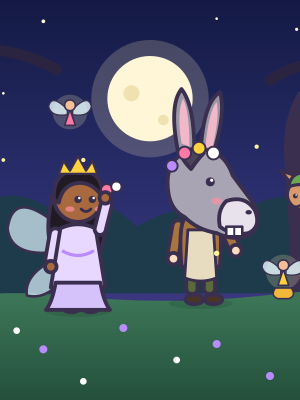
The six actors gathered in a clearing near Titania's bower and began rehearsing, with Bottom offering helpful advice about everyone else's performances. Puck, passing by, was enchanted by the chance for mischief. When Bottom stepped behind a bush, waiting for his cue, Puck transformed his head into the head of a donkey, with long furry ears and a velvety muzzle, and Bottom stepped back out to deliver his next line. His fellow actors took one look at him and fled, screaming that they were haunted. Bottom, who could not see his own head, assumed his friends were trying to frighten him. He decided to prove that he was not afraid by strolling up and down and singing a song as loudly as he could. His braying awakened the queen of the fairies. Titania opened her eyes, beheld a weaver with a donkey's head, and fell hopelessly in love.
"What angel wakes me from my flowery bed?" Titania sighed, and she announced that she loved him and that he must remain in the forest with her forever. Bottom took this very calmly, observing that reason and love keep little company together nowadays. Titania summoned four tiny fairies, named Peaseblossom, Cobweb, Moth and Mustardseed, to wait upon her beloved. She crowned his hairy head with flowers and stroked his long ears, and the fairies fetched him honey and scratched his head. Bottom, enjoying himself enormously, explained that he felt marvelously hairy about the face and that he had a great desire for a bottle of hay. When Puck reported all of this to Oberon, the fairy king laughed with delight. But when Oberon realized that Puck had enchanted the wrong Athenian, he was considerably less amused. He squeezed the flower's juice onto the eyes of Demetrius himself, to put things right.
Things did not go right, because Demetrius awoke just as Helena arrived, pursued by Lysander, and he too fell instantly in love with her. Now both young men adored Helena, who was absolutely certain that this was a cruel joke. Then Hermia appeared, searching for Lysander, and was astonished when he informed her that he despised her. The four friends began a ferocious quarrel. Helena accused Hermia of joining the joke, and Hermia, who was much shorter than tall Helena, decided that her friend had stolen Lysander by flaunting her height, and called her a painted maypole. Helena, terrified, remarked that "though she be but little, she is fierce." The two young men, meanwhile, stomped off into the trees to fight a duel over Helena. Puck, watching with enormous satisfaction, turned to Oberon and exclaimed, "Lord, what fools these mortals be!"
Part Four · Only a Dream
Oberon ordered Puck to repair the damage before anybody was hurt. Puck summoned a thick fog over the forest and darted between the two rivals, imitating each man's voice to lead the other in circles, until both of them were so exhausted that they lay down and fell asleep. Soon Helena and Hermia, wandering lost and weary, lay down and slept nearby. Then Puck squeezed the remedy onto Lysander's eyes, so that he would love Hermia again when he woke. Meanwhile, Titania, still enchanted, happily gave Oberon the little orphan boy, and Oberon, satisfied at last and a little ashamed of himself, released her from the spell. Titania woke and stared in horror at the donkey-headed creature snoring beside her, wondering how she could ever have loved it. Puck removed the donkey's head, the king and queen of the fairies made peace, and they danced together as the dawn approached.
At sunrise, Duke Theseus and Hippolyta, who were hunting in the forest with Egeus, discovered the four young people asleep on the grass. Awakened by the hunting horns, the lovers tried to explain what had happened, but everything seemed as confused and distant as a dream. One thing, however, was perfectly obvious: Lysander loved Hermia, and Demetrius, whose eyes were still enchanted, loved Helena, and the duke overruled the furious Egeus and announced that both couples would be married that day, alongside himself and Hippolyta. Not long afterward, Bottom woke up alone in the clearing, under the impression that he was still in rehearsal. He scratched his ordinary human ears in bewilderment. He announced that he had had a most rare vision, a dream beyond the wit of man to explain, and he would ask Peter Quince to write a ballad about it called "Bottom's Dream," because it had no bottom.
That evening, after the triple wedding, the six working men performed "Pyramus and Thisbe" for the court, and it was the most magnificently terrible play ever staged. One actor impersonated a wall, holding up his fingers to represent the chink through which the lovers whispered, while another impersonated the moon, carrying a lantern, a thornbush and a dog. Snug, the joiner, playing the lion, politely explained to the ladies that he was not really a lion at all, just Snug. Bottom, as Pyramus, died at enormous length, stabbing himself and crying, "Now die, die, die, die, die," and the audience laughed until they wept. At midnight, when everyone had gone to bed, the fairies crept in to bless the house, and Puck turned to the audience with a final suggestion. If the play has offended you, he said, simply imagine that you were sleeping, and that everything you saw was only a dream.