Arachne the Weaver
Part One · The Girl Who Wove
Long ago, in the land of Lydia, across the sea from Greece, there lived a girl named Arachne. Her father was a dyer who spent every day dipping wool into enormous pots of purple dye, and his hands were always stained the color of grapes. They were not wealthy, and they lived in an ordinary little house at the edge of an ordinary little town. But by the time Arachne was grown, people all over the world had heard her name, because she was the most marvelous weaver who had ever lived.
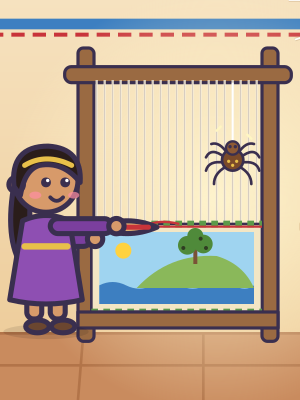
Every morning, Arachne sat down at her loom, a tall wooden frame strung with long threads from top to bottom. She sent her shuttle flying back and forth between them, pulling a colored thread behind it, and gradually a picture appeared in the cloth. Her fingers moved so rapidly that people could hardly see them. She could weave a river that seemed to ripple and a cloud that seemed to drift, and she once wove a rose so realistic that the bees bumped against the cloth, trying to get inside it.
Visitors traveled from distant cities simply to watch her work. Even the nymphs, the shy spirits of the forests and rivers, crept out of the vineyards and the streams to stand in her doorway. They watched her comb the wool until it was as soft as smoke, and they watched her spin it into thread as fine as a hair. "Surely the goddess Athena must have taught her," they whispered. "No ordinary girl could ever weave like that." Athena was the goddess of wisdom, of every useful craft, and especially of the loom.
Part Two · The Old Woman
Arachne heard the whispers, and she did not like them at all. "Nobody taught me anything," she announced, tossing her head. "I taught myself, with my own two hands. If Athena imagines she can weave better than I can, let her come here and try. If she wins, I will accept whatever punishment she chooses." The nymphs gasped and covered their mouths, and several of them hurried back to their streams. It was a dangerous thing to say about a goddess, and everyone understood that except Arachne.
The next day, an old woman came hobbling slowly up the road, with gray hair and a bent back, leaning on a walking stick. She stood beside the loom and watched for a long time, and then she spoke. "I am old, and old people have learned a few things," she said. "Be the greatest weaver among mortals, if you like, and nobody will argue. But do not boast that you are better than a goddess. Ask Athena to forgive you, child, and she certainly will."
Arachne did not even look up from her work. "Save your advice for your own grandchildren," she snapped. "I said exactly what I meant. If Athena is so wonderful, why does she not come herself? Perhaps she is afraid." The old woman straightened her back. "She is here," she said. Her gray hair became shining gold, her walking stick became a spear, and her ragged cloak became a robe of light. The old woman had disappeared, and the goddess Athena stood in the little room, tall and gray-eyed and calm.
The nymphs fell to their knees, and the women of the town bowed their heads. Arachne's cheeks turned pink for a moment and then went pale, but she did not bow, and she did not take back a single word. She only lifted her chin. "Then let us weave," she said. Athena did not answer, because she did not need to. Two looms were set up side by side, and the two weavers tied up their long skirts, picked up their shuttles, and began the most famous contest in the history of weaving.
Part Three · The Contest
The shuttles flew. The threads were every color of the earth and sky: purple from the dye pots, the gold of ripe wheat, the blue of deep water, and the delicate green of new leaves. The two weavers worked so quickly and so happily that the work did not feel like work at all. Crowds packed the doorway and the window, and some even climbed onto the roof to see. Nobody spoke a word. The only sounds were the clack of the wooden frames and the gentle hush of the threads.
In the middle of her cloth, Athena wove the hill of Athens, with herself standing on it beside the mighty sea god Poseidon. Long ago, the two of them had argued about which one would protect the city. Poseidon struck a rock with his spear, and salty water gushed out, but Athena touched the ground, and an olive tree grew up, heavy with fruit. The people chose the olive tree, and they chose Athena. In the four corners of her tapestry, she wove four little pictures of mortals who had boasted they were greater than the gods, and how sorry they had been afterward.
Arachne noticed the little pictures and understood the warning, but she did not stop. She wove pictures of the gods too, but hers showed the gods behaving badly. She wove Zeus, the king of the gods, disguised as a bull and playing tricks, along with gods who lied, gods who cheated, and gods who were silly and vain. Around the edges, she wove a border of flowers twined with ivy. It was the most magnificent cloth that anyone had ever seen, and every face looked alive, and every wave looked wet.
Athena walked slowly along Arachne's tapestry from one end to the other, examining every thread. She could not discover a single mistake in it, not one knot and not one wobble, and even the goddess of weaving could find no fault in it at all. That made her angrier than anything else. The work was perfect, but it was perfectly rude, and it had been made to laugh at the gods. Athena raised her shuttle of boxwood and struck the cloth, and the beautiful tapestry tore from top to bottom.
Part Four · Forever Weaving
Then Athena touched Arachne gently on the forehead with the shuttle, three times, and Arachne felt herself beginning to change. Her hair slipped away like silk, and her nose and her ears shrank until they disappeared. Her head became tiny, and her body became small and round. Her fingers grew long and thin and clung to her sides, and now there were eight of them, eight quick legs. In a moment, the proud weaver had become a little brown spider, dangling from a single silver thread.
The goddess looked down at her, and the anger faded from her gray eyes. "Live, then," Athena said quietly, "and weave. You love weaving more than anything, so you shall never have to stop. You, and your children, and their children after them, will weave until the end of the world." Then she vanished, and the crowd went home, talking in whispers. The little spider climbed to the top of the broken loom, let out a shining thread, and then another, and began to work.
The spider is weaving still. Look into a garden early in the morning, when the dew is on the grass, and you may see her work. It is a wheel of silk stretched between two branches, with every thread exactly in its place, and drops of water shine on it like tiny pearls. There is no weaver in the world who can make anything finer or faster. She does it all without a loom or a shuttle, and she has never needed a teacher.
People have never forgotten Arachne. Even today, scientists call spiders, scorpions and their relatives arachnids, after the girl from Lydia. Whenever somebody is wonderfully talented, people still remember her story, because it is not really about spiders at all. It is about a great gift and a proud heart, and about what happens when they meet. Arachne's hands were the cleverest in the world, and if only she had been a little kinder with her words, she might have been remembered as the weaver who won.