Big Night at Spade Pond: the full story
Part One · The Flags
Ronke Achebe had never lost a counting argument, and she did not intend to start with a pond. It began on the last Saturday in February, when a sign appeared at the edge of the woods behind Quarry Road: FOR SALE, FOURTEEN ACRES, BRIGHTWATER HOMES. Underneath, somebody had added a drawing of a house, with a very large garage. Ronke copied the sign into her notebook, with the time and the temperature. Then she wrote down the thing she was certain of, which was that the woods had a pond in them, and that she had been catching tadpoles there since she was five, and that nobody had asked the tadpoles.
Spade Pond was shaped like a spade, which is why it was called that, with a round bowl of water at one end and a short handle of mud at the other. In February it was a gray skin of ice, with last year's leaves frozen into it like pressed flowers. Her friends were with her that day: Gideon Lund, who exaggerated everything on principle, and Hana Bui, who swam on the town team and had never knowingly touched mud. "It's not even a real pond," Gideon announced. "It's like a puddle that got ideas." "Excuse me," said a voice behind them. "That is not a puddle. It's a vernal pool."
It belonged to Mrs. Oyelaran, who lived next to the woods and had spent forty years as a biologist, studying things that most people stepped on. She wore rubber boots, a cardigan with a hole in it, and an expression of patient surprise. A vernal pool, she explained, fills up with melted snow and spring rain, and dries out again by late summer, so no fish can ever live there. "And that is exactly why it matters," she said. "Fish eat eggs. Every year, when the first warm, rainy night comes, the spotted salamanders walk here from the woods, across Quarry Road, to lay them."
Ronke's pencil stopped. "How many?" she asked. "Hundreds," said Mrs. Oyelaran. "Thousands," said Gideon. "How many, exactly?" said Ronke. Mrs. Oyelaran looked at her for a long moment, in the manner of someone being offered a present she had not known she wanted. "Nobody has ever counted them here," she said. "They come on one night, in the dark, in the rain, and they are gone by dawn. We call it the Big Night." Ronke turned to a clean page in her notebook and wrote BIG NIGHT at the top, and underlined it twice. "Then we will count them," she said.
That was the afternoon that Mr. Brightwater came. He arrived in a clean white car and stepped out of it in a gray suit and a pair of shoes so polished that Gideon could see his own nose in them. There was a small nick on the left toe, like a bite. Mr. Brightwater was friendly in a smooth, rehearsed way. He said that he was delighted to meet such enthusiastic young people, and that the pond was technically a seasonal depression, and that the town only protected pools larger than a thousand square feet. His surveyor had measured Spade Pond at nine hundred.
The surveyor's orange flags stood around the pond in a ring. Ronke counted eleven. She walked around the pond and noticed that the orange flags were all stuck in the leaf litter, where the ground was perfectly dry. The real edge of the water, where the leaves turned dark and slimy and the moss began, lay a long step farther out. "He's measuring the wrong place," she said. They went home, and came back with blue plastic flags from the school art room, and pushed one into the ground at every spot where the dark leaves began.
On Monday morning, three of the blue flags were gone. On Tuesday, there were five, and on Wednesday seven, and all of them had been pulled up and planted again, in neat little rows, a long stride inside the pond's real edge. "Raccoons," Gideon said, immediately. "Gnomes. Mr. Pratt, who hates the frog noise every spring. A secret society of very small surveyors." Ronke did not answer. Ronke crouched at the foot of an oak and drew a shape in her notebook, because there was one clear print in the mud under the tree. It was long, smooth and narrow, with a crescent heel, and it had not been made by a boot.
It was Hana who worked out the rest. She stood very still at the edge of the pond, with her toes curled inside her sneakers, and studied the ground between the bank and the flags. "He didn't step in the mud," she said. "Whoever it was. He stepped on that rock, and that root, and that log, and then there, one single time, because he had to. He walked around the pond without once getting mud on him." She said it in a voice of deep respect. "I do that. I know exactly how a person walks who really hates mud. It's not Mr. Pratt, either. Mr. Pratt lives in his boots."
Part Two · Waiting for Rain
March came in cold and dry, and Ronke wrote fourteen letters to the town's Conservation Commission and received a single postcard that said Thank You For Your Interest. Each morning at ten to seven, the three of them checked the flags, and each morning there was a new row of blue plastic, a little closer to the middle. Mrs. Oyelaran told them that salamanders will not move until the night is both wet and above about forty degrees, so there was nothing to do but wait. Ronke asked whether they could hurry it up, and Mrs. Oyelaran said that in forty years of studying salamanders, she had never once seen anybody rush one.
So they set a trap instead. Mrs. Oyelaran had an old camera for photographing deer, a battered green box with a motion sensor that she strapped to a tree, and aimed at the row of blue flags. The next morning, the camera held eleven pictures. Ten of them were a squirrel. The eleventh, taken at six-twelve in the gray light, showed no face at all. It showed a leg, and part of a coat sleeve, and a clipboard, and a shoe. It was a narrow shoe with a crescent heel, polished to a shine even in the dark, and on its left toe, just visible, there was a small nick, like a bite.
"A shoe is not a person," said Ronke, who was being scrupulously fair, and who also knew that she needed more than a shoe. So they investigated. For nine days, Gideon looked at the feet of everyone he met. He looked at the barber, the librarian and the bus driver, and he followed a man in the supermarket for six minutes before finding out that he was the mayor. Hana checked the shoes at the pool. Ronke wrote it all down in columns. By the end of the ninth day, she had a list of two hundred and eleven pairs of shoes and no nick whatsoever.
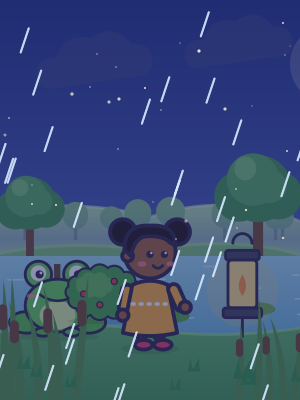
The night finally came on the twenty-second of March. At half past five in the afternoon, the sky turned the color of wet slate, and the first fat drops hit the kitchen window, and the thermometer on Ronke's porch said forty-six. She was standing in her boots before the phone rang. "Tonight," said Mrs. Oyelaran, and hung up. By eight, Quarry Road was lined with cars, and families with flashlights and buckets and umbrellas were drifting down through the rain. Mrs. Oyelaran, in a yellow raincoat, climbed on a stump and told them the rules.
Part Three · The Big Night
Wet hands only, she said, because a salamander's skin is thin as a breath, and dry hands can harm it. Carry each one across the road, in the direction it was already walking, so that it would never be confused. Never pick up a salamander in the middle of a car's headlights. And above all, count everything. "Every one that goes across, every one that does not, every one that is not going to make it," said Mrs. Oyelaran. "Ronke has a sheet. Come and tell her the numbers." Ronke held up a clipboard, in a freezer bag, with three columns: GOING IN, GOING OUT, and a small one at the end that said SAD.
The first salamander walked out of the leaves at twenty past eight. It was the size of a hand, and as black and shiny as a wet glove, with two uneven rows of yellow spots running down its back like someone had spilled mustard in a hurry. It lifted its blunt face to the rain, and it did not seem to be in a hurry at all. "It's HUGE," said Gideon. It was six inches long. Then there was another, and a third, and as the rain thickened there were a dozen on the road at once, moving toward the pond with enormous calm, as though they had made this appointment long ago.
By ten, they had counted sixty-one. By eleven, the number was a hundred and eight, and Gideon was telling anyone who would listen that he had personally carried four hundred. Ronke showed him the sheet. "Thirty-one," she said. "Thirty-one is plenty." Hana had refused to touch one for the first hour. Then a salamander stopped dead in the middle of the road, directly in front of a car, and Hana was on her knees in the wet gravel before she had made any decision at all. She carried it across, in both hands, and when she looked up her face was spotted with mud, and she did not seem to have noticed.
At half past eleven, a gray car came slowly down Quarry Road with its wipers swishing, and stopped at the bend. Two people got out. The first was a tall woman with a clipboard and a large umbrella, whom Ronke had never actually met, though she had written her fourteen letters: Ms. Varga, the chair of the town's Conservation Commission. The second was Mr. Brightwater. He was in a raincoat, over a gray suit, and his shoes were dazzling. He smiled at the crowd. "This is a trespass," he said, pleasantly. "These people should be on public land. I am here as a courtesy."
Nobody said anything for a moment, and the rain drummed on the umbrellas, and then Ronke took a printed photograph out of her freezer bag and held it up in the beam of her flashlight. It was a picture of a leg, and a clipboard, and a shoe. "That's a very nice shoe," she said. Mr. Brightwater looked at the photograph, and then at his feet, and then at the muddy road, and for the first time his smile slipped. A salamander walked calmly across the toe of his left shoe, right over the nick. "I may," he said, "have straightened some flags." "Inward," said Ms. Varga. "By eleven feet."
Part Four · Two Weeks Later
By dawn, the count was two hundred and forty-seven going in, nineteen coming out, and six on the SAD list, which Ronke had written in smaller pencil. Ms. Varga said that the commission could not decide anything that night, and that it would visit the pond properly in two weeks, with its own measuring tape. She took a copy of the tally sheet. She also looked at Mr. Brightwater's shoes for a long time, and then said, in a careful voice, that nobody would be touching any flags at all until then.
The commission came two weeks later, six people in rubber boots, with a long yellow tape. By then, the pond was full to the brim, and every twig in the shallows was wrapped in jelly. Mrs. Oyelaran showed them how to find the egg masses, which were soft and clear and about the size of a softball, each one holding a hundred eggs or more. Some of them were green, because tiny algae live inside the jelly and share their oxygen with the eggs. Ronke counted ninety-six. All of them had been laid well outside the ring of orange flags, in water that, according to the surveyor, did not exist.
They measured the pond with the yellow tape, from the dark leaves on one side to the dark leaves on the other, and it covered thirteen hundred and ten square feet. Nobody cheered, and Ms. Varga wrote the number in her notebook and said that the commission would meet in May. It would weigh all the evidence, including the tally sheet, the egg masses and the photograph. That was all, a number and a date and a pond with ninety-six reasons in it, and Ronke wrote it all down, in order, with the temperature, because somebody should.
Hana was the last to leave. She was standing at the edge of the shallows with her sneakers soaked to the laces and mud up to both elbows, holding a single salamander in her wet hands, and looking at it with her whole face. It had been under the log the whole time. Ronke asked whether she was all right. Hana considered the question, and the mud, and the salamander, which blinked. "It's fine," she said, in the voice of someone who was going to deny this later. She put it down gently under a leaf at the edge of the water, and it walked away.