Black Beauty
Part One · The Meadow
The earliest place I can remember distinctly was a wide, pleasant meadow with a pond of clear water in it. Shady trees overhung the pond, rushes and water lilies decorated the deeper end, and beyond the hedge on one side there was a plowed field. While I was very young, I lived entirely on my mother's milk, because I was unable to eat grass. During the daytime I ran beside her, and at night I lay down close against her. Whenever the weather was hot, we stood together by the pond in the shade of the trees, and whenever it was cold, we sheltered in a comfortable shed beside the grove.
There were six other young colts in the meadow, and we galloped around and around the field together as fast as we could possibly go. Occasionally our games became rather rough, and the others would bite and kick. One day my mother whinnied for me to come to her side. "The colts who live here are very good colts," she said, "but they have never been taught proper manners. You come from a respectable family, and I sincerely hope that you will grow up gentle and good. Do your work with a good will, lift your feet up well when you trot, and never bite or kick, even in play." I have never forgotten her advice.
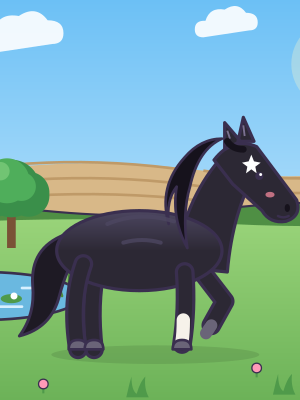
Our master, Farmer Grey, was a considerate man who affectionately called my mother Pet. When I was four years old, he began to break me in, which means teaching a horse to wear a saddle and bridle and to carry a rider obediently. The cold steel bit in my mouth felt horribly uncomfortable at first, and so did the iron shoes that were nailed onto my hooves, but my master was patient, and gradually I learned. He even placed me in a meadow beside a railway, so that I would never be frightened of the roaring locomotives. By then I had developed into a handsome horse, with a glossy black coat, one white foot and a pretty white star on my forehead.
Part Two · Birtwick Park
I was sold to Squire Gordon, a gentleman who lived at Birtwick Park. My new stable was spacious and airy, and in the neighboring stall stood a plump little gray pony called Merrylegs, whom all the children adored. Beyond him was a tall chestnut mare named Ginger, who snapped at me irritably when I arrived. Ginger explained that her earliest masters had treated her harshly, with whips and cruel jerking reins, so she had learned to bite and kick to defend herself. The Squire's wife studied me and said, "He is really quite a beauty, and he has such a sweet, good-tempered face. Why not call him Black Beauty?"
Our coachman, John Manly, and the stable boy, James, were the gentlest people I have ever known, and before long even Ginger stopped snapping. One stormy autumn evening, John and the Squire were driving me home in the carriage when we approached a wooden bridge over a river that was swollen and furious with rain. The moment my hooves touched the bridge, I sensed that something was terribly wrong, and I stopped dead. John flicked the whip impatiently, but I absolutely refused to take another step. Just then a man on the opposite bank ran out with a torch, shouting desperately, "Stop! Stop! The middle of the bridge has been swept away!"
If I had stepped onto that bridge, the carriage, the horse and both gentlemen would have plunged into the dark, rushing water. We traveled the long way home through the woods, and the Squire's wife ran out anxiously to meet us, because she had been dreadfully worried. "God has given men reason, so that they can discover things for themselves," the Squire remarked thoughtfully to John, "but He has given animals a kind of knowledge that is often quicker and more reliable." I felt extremely proud. That night I received an extra feed of oats and a deep bed of straw, and John patted my neck and called me a magnificent fellow.
Some months afterward, we were spending the night at an inn when a careless traveler dropped his pipe into the hay. I awoke to a peculiar crackling sound, and the stable was filling with suffocating smoke, while the other horses stamped and screamed in panic. I was so terrified that I could not move, until James came running in through the smoke. He tied his scarf gently over my eyes, so that I could not see the flames, and he spoke to me soothingly as he led me outside. Then he plunged back into the smoke to rescue Ginger. Both of us were saved, and everybody praised James for his tremendous courage.
One night the stable bell rang violently at midnight, and John came rushing in. "Wake up, Beauty," he cried. "You must do your very best now, because our mistress is seriously ill, and we must fetch the doctor." I galloped eight miles through the darkness without stopping, and then I carried the doctor back again. When we reached home, I was dripping with sweat and trembling with exhaustion. John was still in the town, and the new stable boy, Joe Green, was young and inexperienced. He gave me a bucket of icy water and forgot to cover me with a warm blanket, so I caught a dangerous chill. John nursed me patiently through the night, and I recovered slowly.
Our mistress recovered, too, but the doctor announced that she must leave England and live in a warmer country, or she would never be healthy again. So Birtwick Park was sold, and all of us had to separate. Merrylegs went to a family who promised that he would never be sold. John said goodbye to me with tears in his eyes, and Ginger and I were taken away together to an elegant mansion called Earlshall Park. As we departed, Joe Green, who still felt miserable about the icy water, stroked my nose and promised that he would never forget me.
Part Three · Hard Times
At Earlshall, the lady of the house wanted her carriage horses to hold their heads up high, because she believed that it looked fashionable. So the coachman fastened a bearing rein on us, a tight strap that held our heads so unnaturally high that our necks ached terribly and we could scarcely pull. Every day the strap was shortened by another hole. Ginger endured it for two days. On the third day, she reared and kicked so furiously that she broke free, and she was never harnessed to the carriage again. But I remembered my mother's advice and tolerated it, although my mouth was painful and my spirits sank lower and lower.
One evening, a careless groom named Reuben Smith rode me home in the dark, much too fast, over a road covered with sharp new stones. He never noticed that one of my shoes had come loose. Eventually it dropped off, and the jagged stones split my hoof. I stumbled and fell violently onto both knees, and Reuben was thrown over my head into the road. He was seriously injured, and I stood beside him in the moonlight, in terrible pain, until help arrived. My knees healed gradually, but they were left with ugly scars, and a horse with scarred knees was considered unsuitable for a fine lady's carriage. So I was sold.
Before I left Earlshall, I said goodbye to Ginger. "You have been my dearest friend," I told her, and she nuzzled my neck affectionately. Then I was taken to London to pull a cab, which was a carriage that anybody could hire, rather like a taxi. My new master, Jerry Barker, was a cheerful cab driver who never used his whip unkindly and never worked his horses on Sundays. He and his wife, Polly, and their children, Harry and Dolly, treated me like a member of the family, and they called me Jack. I worked hard in the noisy, crowded streets, but I was contented again.
One afternoon, at the cab stand, I noticed an exhausted chestnut horse with a thin, ragged neck, who looked at me hesitantly and said, "Black Beauty, is that you?" It was Ginger. Her coat was dull, her legs were swollen, and she had been overworked by a series of cruel masters. "I used to fight back," she said sadly, "but men are stronger, and it's useless." I pressed my nose against hers, but I had nothing to comfort her with, and then her driver jerked her away. I never saw Ginger again, but I have never stopped thinking about her and hoping that her troubles ended in kindness.
Part Four · Home at Last
When Jerry became ill from waiting long hours in the freezing cold, the family had to move to the countryside, and I was sold again. My new master was a man named Skinner, who owned numerous cab horses and worked every one of them to exhaustion. I pulled heavy loads from early morning until late at night, seven days a week, with the whip stinging my back. One day, while I was laboring up a steep hill with a carriage crowded with passengers and luggage, my legs collapsed, and I crashed to the ground. I lay perfectly motionless, and I believed that my life was over.
However, a compassionate man poured cold water over my head and gave me medicine, and after a long rest I struggled to my feet. Skinner sent me to be sold at a horse fair, where an elderly gentleman named Farmer Thoroughgood noticed me, felt my thin legs, and looked into my eyes. "There's a horse that has known better days," he told his grandson, Willie. He purchased me for a few pounds and turned me out into a peaceful meadow to rest. Willie visited me every day with carrots and apples, and with plenty of nourishing food and patient care, my strength gradually returned.
In the spring, Farmer Thoroughgood discovered a new home for me with three ladies who wanted a gentle, reliable horse. Their young groom came out to inspect me, and he began to examine me very carefully. "A white star on the forehead, one white foot, and a peculiar little knot of white hair on his back," he murmured in astonishment. "It must be! Black Beauty, do you remember me? I'm little Joe Green, who accidentally made you so ill with that icy water!" I could not honestly say that I recognized him, because he had become a grown man with whiskers, but I lifted my nose affectionately toward him and tried to communicate that we were friends.
I have lived in this happy place for an entire year now. Joe is the best and kindest of grooms, my work is easy and agreeable, and the ladies have promised never to sell me. Frequently in the evenings, while I graze in the orchard beneath the apple trees, I imagine that I am back in the meadow at Farmer Grey's, standing with my old companions under the shady trees beside the clear pond. I think of my mother's advice, and of Merrylegs and John, and of my dear friend Ginger. And I know that my troubles are all over, and that I am home.