Boss Level: the full story
Part One
The school fair was three weeks away, and Jules had a wild idea. "What if we make our own video game and let people play it at our booth?" he asked. Ana, who loved to draw, said yes at once. Dev, who loved puzzles, said yes a moment later. Even Mina, who insisted she was terrible at anything technical, said she would try. That afternoon the four of them sat around a table with a notebook and a single pencil, and the Boss Level team was born.
"Real game studios rely on teams," said Jules, who had been reading everything he could find. "There are designers who plan how a game is played, programmers who do the technical work that makes the ideas run, and artists who make the pictures and the characters." He looked around the table. "We need all of those." They divided the jobs: Jules would be the designer, Dev the programmer, Ana the artist and music picker, and Mina the tester.
Dev found a free tool that ran in a web browser and let beginners make simple two-dimensional games without writing much code. "It is a kind of game engine," he said. "That is a set of tools a team uses to build a game." Their first prototype was ugly: a gray square that jumped over gray blocks. But it worked, and Jules cheered. A prototype is a simple early version that shows whether an idea works.
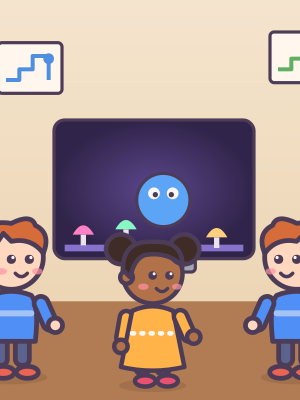
Ana filled a sketchbook with ideas, then redrew the best ones as pixel art, making each small picture by hand, one pixel at a time. Her hero was a round blue creature called Blip, with big eyes and tiny feet. She also drew a cave full of glowing mushrooms for the first level. "A level designer builds the places that players pass through," Jules said, and he sketched a path of ledges and gaps for Blip.
Mina played the game for ten minutes and wrote down every problem she found. "Blip falls through the floor at the third ledge," she said. "The score sticks at zero. And the music is so loud that I jumped." Finding bugs and other problems while the game is being made is a tester's job, and it was a very useful job. Dev groaned, fixed the floor and fixed the score. Ana turned the music down.
On the Friday before the fair, they asked other kids to play the game while they watched. Designers have people play a game and use what they learn to change it. Jules watched a boy get stuck at the same gap four times. "That gap is too wide," he said, and he moved a ledge. By the end of the afternoon, the game was fairer, and everyone who tried it was laughing.
At the fair, a line of kids waited at their booth. Blip hopped, glowed and bounced, and the music they had worked on played in the background. When a little girl beat the final boss, a giant cave bat, she screamed with joy. The team high-fived. Jules looked at the screen and then at his three friends. It had been so much easier together. Making a game is a job for people working together, and they had proved it.