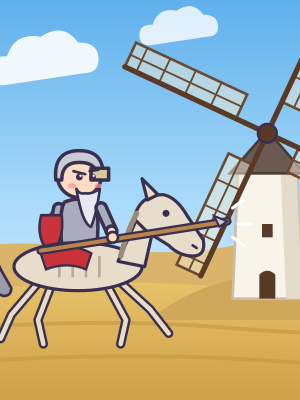
Don Quixote and the Windmills
Part One · Too Many Books
In a village in La Mancha, a dusty region of central Spain, there lived a gentleman of about fifty named Alonso Quixano, who owned a lance he never used, a shield that hung on the wall, a skinny old horse and a greyhound that was faster than both of them. He was lean, an early riser, and moderately fond of hunting, but his genuine passion, the obsession that consumed his days, was reading. Above all, he adored books about knights in shining armor who rode across the world rescuing princesses and battling giants. He read them at breakfast and at dinner and long after midnight, and he sold acres of his own farmland to buy more of them. His niece and his housekeeper watched him with growing alarm.
Eventually he read so much and slept so little that, as the old book says, his brain dried up, and he lost his wits. Every enchanted castle and every thundering battle in those pages became completely real to him, more real than the village outside his window. And so he came to the strangest decision any gentleman in Spain had ever made. He would become a knight-errant himself, ride out into the world in search of adventure, defend the helpless, punish the wicked, and win everlasting glory. The inconvenient fact that knights had not ridden through Spain in that particular fashion for approximately a hundred years did not trouble him in the slightest.
Part Two · Sir Knight
First he needed armor. He discovered a rusty old suit in the attic that had belonged to his great-grandfather, scrubbed it for days, and found that the helmet had no visor to protect his face. So he constructed one out of cardboard. To test its strength, he drew his sword and gave it two mighty whacks, and with the first blow he destroyed a week's work. He built it again, reinforced it with strips of iron, and this time, very sensibly, decided not to test it. Next he considered his horse, a bony creature with more corners than a cupboard, and after four days of thought he named it Rocinante, which he believed was the most magnificent name ever given to a steed.
Then, after another eight days of serious consideration, he chose a new name for himself, Don Quixote de la Mancha, which he felt sounded suitably heroic and announced to the world exactly where he came from. Finally, since every knight in every book was devoted to a beautiful lady, he selected a farm girl from a neighboring village, whom he had seen perhaps twice and never spoken to, and he renamed her Dulcinea del Toboso. She had no idea she had been chosen, and she never found out. Early one summer morning, before anyone in the house was awake, Don Quixote put on his armor, climbed onto Rocinante, and rode quietly out through the back gate into the fields, feeling as triumphant as if he had already won a hundred battles.
His first adventure did not go entirely as he had imagined, since he arrived at an ordinary roadside inn and mistook it for a magnificent castle with silver towers. The innkeeper was a sly fellow who quickly understood that his guest was out of his mind, and to have a little fun, he agreed to make him a knight in a pretend ceremony in the stable yard, reading out of his account book as if it were a holy text. Don Quixote knelt solemnly, received a tap on the shoulder, and rode away delighted. Soon afterward, however, following an unfortunate misunderstanding with some merchants, he limped home bruised and battered, and his friends sincerely hoped the whole ridiculous business was finished.
Part Three · The Giants on the Hill
It was not finished. Don Quixote had realized that every proper knight needed a squire, a loyal companion to carry his supplies and look after him, so he persuaded his neighbor Sancho Panza to join him. Sancho was a short, round, good-hearted farmer with an enormous appetite and very little formal education, but an abundance of practical common sense. Don Quixote promised him that, after a few adventures, he would surely conquer an island and make Sancho its governor. Sancho, who had never governed anything larger than a vegetable garden, found this offer irresistible. One night the two of them slipped out of the village, the knight on Rocinante and Sancho on his gray donkey, with saddlebags full of bread and cheese.
They had been riding across the wide, flat plain for some time when they came upon thirty or forty windmills standing together on the slope of a hill. Their great sails were turning slowly in the breeze, creaking and groaning. Don Quixote pulled up short, and his eyes shone. "Luck is on our side today, Sancho, more than we ever dared to hope," he announced. "Do you see those thirty enormous giants gathered on the hillside? I shall fight every one of them and drive them from the land, and their treasure will make our fortunes. Ridding the world of such wicked creatures is exactly the noble work that a knight was born to do."
Sancho squinted suspiciously at the hill, shading his eyes with his hand, and saw nothing remotely unusual. "What giants?" he asked. "Those, right in front of you," said his master impatiently, "with the colossal arms, some of them nearly two leagues long." Sancho scratched his head. "Begging your worship's pardon," he said patiently, "but those are windmills. The things that look like arms are only their sails, and when the wind pushes them round, they turn the millstones and grind the wheat." Don Quixote gave him a pitying glance. "Clearly," he said, "you have no experience of adventures. Those are giants, and if you are frightened, stand aside and say your prayers while I take them all on at once."
Part Four · The Charge
Without waiting for an answer, Don Quixote dug his heels into Rocinante's ribs and charged, shouting as loudly as he could. "Flee not, cowards and vile creatures!" he roared. "It is only one knight who attacks you!" Sancho shouted behind him that they were windmills, but his master did not hear a word. Just then the wind picked up, and the great sails began to turn faster. "Wave as many arms as you like," cried Don Quixote, "even more than the hundred-armed giant Briareus, and you shall still answer to me!" He thought tenderly of his lady Dulcinea, raised his shield, lowered his lance, and galloped at full speed toward the nearest windmill, with Rocinante wheezing beneath him.
The tip of his lance struck the sail at the very moment it swept past, and the wind turned the sail with such force that the lance snapped into pieces. The sail scooped up both horse and rider, lifted them into the air, and flung them across the field. Don Quixote landed in a crumpled heap, with Rocinante sprawled beside him and his cardboard helmet sitting crookedly on his head. Sancho came hurrying up as fast as his donkey could trot and found his master lying motionless on the grass. "Heaven help us!" Sancho cried. "Didn't I warn your worship that they were only windmills? Anybody could see it, unless he had windmills whirling around inside his own head!"
Don Quixote sat up slowly and straightened his helmet with tremendous dignity. "Hush, Sancho," he said. "Nothing changes as quickly as the fortunes of war. Obviously the wicked enchanter Frestón, who once stole my library, has transformed those giants into windmills at the last moment, purely to cheat me of my victory. But his spells will never defeat an honest sword in the end." Sancho looked at the windmills, which were revolving peacefully in the afternoon breeze as though nothing whatsoever had happened, and then at his battered master. "Well, heaven will sort it out," he said, and helped him back onto Rocinante, who was nearly as dented as the knight.
Part Five · The Road On
They continued toward a mountain pass, and Don Quixote sat crookedly in the saddle, although he absolutely refused to complain. "If I do not complain about the pain," he explained, "it is because knights-errant are never permitted to complain about their injuries, however terrible they may be." Sancho considered this carefully. "Well, as for me," he said, "I will complain about the smallest little ache, unless that rule about not complaining applies to squires as well." Don Quixote laughed in spite of himself and graciously granted Sancho permission to complain as frequently and as loudly as he wished. Then Sancho announced that it was time for lunch, and he ate happily from the saddlebags while his master, being a knight, insisted that he was not hungry.
That night they slept beneath the trees, and Don Quixote stayed awake until dawn, thinking about Dulcinea, as knights in books always did. Sancho slept soundly, as squires always do. Their adventures were only beginning, and in the years to come they would battle flocks of sheep and wineskins and puppets, and Don Quixote would be beaten and bruised more times than anyone could count. Yet everywhere they went, people remembered the thin old knight who saw giants where others saw windmills, and the plump squire who stayed loyally beside him even when he knew better. To this day, when someone fights an imaginary enemy, people say that they are tilting at windmills.