Frankenstein
Part One · The Ice
Late in the eighteenth century, an English explorer named Robert Walton sailed toward the North Pole, determined to discover a passage through the polar ice that no navigator had ever located. One foggy morning, while his ship was imprisoned among enormous floating sheets of ice, his crew witnessed something extraordinary: far across the frozen plain, a sledge pulled by dogs was racing northward, and the figure driving it had the shape of a man but was of gigantic stature. The following morning a second sledge drifted toward the ship on a fragment of ice, carrying a solitary traveler, half frozen and nearly dead, who refused to come aboard until the sailors told him which direction they were traveling. He was a Swiss gentleman named Victor Frankenstein, and as Walton gradually nursed him back toward health, the stranger confessed that he had been pursuing the giant across half the world. Before he died, he related the story of how he had created him.
Part Two · The Spark of Life
Victor had grown up in Geneva, in an affectionate and prosperous family, with a gentle adopted sister named Elizabeth, whom everyone expected he would eventually marry, and a cheerful best friend named Henry Clerval. From childhood Victor had been fascinated by the mysteries of nature, and especially by the deepest mystery of all: what invisible spark distinguishes the living from the dead? At the university of Ingolstadt, in Germany, he studied chemistry and anatomy with ferocious determination, and after two years of relentless experiments, he made a staggering discovery, the secret of bestowing life upon lifeless matter. Intoxicated by his achievement, Victor resolved to construct an entire human being, and because the delicate parts of the body were so difficult to manipulate, he decided to make his creature enormous, approximately eight feet tall. He imagined that an entire new species would bless him as its creator and benefactor.
For months Victor labored in a solitary room at the top of his lodging house, which he later called his workshop of filthy creation. He collected his materials secretly from dissecting rooms and cemeteries, neglected his family's letters, and grew pale and emaciated, until his nerves were so damaged that he trembled at every noise. He had selected every feature of his creature to be beautiful. At last, on a gloomy November night, with rain drumming on the windows and his candle nearly extinguished, Victor watched one dull yellow eye flicker open, and the enormous body shuddered and drew a heaving breath. In that instant the beauty of his dream evaporated, and his heart filled with horror and revulsion. The thin yellow skin barely concealed the muscles beneath, and the watery eyes and dark lips appeared all the more ghastly beside the flowing black hair and gleaming white teeth he had chosen so carefully.
Unable to endure the sight of what he had made, Victor rushed from the laboratory and flung himself upon his bed, where hours later he awoke to discover the creature standing beside him, lifting the curtain and gazing down at him. Its mouth opened and produced sounds that were not yet words, its face creased into something resembling a smile, and it extended one hand toward its maker, perhaps hoping to be welcomed. Victor fled again, out of the house and into the courtyard, where he spent the remainder of the night pacing in terror. When he finally dared to return the next morning, accompanied by Clerval, who had arrived unexpectedly in town, the apartment was empty. Victor collapsed into a nervous fever that lasted for months, and not once did he ask himself what would become of a newborn being, gigantic, nameless and abandoned, wandering into a world that had never been prepared to receive it.
Part Three · The Creature Speaks
Two years later, Victor encountered his creation again, among the glittering ice fields of the glacier beneath Mont Blanc, in the Swiss Alps. The creature came bounding across the crevasses with superhuman speed, and Victor, trembling with fury, denounced him as a devil and a vile insect. But the creature did not attack; instead he spoke, and he spoke eloquently, with a dignity that astonished his creator. Everyone despised the miserable, he observed, so naturally he was despised, because he was the most miserable being in existence, and yet surely his own creator owed him something better than hatred. He implored Victor to listen before condemning him. "I was benevolent and good," he said. "Misery made me a fiend." So Victor reluctantly followed him to a shepherd's hut on the mountain, and they sat beside a fire, and for the first time, the creature described his own experiences. This is what he said.
"My earliest memories are confused and blurred, because light and darkness, sounds and smells, all poured into my senses simultaneously, and I could not separate one sensation from another. I wandered into a forest, where I ate berries and drank from streams, and I discovered the pleasure of warmth when I found a fire that some travelers had abandoned, although when I reached into the glowing embers, I snatched my hand back with a cry, bewildered that the same thing could produce such comfort and such pain. When I ventured into a village, the inhabitants screamed and fainted, and others pelted me with stones until I escaped, bruised and bewildered, into the open countryside. Eventually I took refuge in a miserable hovel, constructed against the wall of a cottage, where I could conceal myself from the cruelty of human beings, and from the snow."
Part Four · The Cottage
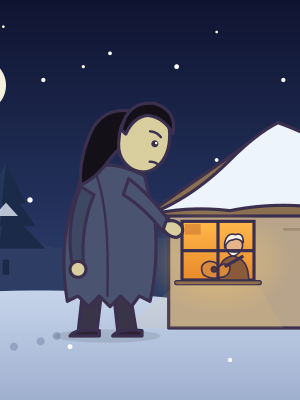
"Through a narrow chink in the wall, I could observe the family who inhabited the cottage: a blind old man, who played melancholy music on a guitar, and his son and daughter, Felix and Agatha. They were impoverished, and sometimes they went hungry, so I stopped stealing their food, and at night I gathered firewood and deposited it at their door, and I was enchanted to hear them marvel at the invisible spirit who assisted them. Later a lovely stranger from Arabia, named Safie, came to live with them, and as Felix taught her their language, I listened through the chink and learned alongside her, until gradually I could speak, and afterward read. In the forest I discovered a leather satchel containing three volumes, and through them I encountered history, philosophy, poetry, and the extraordinary variety of human emotions, and I wondered what I was, and where I had come from, and what my destiny would be."
"I loved these cottagers, whom I called my protectors, and I longed with my entire heart to be loved by them in return. One day, however, I glimpsed my reflection in a transparent pool, and I recoiled in horror, unable at first to believe that I was the monster I beheld. I also discovered, in the pocket of the coat I had taken from your laboratory, your journal, and I read the complete record of my creation, every disgusting detail, written in your own handwriting. Accursed creator! Even the devils in the old poem I had studied possessed companions to comfort them, but I was utterly solitary, and everyone who saw me loathed me. Still, I dared to hope, and I resolved to approach the blind father first, when he was alone, because he could not be frightened by my appearance, and if I could secure his friendship, perhaps his children would accept me too."
"At last the day arrived, and while his children were out walking, I knocked at the cottage door. The old man welcomed me courteously, and as I explained my loneliness, he listened with genuine compassion and promised to help me, and my heart overflowed with gratitude. Then I heard footsteps. Felix, Agatha and Safie entered, and I cannot describe the terror on their faces: Agatha fainted, and Safie fled, and Felix dragged me away from his father and struck me violently with a stick. I was powerful enough to destroy him, but my heart sank within me like a stone, and I did not lift a hand against him. I fled. When I returned, the cottage was deserted, because they had abandoned it forever on my account, and that night, in my despair, I burned it to the ground. Not long afterward I rescued a young girl from drowning in a river, and her companion, seeing me, shot me in the shoulder. So this was how humanity repaid kindness."
"After that, I traveled toward Geneva, searching for you, my creator, to demand justice. In a wood near the city I encountered a beautiful child, and the idea seized me that he was too young to have learned to fear ugliness, and that I could educate him as my companion. But the boy shrieked and called me a monster and an ogre, and he threatened me with his father, Monsieur Frankenstein. Your brother! In my rage I seized his throat to silence him, and in a moment he lay dead at my feet." The creature had then concealed a locket belonging to the boy in the pocket of a sleeping servant, Justine, who was accused of the murder and executed. Victor listened in anguish, and then the creature presented his request. Nobody would ever be his friend, he said, but a companion as strange and as solitary as himself would not reject him. "You must create a female for me," he demanded, "with whom I can live."
Part Five · Into the North
The creature promised that if Victor manufactured a companion for him, the two of them would retreat together into the uninhabited wilderness of South America and never trouble humanity again. Moved by his arguments, Victor reluctantly agreed, and he traveled to a remote island in the Orkneys, off the coast of Scotland, to begin his hideous work once more. One night, however, as he labored, he began to contemplate the consequences. What if the female despised her companion, or refused the bargain, or the two of them produced a race of creatures that would terrorize humankind? Glancing up, he saw the creature at the window, grinning in the moonlight, observing his progress. Seized by a sudden frenzy, Victor tore the unfinished body to pieces. The creature howled in despair and swore vengeance, because Victor had destroyed his final hope. Then he departed, leaving his creator with a chilling warning: "I shall be with you on your wedding night."
The creature kept his terrible promise. One by one, the people Victor loved were taken from him: first his gentle friend Henry Clerval, then Elizabeth, on the very night of their wedding, and then his father, who died of grief. Victor had nothing remaining but his hatred, and he swore to hunt his creation until one of them was destroyed. He pursued him across Europe and Russia, and the creature led him onward, leaving messages carved into trees and boulders, and sometimes leaving provisions so that his pursuer would not starve before the chase was finished. Finally they reached the frozen ocean, where Walton found Victor drifting on the ice. On board the ship, exhausted by sorrow and hardship, Victor Frankenstein died, warning Walton with his final breath to beware of ambition, even the apparently harmless ambition of becoming celebrated for scientific discoveries.
That night Walton heard a sound from the cabin where Victor's body lay, and he discovered a gigantic figure leaning over the coffin, its face concealed by long, ragged hair, uttering exclamations of grief. When the creature noticed Walton, he did not flee, but spoke once more, and his words were full of anguish and remorse. He had never desired to be cruel, he said, because his heart had been fashioned for love and sympathy, and when misery twisted it toward hatred, the transformation had caused him more agony than Walton could possibly imagine. Now his creator was dead, and the only being who could have answered for his existence was gone forever. He would travel to the most northerly extremity of the world, he said, and construct his own funeral pyre, so that no trace of him would remain. Then he sprang from the cabin window onto the ice beside the ship, and he was soon borne away by the waves and lost in darkness and distance.