Gilgamesh
Part One · The King and the Wild Man
Climb the great wall of Uruk and walk along its summit; examine its foundations, inspect its brickwork, fired in kilns and laid in their millions, and consider whether any civilization ever constructed anything so magnificent. This is the oldest surviving story in the world, inscribed on tablets of clay in Mesopotamia, the fertile territory between the Tigris and Euphrates rivers that is now Iraq, more than four thousand years ago. It concerns Gilgamesh, the legendary king who commissioned that wall. The gods had fashioned him two-thirds divine and one-third human, taller than any ordinary man, more powerful than a wild bull, and more beautiful than the sunrise. Unfortunately, they had neglected to make him wise. He exhausted the young men of Uruk with endless labor, interrupted every celebration, and swaggered through the city as though its inhabitants existed exclusively for his amusement, and nobody dared to challenge him, because nobody could.
The citizens of Uruk prayed desperately for deliverance, and eventually the gods responded. The mother goddess Aruru moistened her hands, pinched off a fragment of clay, and flung it into the wilderness, where it became a man called Enkidu, equal to Gilgamesh in strength and as untamed as the gazelles that were his only companions. His entire body was covered with shaggy hair, he grazed on grass beside the antelope, and he drank at the watering holes alongside the herds. Whenever hunters excavated pits to capture the animals, Enkidu filled them in, and whenever they concealed snares, he demolished them. An exasperated trapper, whose livelihood was disappearing, journeyed to Uruk to complain, and the king, intrigued by this description of a creature apparently as formidable as himself, dispatched a woman from the temple named Shamhat to persuade the wild man to visit the city.
Shamhat waited beside the watering hole, and when Enkidu appeared, she addressed him gently and patiently for seven days. She taught him to eat bread and to drink beer, to wash his matted hair and anoint his skin with fragrant oil, and to wear garments like a civilized human being. When Enkidu returned to the gazelles, they took one glance at him and bolted in terror, because he no longer smelled of the wilderness. He was lonely and thoroughly bewildered, yet his understanding had expanded enormously, and he comprehended ideas that had never entered his mind before. Shamhat described the splendid city of Uruk and its arrogant king, and Enkidu's heart filled with an unfamiliar excitement. "Take me there," he declared, "so that I can challenge this Gilgamesh and demonstrate that somebody in this world is as powerful as he is."
Part Two · Closer Than Brothers
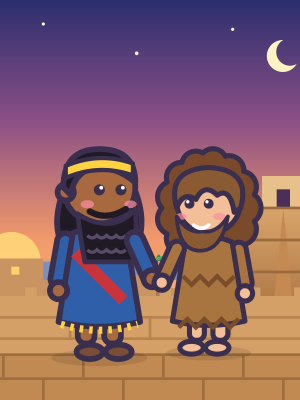
Enkidu marched into Uruk and positioned himself in the middle of the street, obstructing the king's path, and the crowd gasped, because the wild man resembled Gilgamesh so closely that the king might have acquired a twin from the mountains. Gilgamesh lowered his head and charged, and the two of them grappled like bulls, wrestling until the doorposts shattered, the walls shuddered, and clouds of dust billowed over the rooftops. Neither could overpower the other. At last Gilgamesh planted his foot and pinned his opponent, and suddenly, inexplicably, his fury evaporated. Enkidu gazed up at him with reluctant admiration and acknowledged that there was nobody comparable to him in the entire world. Gilgamesh laughed, extended his hand, and hauled him to his feet. From that moment the two were inseparable, closer than brothers, and for the first time in his existence the king possessed someone who could look him directly in the eye.
Friendship transformed Gilgamesh, softening his cruelty, but it also made him restless and ambitious. "Every mortal eventually dies," he observed one evening, "and nobody can climb high enough to reach the heavens, so the only thing that survives us is our reputation. Let us therefore make our names immortal." Far to the west lay the Cedar Forest, where the tallest and most precious trees on earth flourished under the protection of a monstrous guardian named Humbaba, whose roar was a flood, whose mouth was fire, and whose breath was death itself. Enkidu, who had wandered those hills during his wild years, turned pale and implored him to reconsider, and the elders of Uruk pleaded with him as well. But Gilgamesh had already commanded his blacksmiths to forge colossal axes, each one weighing as much as a grown man, and he refused to listen to anybody.
Part Three · The Cedar Forest
The expedition carried them across mountains that an ordinary traveler would have needed six weeks to traverse, and they accomplished it in only three extraordinary days. Every night Gilgamesh dug a well, ascended a hill, and prayed for a dream, and every night he awoke trembling from terrifying visions of collapsing mountains and blazing skies, until Enkidu discovered some encouraging interpretation of the nightmare and persuaded him to continue. When at last they stood at the boundary of the Cedar Forest, its silence was overwhelming, and the immense trees soared above them like the columns of a temple. Then Humbaba came crashing through the branches, and the battle that followed shook the earth so violently that the mountains themselves split apart. The sun god Shamash, who favored Gilgamesh, unleashed thirteen tremendous winds against the monster, and Humbaba was immobilized, unable to advance or to retreat.
Trapped, exhausted and desperate, the guardian of the forest begged for his life, promising to serve Gilgamesh forever and to surrender every cedar in the forest. Gilgamesh hesitated, genuinely moved by the creature's pitiful pleading, but Enkidu warned him not to trust a guardian who would certainly take revenge, and together they struck Humbaba down. Afterward they felled the tallest cedar of all to construct a magnificent door for the temple of their city, and they floated it home on a raft down the Euphrates. In Uruk the population celebrated their triumphant return for days. Yet even in the midst of the festivities, a dying curse from the forest seemed to linger in the atmosphere, and the gods, who had loved Humbaba's forest, were observing the two heroes with mounting displeasure. Glory, it appeared, had a price that nobody had calculated.
Part Four · The Bull of Heaven
Gilgamesh washed the grime of the journey from his hair and dressed himself in his ceremonial royal robes, and he appeared so splendid that the goddess Ishtar fell in love with him and proposed that he become her husband. Gilgamesh refused her, and not politely; he reminded her of all the previous companions she had abandoned or transformed into animals, and he informed her that she was about as dependable as a leaking waterskin. Humiliated, Ishtar ascended to heaven in a fury and demanded that her father release the Bull of Heaven to punish him. The Bull's first snort opened a chasm that swallowed a hundred men, and its second snort swallowed two hundred more. But Enkidu seized the creature by its horns, Gilgamesh plunged in his sword, and together they brought the beast down. Then Enkidu flung a piece of the bull at the goddess herself, which proved to be a catastrophic mistake.
That night Enkidu dreamed that the gods had assembled in council and agreed that, because two heroes had destroyed Humbaba and the Bull of Heaven, one of them must die, and it would not be Gilgamesh. Enkidu awoke in terror and described the dream to his friend, and shortly afterward he fell gravely ill. For twelve days he lay upon his bed, growing steadily weaker, while Gilgamesh remained continuously at his side. At first Enkidu cursed the trapper and Shamhat for luring him out of the wilderness, but the sun god Shamash gently reminded him of everything civilization had given him, the bread and the fine garments and, above everything else, his friend. So Enkidu withdrew his curses and blessed them instead. On the twelfth day, while Gilgamesh held his hand, he died, and the most powerful man on earth discovered that his strength was completely useless.
Part Five · The Ends of the Earth
Gilgamesh could not believe it. He touched his friend's heart, but it no longer beat, and he covered Enkidu's face like a bride's veil and paced around the bed like a lioness whose cubs have been stolen, tearing his royal robes and pulling out his hair. He commanded the entire population of the city to mourn, and he ordered artisans to sculpt a statue of Enkidu in gold and lapis lazuli. But no statue could answer him. When the mourning was finished, the king departed from Uruk alone, dressed in a lion's skin, and wandered into the wilderness where Enkidu had once lived. "Must I die as well?" he cried out to the deserted hills. "Shall I become like Enkidu, who has turned to clay?" For the first time in his existence, the strongest man in the world was afraid, and his fear followed him everywhere like a shadow that refused to leave.
He had heard rumors, passed down from ancient times, of one man who had escaped death, a survivor named Utnapishtim, to whom the gods had long ago granted eternal life, and Gilgamesh resolved to find him and learn his secret. He traveled to the twin peaks of Mount Mashu, where the sun rises and sets, and persuaded the scorpion people who guarded its entrance to let him pass. Then he entered the tunnel of the sun and walked through absolute darkness for twelve double-hours, unable to see anything in front of him or behind him. At last he emerged into a dazzling garden where the trees produced jewels instead of fruit, carnelian and lapis glittering on every branch. Beyond the garden, beside the sea, stood a tavern kept by a wise woman named Siduri, who regarded his ragged lion skin and hollow cheeks with profound compassion.
When Gilgamesh explained his quest, Siduri shook her head. "You will never discover the life you are searching for," she said, "because when the gods created humanity, they allotted death to people and retained eternal life for themselves. So fill your belly, Gilgamesh, and celebrate day and night. Wear clean clothing, wash your hair, cherish the little child who holds your hand, and let your wife rejoice in your embrace, because that is the true occupation of humankind." Gilgamesh listened respectfully to her advice, which was the wisest he had ever received, but he would not turn back. So Siduri directed him to the ferryman Urshanabi, who transported him across the Waters of Death, where a single drop of the water was fatal. Gilgamesh propelled the boat with a hundred and twenty enormous poles, abandoning each one after a single push, until the boat finally touched the farthest shore.
Part Six · The Wall of Uruk
Utnapishtim was waiting there, an unremarkable old man who, to the king's astonishment, looked no different from anybody else. He described how the gods had once released a catastrophic flood to destroy humanity, and how the god Ea had secretly warned him to construct an enormous boat and fill it with his family, his craftsmen, and every variety of animal, wild and tame. Afterward the gods had rewarded him with eternal life, but that had occurred only once and would never be repeated. "If you intend to conquer death," Utnapishtim said, "begin by conquering sleep, and remain awake for six days and seven nights." Gilgamesh sat down to begin, and almost immediately sleep drifted over him like a fog. Utnapishtim's wife baked a loaf of bread for every day he slept and placed it beside him, and when Gilgamesh awoke, insisting he had only closed his eyes, he discovered seven loaves, the first as hard as stone and the last still warm.
Gilgamesh wept, because he understood that he had failed. But as he was departing, Utnapishtim's wife took pity on him, and her husband disclosed one final secret: at the bottom of the sea grew a thorny plant that could restore youth to the elderly. Gilgamesh fastened heavy stones to his feet, sank into the depths, and seized the plant, although its thorns lacerated his hands, and then he cut the stones loose and rose triumphantly to the surface. He decided not to eat it immediately. Instead he would carry it home, test it on an old man, and consume it himself when he was elderly. During the homeward journey, however, he paused to bathe in a cool pool, and while he was in the water, a snake detected the fragrance of the plant, slithered out of the grass, and carried it away. As it vanished, it shed its old skin and emerged young again.
Gilgamesh sat beside the pool and wept, and the ferryman Urshanabi sat with him, because everything he had endured appeared to have been for nothing, and a snake had stolen the prize. Yet when the two of them finally arrived at the gates of Uruk, Gilgamesh raised his eyes and beheld his city as though for the first time. He saw its orchards and gardens, its temples and its crowded streets, all of it bustling with people who would continue living long after he was gone. "Climb the great wall of Uruk, Urshanabi," he said, "and walk along its summit. Inspect its brickwork, and consider whether any civilization ever constructed anything so magnificent." The king had not discovered how to live forever, but he returned wiser than he had departed, he governed his people justly, and the story of his friendship with Enkidu has outlasted the wall itself by thousands of years.