Gulliver in Lilliput
Part One · Tied Down
Lemuel Gulliver was a ship's doctor from England who loved to travel. In the year 1699 he sailed on a ship called the Antelope, bound for the South Seas. For a while the voyage went smoothly, but one dark night a violent storm drove the ship onto a rock, and it split apart. Gulliver and a few sailors scrambled into a lifeboat, but an enormous wave flipped it over. Gulliver never saw his companions again. He swam and swam, pushed along by the wind and the tide, until at last his feet touched the bottom and he staggered onto a strange shore.
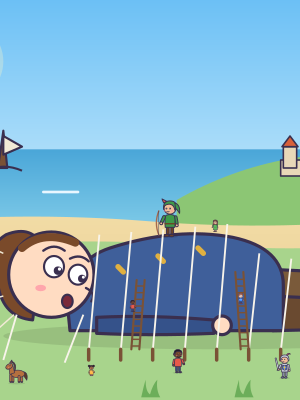
Gulliver was so exhausted that he lay down on the short, soft grass and slept for nine hours. When he awoke, the sun was shining, and he tried to sit up. He couldn't move a muscle! His arms and legs were fastened to the ground, and even his long hair was tied down with dozens of thin strings. He could only look straight up at the sky. Then he felt something alive creeping along his left leg and up over his chest, almost to his chin. Bending his eyes downward as far as he could, he discovered a tiny human creature, not six inches tall, holding a bow and arrow.
Behind the little man came about forty more, and Gulliver was so astonished that he gave a tremendous roar. The tiny people tumbled off in terror, and some of them were hurt jumping from his sides to the ground. Soon they returned, and one of them cried out in a shrill voice, "Hekinah degul!" Gulliver struggled and managed to snap the strings that held his left arm. Immediately a hundred arrows flew at his hand, pricking him like needles, and more of them peppered his face. Gulliver decided that the wisest thing was to lie perfectly still until he understood what was happening.
When the little people saw that he was quiet, they built a wooden stage beside his head, and an important person climbed up on it and made a long speech. Gulliver couldn't understand a word, but he was starving, so he pointed politely at his mouth. The tiny people understood. They propped ladders against his sides, and more than a hundred of them climbed up carrying baskets of food. The legs of meat were the size of a lark's wings, and the loaves of bread were no bigger than marbles, so he swallowed them three at a time. They brought him barrels of drink, too, and he gulped down each barrel in a single mouthful.
The emperor of the land had ordered the giant to be brought to his city. But the drink had a sleeping medicine in it, and soon Gulliver was snoring. Five hundred carpenters built a huge wooden cart on twenty-two wheels. Then nine hundred of the strongest men used ropes and pulleys to hoist the sleeping giant onto it. Fifteen hundred of the emperor's biggest horses, each about four and a half inches high, pulled him half a mile to the city of Mildendo. There they chained him by his left leg inside an old temple. It was the only building big enough to hold him.
Part Two · The Man-Mountain
The country was called Lilliput, and the Lilliputians were amazed by their gigantic prisoner. Thousands climbed onto ladders and rooftops to gaze at him, and they named him Quinbus Flestrin, which means the Great Man-Mountain. The emperor himself rode out to visit, and he was taller than all his courtiers by about the width of Gulliver's fingernail. Two officers were sent to search the giant's pockets. They wrote down everything they found. His handkerchief was "a great piece of rough cloth, big enough to carpet Your Majesty's throne room." His comb was "a fence with long poles, like the railings around Your Majesty's palace."
Gulliver's pocket watch puzzled the officers most of all. They described it as a wonderful machine on a great silver chain, which made a ceaseless noise like a water mill. "We believe it is either an unknown animal," they reported, "or else the god that he worships, because he says that he seldom does anything without consulting it." Gulliver laughed to himself. But he was very careful to be gentle and do as he was told. Little by little he learned to speak their language, and he begged the emperor for his freedom. Children came to play hide-and-seek in his hair, and he let the guards' horses gallop across the palm of his hand.
Gulliver soon discovered that the Lilliputians had some peculiar customs. Whenever an important job in the government was empty, the people who wanted it had to dance on a thin thread stretched two feet above the ground. Whoever jumped the highest without falling won the job. Even the emperor's treasurer had to show how high he could leap. The emperor also held contests in which courtiers jumped over a stick or crept under it, and the winners got silk ribbons in red, blue or green to wear around their waists. Gulliver thought that tiny people could be just as foolish and proud as big ones.
At last the emperor agreed to set Gulliver free, as long as he promised to obey certain rules. He must never walk anywhere without warning people to stay indoors. He must never pick anyone up without permission, and he must never trample anybody's fields or cows. He must also help the emperor against his enemies on the island of Blefuscu. Gulliver signed the promise, the chains were unlocked, and he stretched his legs for the first time in weeks. Then he stepped very carefully over the city wall, walking sideways down the narrow streets in his stockings, to visit the emperor's tiny palace.
Part Three · The War over Eggs
A wise minister explained that Lilliput had been at war with Blefuscu for three years. The quarrel had started long ago, over breakfast. Everybody used to crack their boiled eggs at the big end. But when the emperor's grandfather was a boy, he cut his finger cracking an egg that way, so his father commanded that everybody must crack their eggs at the small end. The people were so angry that they started six rebellions. The rebels, called the Big-Endians, escaped to Blefuscu, and now Blefuscu had built a mighty fleet of warships to attack Lilliput.
Gulliver had an idea. He asked for fifty strong cables and fifty iron bars, and he bent the bars into hooks. Then he waded across the channel toward Blefuscu, swimming only in the middle where it was deep. When the enemy sailors saw a mountain rising out of the sea, they leaped overboard in terror and swam for the shore. Gulliver fastened a hook to the front of every warship and tied all fifty cables together at the end. Thousands of arrows stung his hands and face, so he put on his spectacles to protect his eyes, and he kept on working.
Gulliver cut the anchor ropes with his knife, picked up the knotted cables, and walked back across the channel, towing the whole fleet of Blefuscu behind him. The Lilliputians on the shore could only see the ships coming, because Gulliver was up to his chin in the water, and they feared that the enemy was attacking. Then he waded out, holding up the cables, and shouted, "Long live the most powerful Emperor of Lilliput!" The emperor gave him the highest honor in the land. But then he asked Gulliver to capture every remaining ship, so that Lilliput could rule Blefuscu and force everybody there to crack eggs the small way.
Gulliver refused. He said that he would never help to turn a free and brave people into slaves. From that moment, the emperor's feelings toward him began to cool. Gulliver's enemies at court had always been jealous of him, and now they plotted against him. They accused him of treason and planned a cruel punishment. Luckily, a friend at court crept to Gulliver's house at midnight to warn him. Before dawn Gulliver waded across the channel to Blefuscu. There the emperor welcomed him kindly, because Gulliver had refused to conquer his people.
A few days later, Gulliver noticed something floating far out at sea. It was a real boat, big enough for a man. A storm had probably torn it loose from a ship. The people of Blefuscu helped him mend it, and he loaded it with food, along with six tiny cows, two tiny bulls and a little flock of sheep. After a long voyage, an English ship picked him up. The captain thought that his story about tiny people was nonsense, until Gulliver took the miniature cows and sheep out of his pocket. Then the captain could only stare.