Icarus and Daedalus
Part One · The Tower by the Sea
Long ago, in the city of Athens, there lived an inventor named Daedalus, who was the most brilliant craftsman in the whole of Greece. He invented the saw, the drill and the level, and he carved statues so lifelike that people said they had to be tied down at night to stop them from wandering off. His fame traveled across the sea to the island of Crete, where King Minos ruled, and the king invited Daedalus to come and work for him. Daedalus packed his tools, took his young son Icarus by the hand, and sailed away to the king's enormous palace, expecting to stay for a year or two.
King Minos gave Daedalus an extraordinary and rather alarming task, because deep beneath the palace lived the Minotaur, a monster with the body of a man and the head of a bull, and the king needed somewhere to keep it. So Daedalus designed the Labyrinth, a maze of passages so complicated that anyone who entered it would wander forever without finding the way out, and everyone agreed it was his masterpiece. But when it was finished and the Minotaur was safely inside, Minos refused to let Daedalus leave. "You know the secret of the Labyrinth," the king said, "and you will never tell it to anyone else."
So Daedalus and Icarus became prisoners on the island. They lived in a tall stone tower beside the sea, with soldiers guarding the door and the harbor, and every ship that left Crete was searched from top to bottom. Year after year, Daedalus stood at the tower window and gazed across the water toward home. Icarus grew from a small boy into a lively, restless young man who hated being shut indoors. "There's no way out," he said gloomily one evening. "Minos owns the land and he owns the sea." Daedalus watched a seagull glide past the window. "Yes," he said slowly. "But he does not own the sky."
Part Two · Feathers and Wax
The next morning, Daedalus began collecting feathers, quietly and patiently. He gathered them from the beach and the cliffs and the windowsill, gull feathers and goose feathers and the long gray feathers of eagles, and he laid them out on the floor in rows, from the smallest to the largest. He tied the big feathers together in the middle with strong linen thread, and he fastened the small ones at the ends with soft, warm beeswax from a candle. Then he bent the rows into a gentle curve, exactly like the wing of a real bird. It took him many weeks, and he worked on it in secret, every night, by the light of a single lamp.
Icarus could not resist helping, although he was not particularly helpful. He chased feathers around the room whenever the wind blew them away, and he pressed his thumb into the soft yellow wax to see the print it made. He tried on half-finished wings and flapped around the tower, knocking over his father's tools, until Daedalus laughed and sent him outside. At last, two pairs of wings were complete, one big pair for Daedalus and one smaller pair for Icarus. They were beautiful, and when the sea breeze blew through the window, the feathers rippled as if they were eager to fly.
Before dawn on the day of their escape, Daedalus strapped the wings onto his son's arms, and his hands were trembling. "Listen carefully, Icarus," he said. "You must fly halfway between the sea and the sun. If you fly too low, the spray from the waves will soak your feathers and drag you down. If you fly too high, the heat of the sun will melt the wax. Stay close beside me and follow my path exactly. Do not try to steer by the stars, and do not show off. Do you understand?" "Yes, Father," said Icarus, who was hardly listening, because he was staring at the sky.
Part Three · The Sky
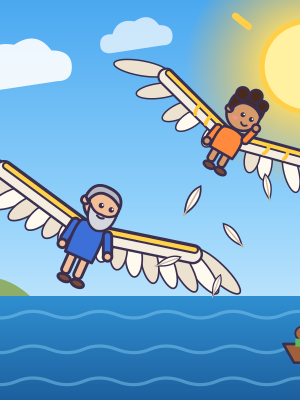
Daedalus climbed onto the window ledge, spread his arms, and leaped. For one terrible moment he dropped like a stone. Then the wind caught his wings, and he swooped upward over the sea. Icarus jumped after him, and suddenly the tower and the soldiers and the whole island were falling away beneath his feet. The air was cool and enormous and full of light. Far below, a fisherman looked up from his nets, and a shepherd leaned on his staff with his mouth open, and a farmer let go of his plow. They were certain they were seeing two gods crossing the sky.
At first Icarus flew carefully, right behind his father, beating his wings when Daedalus beat his and gliding when Daedalus glided. They passed the islands of Delos and Paros on their left, and the island of Calymne on their right. But flying was the most wonderful feeling in the world, far better than running or swimming, and soon Icarus grew bolder. He swooped and spun and turned somersaults in the air. He found that if he beat his wings very hard, he could climb higher and higher, and the higher he went, the more the whole world seemed to belong to him alone.
"Icarus!" called Daedalus. "Come back down!" But the wind carried his words away, and Icarus kept climbing. The sea shrank to a sparkling blue cloth, and the islands became tiny pebbles, and the sun grew larger and hotter and closer than he had ever imagined. He felt its tremendous heat on his face and his shoulders, and then he felt something soft and warm dripping down his arms. The wax was melting. One feather drifted away, and then another, and then a whole flurry of them went twirling off into the bright air like snowflakes.
Part Four · The Sea
Icarus flapped his arms wildly, but there was nothing left to push against the wind. He began to fall, and he tumbled over and over through the sky, calling for his father, while the sea rushed up to meet him, until he plunged into the waves with an enormous splash and disappeared beneath the water. Daedalus saw the splash from far away, and he folded his wings tight against his body and dived, straight down, faster than any hawk, crying his son's name, and he did not care at all whether the spray would soak his feathers.
Daedalus skimmed low over the waves, searching everywhere, until he spotted a hand and a head of wet hair bobbing among a drift of floating feathers. He swooped down, seized Icarus by the arm, and hauled him up out of the water. But his own wings were drenched now, and much too heavy to carry two people. They both sank into the sea, kicking and gasping, and Daedalus held his son's head above the waves with all his remaining strength. Just when his arms were about to give out, a shadow fell across them. It was the fisherman, who had followed them across the water in his little boat.
The fisherman pulled them both over the side of his boat, where they lay among the fish, coughing up seawater and shivering in the sun. Icarus was bruised and soaked and frightened, but he was alive. For a long time, he could not say anything at all. Then he looked at his father, whose beard was dripping and whose ruined wings hung from his shoulders like wet laundry. "I'm sorry," Icarus whispered. "I didn't listen. I thought I could reach the sun." Daedalus hugged him so tightly that neither of them could breathe. "So did I, once," he said. "That's how I ended up building a labyrinth for a king."
Part Five · High Enough
The fisherman rowed them to a small island nearby, and they rested there for many days while their bruises healed. Afterward, a merchant ship carried them west to the island of Sicily, where the kind King Cocalus welcomed Daedalus and never once tried to lock him in a tower. Daedalus built him beautiful bathhouses and strong walls, but he never made another pair of wings. He hung the last few feathers above the door of his workshop, so that he would see them every day and remember. The little island where they had rested was named Icaria, and the sea around it is still called the Icarian Sea.
Icarus grew up to be a remarkable inventor, nearly as ingenious as his father, and considerably more careful. He still loved the sky, and on summer evenings he would lie on the roof of the workshop and watch the seagulls soaring above the harbor. Sometimes his own children begged him to build them wings so that they could fly too. Icarus would smile and tell them the story of the day he flew too close to the sun. "Flying is a wonderful thing," he always finished. "But the trick is knowing how high is high enough."