Little Women
Part One · Christmas Without Presents
"Christmas won't be Christmas without any presents," grumbled Jo, lying on the rug in front of the fire. It was December in a small New England town during the American Civil War, and the four March sisters were knitting in the twilight while they waited for their mother. Their father, an affectionate minister, was serving with the Union army as a chaplain, and the family had lost most of its fortune years before. Meg, the eldest at sixteen, was pretty and longed for elegant dresses and luxuries. Jo, fifteen, was tall and coltish, with a ferocious temper and an imagination crammed with adventures, and she resented being a girl, because girls could not enlist and go to war. Beth, thirteen, was so painfully timid that she studied at home, and she treasured music above everything. Amy, the youngest, was an ambitious artist with golden curls who adored impressive vocabulary and frequently selected the wrong words.
Each sister possessed a single dollar, and each had intended to purchase something for herself: a novel for Jo, new sheet music for Beth, drawing pencils for Amy. But as they noticed their mother's worn slippers warming beside the fire, they reconsidered, and secretly agreed to spend the money on presents for her instead. When Marmee arrived, cheerful and exhausted, she read them a letter from their father. He sent his love to his "little women" and asked them to be courageous, to do their duty, and to conquer their faults, so that he could be prouder of them than ever when he returned. The girls remembered a game they had played as small children, carrying burdens from the cellar to the attic, like the pilgrims in an old allegory. Now, Marmee suggested, they could play it in earnest. Jo's burden was her temper, Meg's was her vanity, Beth's was her shyness, and Amy's was her selfishness.
On Christmas morning Marmee came in from the snow with a request. An impoverished German widow named Mrs. Hummel lived nearby with six children and a newborn baby, and they had no firewood and nothing whatsoever to eat. Would the girls donate their Christmas breakfast? For a long moment nobody spoke, because they were extremely hungry. Then Jo exclaimed, "I'm so glad you came before we began!" and they carried the buckwheat cakes, the muffins and the cream through the snow, and the astonished Hummel children called them angels. The sisters ate bread and milk themselves, and they had never felt more contented. That evening, Jo's melodramatic play was performed for their friends, with Jo portraying the villain in her treasured leather boots. Afterward came a surprise: the supper table was crowded with ice cream, cake, fruit and flowers. Old Mr. Laurence, the wealthy neighbor in the mansion next door, had heard about the breakfast and had sent a magnificent feast.
Part Two · The Boy Next Door
On New Year's Eve, Meg and Jo were invited to a dance, and they prepared with tremendous excitement and very little money. Jo's best dress had been scorched at the back from standing too close to the fire, so she promised to remain motionless with her back against the wall, and since each sister owned only one respectable glove, they each wore one and carried a stained one. At the party Jo grew bored and slipped behind a curtain to hide, and she discovered that someone was concealed there already. It was the Laurence boy from next door, the old gentleman's grandson. His name was Theodore, but he preferred to be called Laurie, and he had been educated in Europe and could describe Paris and Switzerland. Soon they were laughing like old acquaintances, and they danced a polka together in the deserted hallway, where nobody could observe the scorch. When Meg sprained her ankle in her fashionable shoes, Laurie sent the sisters home in his grandfather's carriage.
Laurie was lonely. He lived in the enormous house with his stern grandfather and his tutor, Mr. Brooke, and he frequently stood at his window, watching the March sisters hurrying in and out of their shabby, cheerful home. One winter afternoon, when he was confined indoors with a cold, Jo marched across the snow and invited herself in, carrying Meg's pudding and Beth's three kittens. She entertained him for an hour with anecdotes about her family before she wandered into the library and found herself face to face with old Mr. Laurence. Before she realized who he was, she had announced that his portrait had kind eyes but an obstinate mouth. The old gentleman laughed, because he appreciated her honesty, and he decided that his grandson required precisely such companions. After that the March girls were constantly visiting the mansion, all except Beth, who was terrified of Mr. Laurence and yet secretly longed for his grand piano.
When Mr. Laurence discovered this, he mentioned to Marmee, in a loud voice that he hoped Beth would overhear, that his piano was suffering from neglect, and that anybody who wished to practice could come in quietly without being disturbed. So every afternoon Beth crept through the hall like a mouse and played, and she never noticed that the old gentleman left his study door open to listen. To express her gratitude, she secretly embroidered him a pair of slippers decorated with purple pansies. The next day a beautiful little piano was delivered to the March house, with a note from Mr. Laurence explaining that it had belonged to his granddaughter, who had died young. Beth's sisters expected her to collapse with fright. Instead, timid Beth walked directly across to the mansion, knocked at the study door, put her arms around the gruff old man's neck, and kissed him, and from that day they were devoted friends.
Part Three · Burdens
Jo's temper, however, was not so easily conquered. One evening, when Meg, Jo and Laurie attended the theater, Jo refused to let Amy accompany them, and Amy called after her, "You'll be sorry for this, Jo March!" The next day Jo could not locate her manuscript, a little volume of fairy tales she had labored over for years and hoped to publish. Amy confessed that she had burned it in the fireplace. Jo shook her sister until her teeth chattered, then rushed away to grieve, and when Amy apologized that evening, Jo refused to forgive her. The following afternoon Jo went skating on the river with Laurie, and Amy followed. Jo watched her struggling to fasten her skates, but she was still too resentful to warn her that the ice in the middle was dangerously thin. A moment later there was a crack and a desperate cry, and Amy's blue hood disappeared into the black water.
Laurie was beside the hole instantly, shouting to Jo to fetch a rail from the fence, and between them they dragged Amy out, frightened and soaked but uninjured. That night, while Amy slept, Jo sat beside her mother and wept. "It's my dreadful temper!" she sobbed. "I'm afraid I shall do something terrible someday." Then Marmee confided a secret: she herself was angry nearly every day of her life, she admitted, and it had required forty years of effort for her to learn not to show it. The method, she explained, was to pause and consider before the furious words escaped, and to forgive before the sun went down. Jo was astonished, because she had always assumed that her mother was naturally serene, and the confession comforted her more than any lecture could have. She kissed Amy's sleeping face, and Amy opened her eyes and smiled, and neither of them needed to say anything at all.
When summer arrived, the girls begged to be excused from their duties, so Marmee proposed an experiment: for an entire week, nobody would accomplish anything useful whatsoever. By Friday the household was in chaos, and everybody was bored and irritable. On Saturday Marmee and their elderly servant, Hannah, took a holiday as well, so Jo prepared a formal dinner for Laurie and the neighbors, and it was a catastrophe. The asparagus was scorched, the bread was blackened, and she sprinkled salt on the strawberries instead of sugar. Worse still, Beth discovered that she had forgotten to feed her canary, and the little bird lay motionless in its cage. The sisters concluded that an existence of uninterrupted leisure was not nearly as delightful as it appeared. That autumn, Jo secretly delivered two of her stories to a newspaper office, and one was published. She read it aloud to her admiring sisters without revealing the author, and then announced triumphantly that she had written it herself.
Part Four · The Telegram
One gray November afternoon a telegram arrived. It informed them that Mr. March was dangerously ill in a military hospital in Washington, and that Mrs. March must come immediately. The household was thrown into confusion, and money for the journey had to be borrowed from their wealthy and disagreeable Aunt March. Jo disappeared for the afternoon, and when she returned, she laid twenty-five dollars in her mother's hand and removed her bonnet. Her long chestnut hair, her one beauty, had been cut short. She had sold it to a barber to help pay for her father's care. Her sisters exclaimed in dismay, but Jo insisted that it would be wholesome for her vanity, and that her head felt deliciously cool. Only that night, in the darkness, did Meg hear her sobbing, not for her father, but for her lost hair. The following morning, in the gray dawn, Marmee departed for Washington, and Laurie's tutor, Mr. Brooke, accompanied her to assist.
At first the sisters managed the household perfectly, but day by day their good intentions dwindled. Only Beth continued to perform her own work and everybody else's, and only Beth persisted in visiting the impoverished Hummels, although she begged her sisters to share the duty. One evening she returned pale and silent and shut herself into her mother's closet. The Hummel baby had scarlet fever, she confessed to Jo, and she had cradled it in her lap until the doctor arrived, and now her own throat ached and her head throbbed. Meg and Jo had already survived the disease, but Amy had not, so she was dispatched to stay with Aunt March, protesting bitterly until Laurie promised to visit her daily. The older girls decided not to alarm their mother with the news. Hannah nursed Beth, and Jo nursed her too, day and night, while the house grew silent and the little piano stood closed.
Beth grew steadily worse, until she no longer recognized her sisters, and she called for her mother in a hoarse whisper, and at last the doctor advised that Mrs. March should be summoned. Jo flung on her coat to send the telegram, but Laurie stopped her, confessing that he had already sent one the previous day, and that Marmee would arrive that very night on the late train. Snow fell, the hours dragged, and Meg and Jo sat beside the bed, feeling utterly helpless. Just after midnight a mysterious change came over Beth. The feverish flush faded, and she lay peacefully on the pillow, breathing easily, and when the doctor examined her, he smiled. "Yes, my dears," he said, "I think the little girl will pull through this time." At two o'clock Laurie heard wheels at the door and called softly, "Girls, she's come!" Marmee had arrived, and when Beth awoke, the first thing she saw was her mother's face.
Part Five · Home Again
Christmas came again, and Beth was strong enough to be carried to the window to admire the splendid snow maiden that Jo and Laurie had constructed in the garden. In the afternoon Laurie opened the parlor door and announced, in a voice he struggled to control, "Here's another Christmas present for the March family." Then Mr. March walked in, leaning on Mr. Brooke's arm, and nobody behaved sensibly for several minutes. That evening their father considered each of his little women in turn. Meg's hands were rougher, he observed, but they had labored generously for others, and Jo, with her cropped head, had matured into a gentler, more thoughtful young woman. Amy had learned to consider other people first and her own wishes last. As for Beth, he only held her close and gave thanks that she had been spared. Then Beth went to her little piano and played the old hymn they loved best.
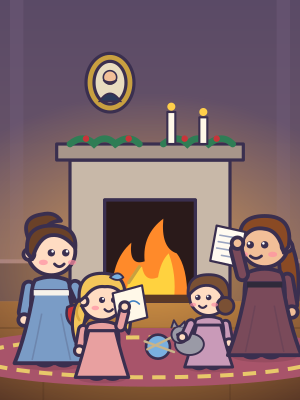
Mr. Brooke had fallen in love with Meg while he assisted her mother in Washington, and Meg, it emerged, loved him too. When Aunt March threatened not to leave Meg a single penny if she married an impoverished tutor, Meg's temper flared for once. She would rather marry an honorable man who worked diligently, she declared, than a wealthy one who was unkind, and the young couple agreed to be married in three years. Jo was dismayed, because she wanted nothing in her family to change, but Laurie promised to stand by her always. So the first part of the story concludes with the entire family assembled in the firelit parlor: Father and Mother side by side, Meg and John Brooke smiling at each other, Amy sketching, Beth singing softly at her piano, and Jo in her favorite low chair, her shorn head resting on her hand, wondering what the future would bring.