Moby-Dick
Part One · Call Me Ishmael
"Call me Ishmael." So begins one of the most celebrated novels in literature, narrated by a restless young schoolteacher who, whenever he found himself growing melancholy and irritable, with a damp, drizzly November in his soul, recognized that it was time to go to sea. One December, with a few dollars in his pocket and a carpetbag over his shoulder, Ishmael traveled to New Bedford, in Massachusetts, intending to enlist aboard a whaling ship. In those days, before electricity, whale oil illuminated the lamps of America, and whaling was an enormous and perilous industry, dispatching ships around the globe on expeditions that could continue for three or four years. The town's inns were overflowing, and the landlord of the Spouter Inn informed Ishmael that the only available accommodation was half of a bed, which he would have to share with a harpooner who was out in town, attempting to sell a peculiar souvenir from the South Seas.
Ishmael lay awake in the darkness, dreading the arrival of this mysterious stranger, until long after midnight the harpooner entered with a candle, and Ishmael, peeking from beneath the blankets, nearly fainted. The man's face and body were covered with elaborate tattoos, his head was shaved except for a single knot of hair, and before retiring he performed a solemn little ceremony in front of a small wooden idol and then lit a tomahawk that was also a pipe. When he discovered Ishmael in his bed, both of them shouted in alarm until the landlord intervened. His name was Queequeg, and he was the son of a king from Kokovoko, a distant island in the South Pacific, who had voluntarily abandoned his royal privileges to investigate the wider world. By morning Ishmael had concluded that it was preferable to sleep beside a sober, dignified stranger than a drunken neighbor, and he discovered, to his astonishment, that he had acquired a friend.
Within days, Ishmael and Queequeg had become inseparable. Queequeg divided his money with his new companion and announced, according to the custom of his island, that they were now friends for life, and that he would willingly die for Ishmael if necessary. On the little ferry to the island of Nantucket, where the greatest whaling ships were based, a passenger ridiculed Queequeg, and the harpooner flung him into the air; moments later, when that same passenger was swept overboard by a swinging beam, Queequeg plunged instantly into the freezing water and rescued him, then calmly requested a drink of fresh water, as though nothing remarkable had occurred. In Nantucket the two friends signed aboard a weather-beaten old ship called the Pequod, decorated with the teeth and bones of whales and owned by a pair of shrewd, penny-pinching Quaker captains, who negotiated ferociously over every penny of Ishmael's wages before they would let him aboard.
Part Two · The Captain
Nobody had glimpsed the Pequod's captain, a man named Ahab, who remained secluded in his cabin, and the owners remarked mysteriously that he was a grand, ungodly, godlike man who had lost a leg on his previous voyage. On the dock, a ragged stranger warned Ishmael and Queequeg that they would regret sailing with Ahab, but they laughed and ignored him. The Pequod departed on Christmas Day, into the freezing Atlantic, and for days the captain remained invisible, while the vessel was managed by its three mates: Starbuck, a serious, courageous and religious man from Nantucket; Stubb, who was perpetually cheerful and never stopped smoking his pipe; and Flask, who regarded whales as personal enemies. Each mate commanded a whaleboat, and each had his own harpooner: Queequeg; Tashtego, a Wampanoag from the island of Martha's Vineyard; and Daggoo, a gigantic and majestic African, whose golden earrings were so enormous that the sailors called them ringbolts.
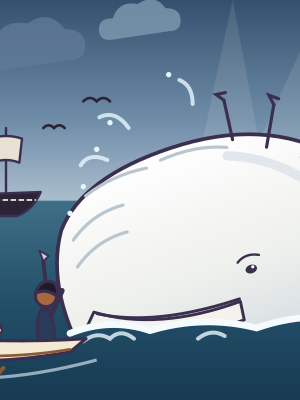
At last, as the ship sailed into warmer latitudes, Captain Ahab appeared on deck, and Ishmael experienced a shiver of foreboding. Ahab resembled a man who had been burned at the stake and had somehow survived, scorched from head to foot but not destroyed. A livid white scar descended down one side of his face and neck, and he stood upon an artificial leg carved from the polished jawbone of a sperm whale, its end fitted into a hole bored in the planks. One morning he summoned the entire crew and nailed a gold coin, a Spanish doubloon, to the mainmast, announcing that whoever first sighted a white whale with a wrinkled forehead and a crooked jaw would receive it. Tashtego, Daggoo and Queequeg immediately recognized the description: this was Moby Dick, a legendary sperm whale, gigantic and ghostly pale, whose ferocity was notorious in every port, and who carried a forest of twisted harpoons embedded in his back.
"It was Moby Dick that dismasted me," Ahab cried, pointing at the ivory leg, and he declared that he would pursue that white whale around Africa, around Cape Horn, and around the flames of destruction before he surrendered, and that the genuine purpose of this voyage was revenge. The crew roared their agreement, intoxicated by his passion, but Starbuck alone protested. He had come to hunt whales for oil, he said, not to accomplish his commander's vengeance, and it was madness to rage against an unthinking animal that had merely defended itself. Ahab replied that the whale was only a mask, and that he would strike through that mask at whatever malicious intelligence lay concealed behind it, even if it were the sun itself. Then he ordered his harpooners to pour liquor into the hollow sockets of their harpoons, and the entire crew drank together to the destruction of Moby Dick.
Part Three · The Hunt
Months of hunting followed, and Ishmael learned the brutal and astonishing business of whaling. When the lookout cried "There she blows!", the boats were lowered, and the crews rowed with all their strength toward the spouting whale, until the harpooner stood up and hurled his iron. The wounded whale would then dive or race away, towing the little boat behind it at terrifying velocity, on what sailors called a Nantucket sleigh ride, until it was exhausted and could be killed with a lance. Afterward its blubber was stripped away and boiled into oil in enormous iron cauldrons on deck, and at night the flames of these furnaces transformed the Pequod into a floating inferno. Between hunts, Ishmael contemplated the whale itself, its mysterious intelligence, its tremendous power, its unknowable inner life, and above everything else the whiteness of Moby Dick, a whiteness that seemed to him more terrifying than any color imaginable.
Despite Ahab's obsession, the voyage had its moments of wonder. Once, the Pequod's boats drifted into the center of an immense herd of whales, where the water was tranquil and transparent, and Ishmael gazed down at mother whales nursing their newborn calves beneath the surface, peaceful and unafraid. But the ocean also had its terrors. A little cabin boy named Pip, panicking during a chase, leaped from a whaleboat and was abandoned, floating alone in the middle of the ocean, for hours before the ship rescued him, and the loneliness of that infinite water drove him out of his mind. Later Queequeg became desperately ill with a fever, and believing he would die, he asked the carpenter to construct a coffin shaped like the canoes of his island, and he lay down in it to test whether it fit. But Queequeg recovered, and the empty coffin was eventually sealed and converted into a life buoy.
Whenever the Pequod encountered another ship, Ahab's first question was always identical: "Hast seen the White Whale?" One captain had lost an arm to Moby Dick and wanted nothing further to do with him, and another ship's crew had witnessed a sailor killed by the whale. Then the Pequod met a vessel called the Rachel, whose captain had sighted Moby Dick only the previous day, and whose own twelve-year-old son had disappeared in a whaleboat during the chase. The desperate father begged Ahab to help him search the ocean for the missing boat, but Ahab, sensing his enemy nearby, coldly refused, and sailed on. Soon afterward a typhoon struck the ship, and mysterious flames, called corposants, burned on the tips of the masts like gigantic candles. The terrified crew begged to turn homeward, but Ahab seized a harpoon whose point was blazing with that eerie fire and swore that he would never abandon the chase.
Starbuck could no longer endure it. One night, discovering Ahab's loaded muskets in a rack beside the cabin door, he lifted one and stood trembling outside the cabin, knowing that a single shot would preserve the lives of thirty men. But he was a decent man, and he could not commit murder, so he replaced the musket. Days later, on a calm, beautiful afternoon, Ahab himself stood at the rail and confessed to Starbuck that he was weary, that he had spent forty years at sea, and that he had left a young wife and a little son in Nantucket. For a moment Starbuck believed he had persuaded his captain to turn toward home. Then the moment passed, Ahab's face hardened again, and he wondered aloud what nameless, inscrutable power commanded him to continue pursuing, against all his own natural longings. That very night, Ahab smelled the whale on the wind, and he knew his enemy was near.
Part Four · The White Whale
At dawn Ahab himself, hoisted to the masthead in a basket, sighted the hump of a gigantic white whale rising like a snowy hill from the sea, and he shouted, "There she blows! It is Moby Dick!" and claimed the doubloon for himself. The boats were lowered, and the chase began. On the first day, the white whale turned upon Ahab's boat, seized it in his jaws, and bit it in half, flinging the captain into the sea, and the boats retreated. On the second day, the whale demolished two more boats and dragged one man down to his death, and Ahab's artificial leg was snapped off. Starbuck pleaded with him, in the name of God, to abandon the chase before it destroyed them all, but Ahab only declared that he was obeying a destiny that had been determined long before the ocean rolled, and that he could not have turned aside even if he had wished to.
On the third day, Ahab lowered his boat once more, after bidding Starbuck farewell and clasping his hand, and Moby Dick surfaced beside him, his body still entangled in the ropes and harpoons of the previous days. Then the whale turned away from the boats and charged directly at the Pequod itself. His enormous forehead struck the bow, the ship shuddered from end to end, and the sea began pouring in. "The ship! The hearse!" Ahab cried, realizing that the ship itself was the hearse a mysterious prophecy had foretold for him. With a final curse, he hurled his harpoon into the whale, but the rope flew out and caught him around the neck, and he was snatched from the boat in an instant and disappeared beneath the waves. The Pequod sank, and as it went down, it generated a whirlpool that dragged the boats, the oars, and every last man into the depths.
Only Ishmael, who had been flung from his boat during the final chase, floated at the margin of that vortex, and he was gradually drawn toward its center. Then, just as he reached it, something burst up from the depths and bobbed to the surface beside him. It was Queequeg's coffin, the life buoy, sealed tight and buoyant. Supported by the coffin of his dearest friend, Ishmael drifted for an entire day and night across a gentle sea, and the sharks swam harmlessly past him, as though their jaws were padlocked. On the second day a ship approached, and it was the Rachel, still searching the ocean for her missing children, and finding only another orphan. Ishmael survived to tell this story, and he has been telling it ever since, to anybody who has ever wondered what it means to pursue something across the entire world, and what it can cost.