Eight Arms: the full story
Part One · A Very Strange Body
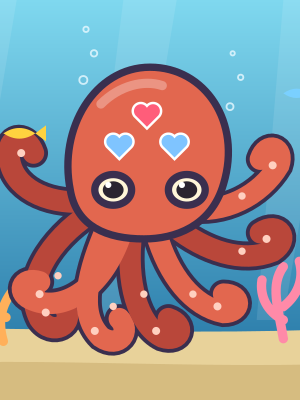
What if your fingers could taste your lunch before it ever reached your mouth? For an octopus, that is just an ordinary day. An octopus is a soft animal that lives in the sea, with a round body, a big head, and eight long arms. It has no bones at all. Some octopuses are smaller than your thumb, and others are bigger than a grown-up.
Put your hand on your chest, and you can feel one heart beating. An octopus has three! Two of the hearts pump blood past the gills, where the animal takes in air from the water. The third heart pumps blood to the rest of the body. And the blood is not red like yours. It is blue, because it carries a metal called copper.
An octopus has a very big brain for an animal with no bones. It also has a lot of brain cells in its arms. About two thirds of all its brain cells are out in the arms, not in the head, so each arm can do some of its own thinking. People sometimes say that an octopus has nine brains, one in the head and one for each arm.
Each arm is covered with round, sticky cups called suckers, and a big octopus can have about two thousand of them. The suckers can hold on to things very tightly. They can also taste! An octopus does not have to put food in its mouth to learn what it is. It can tell a crab from a rock just by touching it.
Because an octopus has no bones, it can squeeze into places that look far too small. The only hard part of its body is its beak, which is shaped like a parrot's beak. If the beak can fit through a gap, the rest of the octopus can pour in after it, like toothpaste going back into the tube. A big octopus can slip through a hole not much wider than its beak.
Part Two · Tricks and Disguises
Octopuses are the masters of hiding. Their skin has thousands of tiny spots called chromatophores that open and close to change color in less than a second. Blink, and an octopus can turn red, brown, white, or speckled. It can also raise little bumps on its skin, so it looks just like a rock or a clump of seaweed.
Here is a strange part. Scientists think most octopuses cannot see color the way you do, yet they match the colors around them very well. Nobody is completely sure how they do it. Some scientists think the skin itself can sense light. Others think the octopus uses its odd-shaped eyes in a clever way. It is still a mystery, waiting for someone to solve it.
When an octopus needs to get away, it has more tricks. Whoosh! It shoots out a cloud of dark ink, which makes a smoky blur in the water. Then it zooms off by squirting water out of a tube on its body. This is called jet power. It works a little like a balloon zipping around the room when you let the air out.
Octopuses are good at solving puzzles. In labs, they have learned to open jars by twisting off the lids from the inside. They can find their way through mazes, and some have learned to squirt water at a light they did not like. One kind, the veined octopus, carries two halves of a coconut shell across the sand. When danger comes, it climbs inside and pulls the shell shut.
Part Three · A Short, Busy Life
Most octopuses live alone, and they do not live very long. Many live only one to five years. A mother octopus lays her eggs, sometimes thousands of them, and takes care of them. She keeps them clean and blows fresh water over them. She hardly eats while she waits. One deep-sea mother was watched guarding her eggs for more than four years.
The giant Pacific octopus is the biggest kind. With its arms stretched out, it can be about sixteen feet across, as long as a small car. It can weigh more than a big dog. The smallest kind is only about an inch long. It would fit on the tip of your finger, and it is still a true octopus.
If an octopus loses part of an arm, it can grow a new one. Some octopuses stack shells and stones to build a little wall around their den. So next time you see an octopus, remember: three hearts, blue blood, and arms that can taste. And somewhere in the sea right now, one of them is probably solving a puzzle.
 Goodbye, Waffles
 A Day on the Space Station
 Anansi and the Pot of Wisdom
 Biscuit and Ask, Wait, Stroke