Pandora's Box
Part One · The Stolen Fire
At the very beginning of the world, people lived without fire. They ate their food cold. They shivered through every winter night, and when the sun went down, they sat together in the cold dark. High above them, on the cloudy top of Mount Olympus, the gods kept fire all to themselves. Zeus, the king of the gods, liked it that way. "Fire is for gods," he rumbled, "not for little creatures made of mud."
But one of the Titans, the old giants who were there before the gods, felt sorry for people. His name was Prometheus. He had watched them shivering in their caves, and he was tired of hearing their teeth chatter. So one night he climbed up to the gods' hall, held out a hollow stalk of fennel, and touched it to the flames. A glowing coal dropped inside. Prometheus hid the stalk under his cloak, crept down the mountain, and gave the fire to the people of the earth.
Soon there were cooking fires in every village and warm lamps in every window. People baked bread, melted metal, and told stories late into the night. When Zeus looked down and saw all those twinkling lights, his face turned as dark as a thunderstorm. "Prometheus has tricked me," he growled, "and the people are laughing beside my fire. Very well. I will send them a present that they will never forget."
Part Two · All the Gifts
Zeus called the blacksmith god, Hephaestus, and ordered him to mix earth and water and shape a woman, as lovely as a goddess. Then every god brought her a gift. Athena taught her to weave beautiful cloth. Aphrodite gave her grace and charm. Hermes, the clever messenger, gave her a quick tongue and an enormous curiosity. They named her Pandora, which means "all the gifts." Last of all, Zeus handed her a tall clay jar, sealed with a heavy lid. "Keep this safe," he said, "and never, ever open it."
Hermes carried Pandora down to the earth, to the house of Epimetheus, the brother of Prometheus. Prometheus had warned his brother, "Never accept a gift from Zeus." But Epimetheus was not a careful thinker. His name meant "thinks afterward," and that was exactly what he did. When he saw Pandora smiling at his door, he forgot every warning and welcomed her inside. Before long they were married, and the mysterious jar stood in the corner of their house.
The old Greek poets said it was a jar, tall and round, though people today call it Pandora's box. Either way, Pandora could not stop thinking about it. While she wove, she glanced at it. While she cooked, she wondered about it. At night she lay awake and thought about what might be hidden in it. Jewels, perhaps, or golden robes, or something even more wonderful. "Why would anyone give a present that no one is allowed to open?" she asked. Epimetheus only shrugged.
Every day she wanted to look inside a little more. Pandora polished it, tapped it, and pressed her ear against its cool clay side. Once she was almost sure she heard a faint rustling inside, like dry leaves blowing. Once she heard a tiny voice whisper, "Let us out." She jumped back and told herself it was only the wind. But her curiosity grew and grew until it was the biggest thing in the house, bigger even than the jar.
Part Three · The Lid
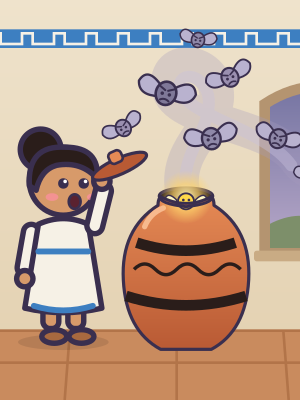
One afternoon, when Epimetheus was out in the fields, Pandora finally decided. "I'll only take one little peek," she told herself, "and then I'll close it again, and no one will ever know." She knelt beside the jar, took hold of the heavy lid, and lifted it just a crack. That was all it took. With a roar like a swarm of angry bees, a dark cloud burst out of the jar and filled the room.
Out flew hundreds of tiny gray creatures, with wings like moths and cross little faces. There was Sickness, sneezing and coughing, and Sorrow, dripping tears, and Worry, who could never sit still. There were Quarrels and Jealousy, Toothaches and Bad Tempers, and a thousand other troubles that nobody had ever known before. They stung Pandora on the arms, buzzed out through the window, and scattered across the whole wide world.
Pandora cried out and slammed the lid down as hard as she could. It was too late! The troubles had already gone. All over the earth, for the very first time, people caught colds and argued with their neighbors and lay awake worrying. Pandora sat on the floor beside the jar with her stinging arms wrapped around her knees, and she wept. "Zeus was right," she sobbed. "I should never have opened it."
Then, in the silence, she heard a small sound from the jar, soft as a bird settling into its nest. Pandora wiped her eyes and peered down through a tiny gap beneath the lid. Something was still in there, tucked deep in the bottom. It was not gray or cross. It glowed, warm and golden, like the last coal of a fire. Its name was Hope, and nobody knows why Zeus had packed it in among the troubles.
Some say the lid shut before Hope could fly away. Others say Hope stayed behind on purpose, so that it would always be close at hand. Either way, it never left. Pandora kept the jar by the fire, and when Epimetheus came home, she told him the whole story. He was sad, but he was not angry. The troubles are still out in the world, buzzing about, as you know. But when one stings you, think of Pandora's jar. No matter how many troubles fly out, there is always some hope left inside.