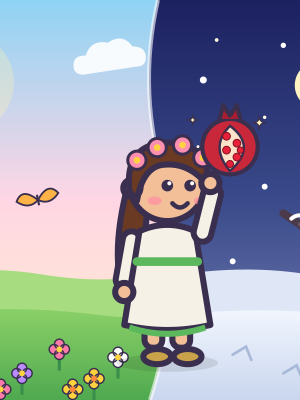
Persephone and the Seasons
Part One · The Meadow
Long ago, when the world was young, the earth was ruled by a goddess named Demeter. She was the goddess of the harvest, and wherever she walked, wheat sprang up golden, apples grew round and red, and grapes swelled fat and purple on the vines. In those days, there was no winter at all. The sun was warm all year long, the fields were always green, and the farmers never had to worry about frost, because Demeter was always happy.
She was happy because of her daughter, Persephone. Persephone loved flowers more than anything, and flowers seemed to love her back. Wherever she ran, daisies opened their faces, and violets peeked out from under the leaves. Every morning, she wandered through the meadows with her friends, the nymphs of the streams, gathering armfuls of roses and crocuses and lilies, while her mother worked in the fields nearby and listened to her laughter drifting across the hills. Demeter often said that a field without Persephone in it was only half a field.
One bright morning, Persephone wandered a little farther than usual. At the edge of the meadow, she discovered a flower she had never seen before, a narcissus with a hundred blossoms on one stem, glowing white and gold and smelling sweeter than honey. "Oh, come and see!" she called to her friends, but they were far behind. She knelt down, wrapped her fingers around the stem, and pulled. The flower came up, roots and all, and the ground beneath it began to shake.
Part Two · The King Below
With a crack like thunder, the earth split wide open. Out of the darkness thundered a golden chariot pulled by four black horses with fiery eyes. Holding the reins was Hades, the king of the underworld, the kingdom deep below the ground where no sunlight ever reached. He had been lonely in his shadowy palace for a very long time, and he had watched Persephone from below as she danced among the flowers. Before she could cry out a second time, he lifted her into his chariot, and the ground closed over them.
Persephone's flowers lay scattered on the grass. Her friends came running and searching, but they found only an empty meadow, and a long crack in the earth that was already disappearing. Far away in the fields, Demeter heard one faint cry, like the call of a bird, and her heart turned cold. She dropped her basket of wheat and ran toward the meadow as fast as the wind, calling her daughter's name. But the only answer was the wind in the grass, and a few crushed flowers lying where a girl had been.
Down in the underworld, the palace of Hades was dark and quiet and grand. Its walls glittered with silver and jewels from deep inside the earth, and pale shadows drifted through its halls without a sound. Hades was not cruel to Persephone. He gave her a throne beside his own and a crown of dark gems, and he told her she would be queen of everything beneath the ground. But Persephone did not want to be a queen. She wanted the sun on her face and her mother's arms around her, and she would not eat or drink a single bite.
Part Three · The Long Search
Above the ground, Demeter searched for nine days and nine nights. She lit two great torches and carried them over mountains and across rivers, through forests and deserts and lonely towns, asking everyone she met, "Have you seen my daughter?" Nobody had. She did not stop to eat, she did not stop to bathe, and she did not stop to sleep. On the tenth day, Helios, the sun god, who sees everything from his chariot in the sky, finally told her the truth. Hades had taken Persephone, and Zeus, the king of the gods, had allowed it.
Demeter's grief turned into anger. She threw away her torches and left the bright home of the gods, and she wandered the earth disguised as an old woman, gray and silent. And because the goddess of the harvest was miserable, nothing could grow. Leaves turned brown and dropped from the trees. The wheat withered in the fields. Cold winds blew down from the mountains, and frost crept across the meadows where Persephone had gathered flowers. For the first time ever, the world felt winter.
The farmers planted their seeds, but nothing came up. They plowed their fields again and again, but the earth stayed barren and hard. The cows grew thin, and the people grew hungry, and the gods on Mount Olympus noticed that no one was bringing them gifts of grain or fruit anymore, because there was nothing left to bring. At last, Zeus understood that if Demeter stayed sad, the whole world would starve. He sent Hermes, the messenger of the gods, with his winged sandals, flying down to the underworld.
Part Four · Six Red Seeds
Hermes found Persephone sitting pale and silent beside the dark throne. "Zeus commands it," he told Hades. "She must go home to her mother." Hades bowed his head, because even the king of the underworld must obey Zeus. But before Persephone left, he came to her holding a pomegranate, a fruit with a hard red skin and hundreds of shiny red seeds inside, each one like a tiny jewel. "You have eaten nothing for so long," he said gently. "Please, take something for your journey."
Persephone was so hungry by then, and so happy to be going home, that she took the fruit without thinking. She ate six of the juicy red seeds, one after another. Then she climbed into the golden chariot beside Hermes, and the black horses galloped up through the dark, up and up, until they burst out into the gray daylight of the cold world. There, standing in a frozen field, was her mother. Demeter ran to her with her arms wide open, and they held each other and cried and laughed at once.
But then Demeter stepped back and looked at her daughter's face. "Child," she asked, trembling, "while you were below, did you eat anything?" Persephone remembered the pomegranate, and her smile faded. It was an ancient rule, older than the gods themselves, that anyone who ate the food of the underworld must return there. "Only six seeds," she whispered. Demeter's face fell, and the frost on the field grew thicker around their feet. For a moment, it seemed as if the cold would never end, and as if the sun would never be warm again.
Part Five · Why the World Has Seasons
Then Zeus decided. Because Persephone had eaten six seeds, she would spend six months of every year below the ground with Hades, as his queen. For the other six months, she would live in the sunlight with her mother. It was not everything Demeter wanted, but it was enough. And that is how it has been ever since. When Persephone is away, her mother misses her so much that the leaves fall, the fields rest, and snow covers the sleeping ground.
But every year, when the time comes for Persephone to return, Demeter waits at the edge of the meadow, watching for her. The moment her daughter steps out into the light, the goddess is so overjoyed that everything bursts into life at once. The ice melts, and the streams begin to sing. Green shoots poke up through the dirt, blossoms open on the apple trees, and the birds come home. That is spring. Then comes summer, warm and golden, and the harvest, when there is plenty for everyone.
So the next time the trees turn bare and the first snow falls, you will know what it means. Somewhere, a mother is missing her daughter. And when the first crocus pushes up through the cold ground, purple and brave, you will know that, too. It means that Persephone is on her way home, and that every winter, however long and dark it seems, always comes to an end. So when you plant a seed in the spring, you might plant it for Persephone, and for her mother, who waited.