Persephone Goes Down: the full story
Part One · The Meadow
Long ago, the Greeks said, the earth was ruled by a goddess named Demeter. She was the goddess of the harvest. Wherever she walked, wheat grew gold and apples grew red. In those days there was no winter at all, because Demeter was always happy.
Demeter was happy because of her daughter, Persephone. Persephone loved flowers more than anything, and the flowers seemed to love her back. Every morning she played in the meadows with her friends, the nymphs of the streams. She picked roses and lilies, and her mother listened to her laugh.
One bright morning, Persephone walked a little farther from home. At the edge of the meadow she found a flower she had never seen. It had a hundred blossoms on one stem, and it smelled sweeter than honey. She knelt down and pulled. The ground began to shake.
The earth split wide open. Out of the dark came a golden chariot with four black horses. Holding the reins was Hades, the king of the underworld. That is the land deep below the ground, where no sunlight ever comes. Hades had been lonely for a long time. He lifted Persephone into his chariot, and the ground closed over them.
Her flowers lay scattered on the grass. Her friends came running, but they found only an empty meadow. Far away, Demeter heard one faint cry, and her heart turned cold. She ran to the meadow, calling her daughter's name. Nobody answered but the wind.
Part Two · The Winter
The palace of Hades was dark and quiet. Hades was kind to Persephone, in his way. He gave her a throne and a crown of dark gems. But she did not want a crown. She wanted the sun on her face and her mother's arms around her. She would not eat a single bite.
Up above, Demeter searched for nine days and nine nights. She carried two great torches over mountains and rivers. She asked everyone, "Have you seen my daughter?" Nobody had. On the tenth day, the sun, who sees everything, told her the truth. Hades had taken Persephone, and Zeus had let him.
Demeter was full of grief. She left the gods and wandered the earth as an old woman. Because she was so sad, nothing could grow. Leaves turned brown and fell. The wheat dried up. Cold winds blew, and frost crept across the meadow. For the first time ever, the world had winter.
The farmers planted seeds, but nothing came up. The people grew hungry. At last Zeus saw the trouble. If Demeter stayed sad, the whole world would starve. He sent Hermes, the messenger of the gods, down to the underworld. Hermes flew on winged sandals.
Part Three · The Seeds
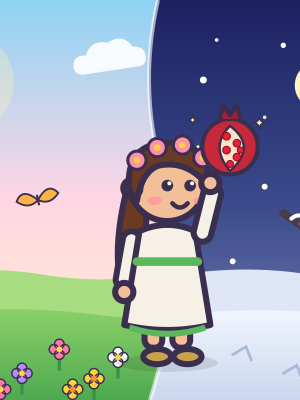
Hermes found Persephone sitting pale and quiet. "Zeus says she must go home," he told Hades. Hades bowed his head, for even he must obey Zeus. But first he held out a pomegranate. It had a hard red skin and shiny red seeds, like tiny jewels. "You have not eaten for days," he said gently. "Take something for your trip."
Persephone was so hungry, and so glad to be going home, that she took it without thinking. She ate six of the red seeds. Then she climbed into the chariot beside Hermes. The horses galloped up through the dark into the gray daylight. There in a frozen field stood her mother. They held each other and laughed and cried at once.
But Demeter stepped back. "Child, did you eat anything below?" she asked. Persephone remembered the pomegranate. There was an old rule that anyone who ate the food of the underworld must go back. "Just six seeds," she whispered. Then Zeus decided. For six months each year, Persephone would live below. For the other six, she would live in the sun with her mother.
That is how it has been ever since. When Persephone is away, her mother misses her so much that the leaves fall and snow covers the ground. But when she comes home, Demeter is so glad that everything bursts into life. The ice melts, the streams sing, and the birds come back. That is spring.