Perseus and Medusa
Part One · The Chest on the Sea
Long ago, in the Greek city of Argos, there ruled a king named Acrisius who was terribly afraid of the future. An oracle, a priestess who could foresee what was coming, had warned him that one day his own grandson would cause his death. So when his daughter Danae gave birth to a baby boy named Perseus, the frightened king ordered his carpenters to build an enormous wooden chest. He placed Danae and the infant inside, nailed down the lid, and pushed the chest out onto the open sea, hoping that the currents would carry them far away and that he would never see either of them again.
For days the chest drifted helplessly over the waves, while Danae cradled her baby and sang to him so that he would not be frightened. At last it washed up on the rocky shore of a little island called Seriphos, where a kind fisherman named Dictys discovered it tangled in his nets. When he pried open the lid and saw an exhausted young mother and a sleeping baby, he wrapped them in his own cloak and carried them home. Dictys had no children of his own, so he raised Perseus as his son, and the boy grew up strong, honest and courageous, mending nets and hauling in fish.
Unfortunately, the island also had a ruler, King Polydectes, who was Dictys's brother and his opposite in every possible way. He was greedy and cruel, and he was determined to marry Danae, although she had refused him again and again. The only obstacle in his way was Perseus, who was now a tall young man and guarded his mother fiercely. So Polydectes devised a scheme to get rid of him. He announced a magnificent banquet and commanded every young man on the island to present him with a splendid gift, knowing perfectly well that Perseus was far too poor to bring anything.
Part Two · The Gifts of the Gods
The other guests arrived with horses and golden goblets, but Perseus arrived with empty hands, and Polydectes mocked him in front of everyone. Perseus's face burned with embarrassment. "Name any gift you desire," he declared proudly, "and I will bring it to you, even the head of the Gorgon Medusa." The hall fell silent, and then the king smiled a slow, satisfied smile. "Then that is exactly what I desire," he said. Everyone in the room understood that Perseus had just promised the impossible, and that Polydectes fully expected never to see him again. Perseus walked home slowly, and he did not tell his mother what he had done.
The Gorgons were three monstrous sisters who lived at the farthest edge of the world. They had golden wings and bronze claws, and instead of hair, living snakes writhed and hissed upon their heads. Two of the sisters were immortal and could never be destroyed. The third, Medusa, was mortal, but she was the most dangerous of all, because anyone who looked directly into her face was instantly turned to stone. Perseus sat alone on the beach that night, staring at the dark and restless sea, and wondered how he could possibly keep his foolish promise. He did not even know which way to go.
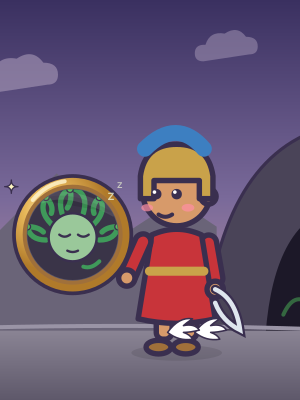
But the gods had been watching him. In the moonlight, two figures appeared beside him on the sand. One was Athena, the gray-eyed goddess of wisdom, who handed him a bronze shield polished so brilliantly that it gleamed like a mirror. "Never look at Medusa herself," she cautioned him. "Look only at her reflection in this shield." The other was Hermes, the swift messenger of the gods, who presented him with a curved sword strong enough to slice through anything. "First," Hermes advised, "you must find the Gray Sisters, because only they know the way." Then the two gods were gone, and Perseus was alone on the sand with his new gifts.
Part Three · The Edge of the World
The Gray Sisters were three ancient women who had been born old, and among them they shared only one eye and one tooth, which they passed from hand to hand. Perseus crept up to their cave and waited patiently. As one sister pulled the eye from her face to hand it to the next, he darted forward and snatched it. "Give it back!" they shrieked, groping blindly around the cave. "Tell me the way to the nymphs who guard the gifts of the gods," Perseus replied, "and you shall have your eye again." Grumbling furiously, they told him, and he kept his promise.
The nymphs lived in a peaceful garden in the distant north, and they welcomed Perseus warmly. They presented him with three marvelous gifts: a pair of winged sandals that could carry him through the air, a magical cap that made whoever wore it invisible, and a sturdy leather bag to hold the Gorgon's head. Perseus fastened on the sandals, the little wings fluttered, and suddenly he was rising into the sky, laughing with astonishment. Then he flew west, over mountains and oceans and deserts, toward the very edge of the world, where the sun sinks down each evening. Far below him, ships looked like tiny toys on the blue water.
The land of the Gorgons was gray, silent and desolate. All around their cave stood statues of stone: soldiers with their swords raised, a lion in the middle of a roar, a shepherd with his hand flung up over his eyes. Every one of them had once been alive, until they made the terrible mistake of looking at Medusa. Perseus put on his cap, became invisible, and walked backward into the cave with his eyes fixed firmly on his shield. In the polished bronze, he could see the three Gorgons lying asleep, their snakes curled up and drowsing on their heads.
Part Four · Medusa
Step by careful step, he moved closer, watching only the reflection, while his heart pounded so loudly that he was certain it would wake them. One of Medusa's snakes opened a yellow eye and flicked out its forked tongue, and Perseus held his breath. Athena seemed to guide his arm, and with one swift stroke of Hermes's sword, it was over. Without ever looking down, he slipped Medusa's head into the leather bag and pulled the strings tight. At that very moment, something extraordinary happened. A dazzling white horse with great feathered wings sprang up from the floor of the cave. It was Pegasus, the winged horse, and it soared out of the cave and away into the sky.
The other two Gorgons awoke with a horrible scream and flew up, beating their golden wings, searching everywhere for whoever had done this. But Perseus was invisible, and they never saw him slip out of the cave and leap into the air. He flew east as fast as his sandals would carry him, with the heavy bag at his side, until the furious cries of the Gorgons faded behind him. He flew over the scorching sands of Africa, and all the way, he made absolutely sure that the bag remained tightly closed. He did not peek inside, not even once, and he did not let it swing open in the wind.
Near the coast of Ethiopia, he glanced down and noticed something strange. A young woman was chained to a rock at the edge of the sea, while a crowd wept on the beach nearby. Perseus swooped down and asked what had happened. Her name was Andromeda, the young woman explained. Her mother, Queen Cassiopeia, had been so boastful about her daughter's beauty that she had insulted the sea nymphs, and now the angry sea god had sent a monster to punish the entire kingdom. An oracle had declared that only Andromeda could satisfy it, so here she was, waiting for it all alone. "I will not let it take you," said Perseus.
Part Five · Andromeda
Even as she spoke, the sea began to churn and boil. A gigantic monster rose from the waves, as long as a ship, with a mouth full of jagged teeth, and it swam directly toward the rock. Perseus did not hesitate for a moment. He shot up into the sky, then dived down on the monster like an eagle, and struck at its scaly back with his sword, darting away whenever it snapped at him. At last the monster sank beneath the foam and did not come up again. Perseus broke Andromeda's chains, and the crowd on the shore cheered until they were hoarse.
Andromeda's parents were so grateful that they agreed immediately when Perseus asked to marry her, and the wedding was celebrated with music, dancing and feasting for many days. Then Perseus and Andromeda sailed home together to Seriphos. When they arrived, however, they discovered that while Perseus had been away, things had grown much worse. Polydectes had tried to force Danae to marry him, and she and old Dictys had been obliged to take refuge in a temple, where they had been trapped for weeks, afraid to step outside. Perseus hugged his mother, and then he went to find the king.
Perseus marched straight to the palace. Polydectes was holding another banquet, and when he noticed Perseus standing in the doorway, he burst out laughing. "So the fisherman's boy has returned," he jeered, "and I suppose you have brought me Medusa's head?" "I have," Perseus answered quietly, "exactly as I promised." He shouted a warning to his friends to cover their eyes. Then he turned his own face away, untied the bag, and held up the Gorgon's head. When he lowered it again, the cruel king and his guests sat perfectly motionless at their table, petrified, as gray and silent as the statues at the edge of the world.
Part Six · Home
Perseus returned the head to the bag for the last time. He made kind old Dictys the new king of Seriphos, and the island was finally governed with fairness and generosity. Then he returned his borrowed gifts. He gave the sandals, the cap and the bag back to Hermes so that they could be delivered to the nymphs, and he gave Medusa's head to Athena, who placed it in the center of her shield, where it protected her forever after. Perseus and Andromeda lived long and happy lives together, and their children became kings and queens. As for Pegasus, the winged horse flew over the land for many years, and some say he still does.
Even the oracle's warning came true in the end, though not in the way anyone had feared. Years later, Perseus entered an athletic competition, throwing the heavy metal discus. A sudden gust of wind carried his throw into the crowd, where it struck an old man watching from the benches, who turned out to be Acrisius. The old king had spent his entire life running away from the future, but the future had found him anyway, completely by accident, at a game. Perseus was deeply sorry, because he had never wished to harm anyone, not even the grandfather who had sent him out to sea in a box.
Today, if you look up on a clear autumn night, you can still find them among the stars. The Greeks named whole groups of stars, called constellations, after Perseus, Andromeda, Cassiopeia and the winged horse Pegasus, and they still shine there above us. The story is still told, because Perseus did not succeed by being the biggest or the strongest. He succeeded by listening to good advice, by looking at danger the clever way, and by keeping every one of his promises, even the ones that seemed far too big to keep. Look for him up there, with his shield and his winged sandals, on the next clear night.