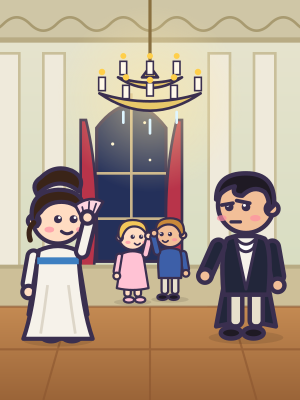
Pride and Prejudice
Part One · First Impressions
The famous first sentence of this novel declares that it is "a truth universally acknowledged" that a wealthy single gentleman must be searching for a wife, and nobody believed it more devoutly than Mrs. Bennet of Longbourn, in the English county of Hertfordshire. She had five unmarried daughters and a serious problem, because by an old legal arrangement called an entail, their comfortable house could only be inherited by a male relative, so that when Mr. Bennet died, his wife and daughters would lose their home. Consequently, when she heard that a rich young gentleman named Mr. Bingley had rented the grand neighboring estate of Netherfield Park, she was overjoyed. Mr. Bennet, a clever, sarcastic man who preferred his library to his family's excitement, teased her mercilessly, pretending that he had no intention of visiting the newcomer, although secretly he had already called on him and simply enjoyed tormenting her. Teasing his wife was his favorite entertainment.
The Bennet sisters were remarkably different from one another. Jane, the eldest, was beautiful, gentle, and determined to think well of absolutely everyone, even people who did not deserve it, while Elizabeth, the second, known as Lizzy, was her father's favorite, intelligent and lively, with a talent for noticing everybody's absurdities and laughing at them. Mary was serious and fond of lecturing, while Kitty and Lydia, the two youngest, were silly, noisy, and interested in nothing except bonnets, gossip, and the officers of a regiment that was stationed in the nearby town of Meryton. At a public ball in the assembly rooms at Meryton, the whole neighborhood gathered to inspect the newcomers. Mr. Bingley proved to be handsome, good-humored and unaffected, and he danced every dance, twice with Jane, with whom he was obviously enchanted. But his closest friend, Mr. Darcy, who was even wealthier, owning a magnificent estate in Derbyshire called Pemberley, made a very different impression.
Mr. Darcy was tall, handsome and distinguished, and for the first half of the evening the entire room admired him, until they discovered how proud and disagreeable he was. He danced only with Bingley's sisters, refused to be introduced to anybody else, and stalked around the ballroom with an expression of weary superiority, as though the company were beneath his notice. When Bingley urged him to dance with Elizabeth, who was sitting down for lack of partners, Darcy glanced at her and coolly replied, within her hearing, that she was "tolerable, but not handsome enough to tempt me." Elizabeth, far from being crushed, found the remark perfectly ridiculous, and she repeated the story to her friends with great amusement. From that evening, the whole neighborhood agreed that Mr. Darcy was the proudest, most unpleasant man in the world, and Elizabeth formed an opinion of him that she was quite certain nothing could ever change.
Part Two · Charming Strangers
Shortly afterward, Jane was invited to dine at Netherfield, and her mother, hoping to keep her there, insisted that she ride on horseback in the rain. As intended, Jane caught a severe cold and was obliged to remain at Netherfield for several days, and Elizabeth, anxious about her sister, walked three miles across muddy fields to nurse her, and arrived with her stockings dirty and her face glowing with exercise. Bingley's sisters, particularly the snobbish Caroline Bingley, who hoped to marry Mr. Darcy herself, were horrified by the six inches of mud on her petticoat and ridiculed her once she had left the room. Darcy, however, said nothing unkind. He remarked only that the walk had brightened her fine eyes. During those days at Netherfield, he and Elizabeth argued constantly, and the more she challenged and teased him, the more he found himself, much against his will, fascinated by her intelligence and her impertinence.
Soon afterward, Longbourn received a visit from Mr. Collins, the cousin who would someday inherit it. He was a pompous, ridiculous clergyman who could not stop praising his patroness, the haughty Lady Catherine de Bourgh, and who had decided to choose a wife from among the Bennet daughters, as a kind of generous compensation. Within a week, he proposed to Elizabeth in a long, solemn speech, and refused for some time to believe her refusal, convinced that elegant young ladies always rejected a man the first time. Mrs. Bennet was furious and declared that she would never see Elizabeth again unless she married him. Her father calmly observed that Elizabeth now faced an unhappy choice, because her mother would never see her again if she refused Mr. Collins, and he would never see her again if she accepted him. Three days later, Mr. Collins proposed to Elizabeth's practical friend Charlotte Lucas, who accepted him.
Meanwhile, the officers of the regiment had become a sensation in Meryton, and the most charming of them all was a handsome newcomer named Mr. Wickham. He paid Elizabeth particular attention, and he confided to her an astonishing story: he had grown up at Pemberley as the son of the old steward, and the late Mr. Darcy had promised him a comfortable career, but the present Mr. Darcy, out of jealousy, had cruelly cheated him of it. Elizabeth believed every word, because it confirmed everything she already thought about Darcy. Then came a second blow. After a splendid ball at Netherfield, Bingley and his entire party suddenly departed for London without explanation, and Caroline Bingley wrote coolly to Jane that her brother would not be returning, and that he was expected to marry Mr. Darcy's young sister. Jane concealed her heartbreak with quiet dignity, insisting that she blamed nobody, but Elizabeth suspected that Mr. Darcy had something to do with it.
Part Three · The Letter
In the spring, Elizabeth traveled to Kent to visit Charlotte, now Mrs. Collins, in her new home, which stood beside the vast park of Rosings, the estate of Lady Catherine de Bourgh. To her surprise, Lady Catherine's nephew arrived for a visit: Mr. Darcy himself. He called at the parsonage often, sitting silently and staring at Elizabeth, and she could not imagine what he wanted. Then, from his cousin, Colonel Fitzwilliam, she learned that Darcy had recently congratulated himself on rescuing a friend from a most imprudent marriage, and she realized at once that he meant Bingley and Jane. Elizabeth was still trembling with indignation that evening, alone in the parsonage, when the doorbell rang, and Mr. Darcy walked in, paced about the room in agitation, and then burst out: "In vain have I struggled. It will not do." His feelings, he declared, could no longer be suppressed, and he must tell her how ardently he admired and loved her.
Elizabeth was utterly astonished. Darcy proceeded to explain, at considerable length, how much he had struggled against his feelings, because her family was so inferior to his own and her relatives behaved so foolishly, and it was perfectly obvious that he expected her to accept him gratefully. Instead, her anger exploded. She told him that his arrogance, his conceit and his selfish disdain for the feelings of others had convinced her, from the very beginning, that he was "the last man in the world whom I could ever be prevailed on to marry." She accused him of ruining her sister's happiness and of treating poor Mr. Wickham cruelly. Darcy, pale with shock and wounded pride, apologized for having taken up so much of her time, wished her health and happiness, and left the house. Elizabeth sat down and cried for half an hour, without entirely understanding why, because it was flattering, she admitted, to have inspired such an affection.
The next morning, while she was walking in the park, Darcy handed her a long letter and departed without waiting for an answer, and in it, he explained himself calmly, honestly, and without a single word of complaint. He had separated Bingley from Jane because Jane's serene manners had convinced him she did not truly love his friend. As for Wickham, the truth was very different from Wickham's story. Darcy had given him a large sum of money in place of the career he had been promised; Wickham had wasted it all, and then, the previous summer, he had tried to persuade Darcy's fifteen-year-old sister Georgiana to elope with him, in order to get her fortune. Elizabeth read the letter again and again, and slowly she understood that she had been completely deceived by Wickham's charm and blinded by her own prejudice. She was ashamed of her own vanity, and of the confidence with which she had judged. "Till this moment," she thought, "I never knew myself."
Part Four · Pemberley
That summer, Elizabeth went traveling with her favorite aunt and uncle, the sensible Mr. and Mrs. Gardiner, and their route took them through Derbyshire, near Pemberley. Assured that the owner was away from home, Elizabeth agreed to visit the house, and she was enchanted by its beautiful grounds and its tasteful, unpretentious rooms. The housekeeper, who had known Darcy since he was four years old, praised him as the kindest master and the most generous brother imaginable, and Elizabeth reflected, with a curious pang, that she might have been mistress of all this. Then, unexpectedly, Darcy himself appeared, having returned a day early. To her amazement, he was courteous and gentle, treating her aunt and uncle, whom he might have dismissed as unfashionable tradespeople from London, with genuine respect, and he asked whether he might introduce his shy young sister to her. Elizabeth began to wonder whether she had ever really known him.
Then a letter arrived from Jane with catastrophic news. Lydia, the youngest Bennet sister, only sixteen years old, had run away with Mr. Wickham, without any intention on his part of marrying her. In those days such a scandal could disgrace an entire family, and none of the Bennet sisters would ever be respectably married. Elizabeth, in her distress, told Darcy everything, and he listened gravely, and left. She was certain that she would never see him again, and she realized, now that it was too late, how much she wished she could. The fugitives were found in London, and to everyone's astonishment, Wickham agreed to marry Lydia after all, and Lydia returned to Longbourn as cheerful and shameless as ever. Only later did Elizabeth discover, from a careless remark of Lydia's, that it was Darcy who had tracked the couple down, paid Wickham's debts, and arranged the marriage, all in complete secrecy.
Soon afterward, Bingley returned to Netherfield, having confessed to Darcy that he had never stopped thinking about her, and within days he proposed to Jane, who accepted him with the happiest smile in Hertfordshire. Then, one evening, a grand carriage drew up at Longbourn, and out stepped Lady Catherine de Bourgh, who had heard a rumor that her nephew intended to marry Elizabeth. She demanded that Elizabeth promise never to accept him, reminding her of her inferior connections and her disgraceful sister, but Elizabeth politely and firmly refused to promise anything at all. Lady Catherine stormed away in fury, and promptly reported the conversation to Darcy, which was precisely the opposite of what she intended, because it gave him hope. A few days later, walking with Elizabeth along a country lane, Darcy told her that his feelings had not changed, but that if hers were the same as they had been in April, he would never mention the subject again.
Elizabeth, with considerable embarrassment, managed to explain that her feelings had changed so completely since April that she could now receive his assurances with gratitude and pleasure. As they walked on, they confessed how much each had learned. Darcy admitted that he had been raised to be selfish and proud, and that her reproofs had taught him a lesson he badly needed; Elizabeth admitted that she had been proud of her own cleverness, and had judged him in an instant and then refused to look again. Both of them, it seemed, had been guilty of pride, and both of them guilty of prejudice, which is how the novel got its name. Mr. Bennet was astonished, because he had always believed that Elizabeth despised Darcy, and Mrs. Bennet was nearly speechless with delight at the thought of ten thousand a year. Elizabeth and Darcy were married, and at Pemberley they were very happy, and Elizabeth never stopped teasing him, which, he discovered, he liked best of all.