Rama and Sita
Part One · The Prince of Ayodhya
Long ago, in the shining city of Ayodhya in northern India, there lived a good king named Dasharatha, who had four sons. The eldest was Rama, whom Hindus honor as a form of the god Vishnu, born on earth to protect what is good. Rama was courageous, gentle and wise, a skilled archer and a patient listener, and everyone who met him admired him. His younger brother Lakshmana loved him most of all, and followed him everywhere like his shadow. The other two brothers, Bharata and Shatrughna, were devoted to each other in the same way, and the whole kingdom was peaceful and prosperous, with flourishing gardens, overflowing granaries, and magnificent temples whose bells rang every evening.
One day, the four princes traveled to the kingdom of Mithila, where King Janaka was choosing a husband for his daughter, Sita. Sita was wise and kind and courageous, and Janaka had declared that she would marry only the man who could lift and string the enormous bow of the god Shiva. Princes had come from every corner of the land to try, but none of them could even move it. Then Rama stepped forward. He lifted the bow as easily as a branch, bent it to string it, and it broke in two with a crack like thunder. Rama and Sita were married with great celebration, and they loved each other completely.
Years later, old King Dasharatha decided that Rama should be crowned king. But his youngest queen, Kaikeyi, listened to the whispers of her jealous maid, who persuaded her that her own son, Bharata, deserved the throne. Long before, the king had promised Kaikeyi two boons, two wishes that she could ask for whenever she chose. Now she asked for them. "Make Bharata king," she said, "and send Rama away into the forest, in exile, for fourteen years." The king was heartbroken and pleaded with her to change her mind, but he had given his solemn word, and in Ayodhya a promise, once spoken, could never be broken, not even by a king.
Part Two · Fourteen Years in the Forest
Rama did not argue and did not complain. "My father's word is more important than any crown," he said calmly, and he took off his royal robes and dressed in simple bark cloth. Sita refused to stay behind. "Where you go, I go," she told him, "and the forest with you will be sweeter than any palace without you." Lakshmana insisted on coming too. When Bharata returned home and discovered what had happened, he was horrified, and he hurried into the forest to beg Rama to come back. Rama gently refused, so Bharata carried home Rama's sandals and placed them on the throne, and ruled only in his brother's name until he returned.
The years in the forest passed peacefully, and in some ways they were the happiest of Rama's life. Rama, Sita and Lakshmana built a little hut of leaves and branches, visited the holy sages who lived among the trees, and protected them from the rakshasas, the demons who troubled the forest. But far to the south, on the island of Lanka, ruled the mightiest rakshasa of all. His name was Ravana, and he had ten heads and twenty arms, and he was clever and proud and enormously powerful. When Ravana heard descriptions of the beautiful Sita, living unprotected in the forest, he became obsessed with her and resolved to carry her away to his island fortress.
Ravana sent a rakshasa disguised as a marvelous golden deer, with silver spots and jeweled antlers, to graze outside the hut. Sita had never seen anything so lovely, and she asked Rama to catch it for her. Rama chased the deer deep into the forest, but when his arrow finally struck it, the creature cried out in Rama's own voice, "Lakshmana! Help me!" Sita begged Lakshmana to run to his brother. Before he left, as many families tell it, Lakshmana drew a line on the ground around the hut with the tip of his arrow. "Do not step across this line," he said solemnly, "and no harm can reach you." Then he hurried away anxiously into the darkening forest.
Part Three · The Search
As soon as both brothers were gone, an old holy man in saffron robes came to the hut, begging for food. Sita felt sorry for him, and she stepped across the line to give it to him. Instantly the old man became Ravana, with all his ten heads, and he seized Sita and swept her up into his flying chariot. The brave old vulture king Jatayu flew at Ravana to stop him and fought with all his strength, but he could not win. As the chariot flew south, Sita pulled off her jewelry, piece by piece, and dropped it toward the earth, so that Rama might discover which direction she had been taken. Far below, some curious monkeys sitting on a mountaintop watched the sparkling ornaments tumble out of the sky and gathered them up.
When Rama and Lakshmana returned and found the hut empty, Rama's grief was terrible to see. The brothers searched the forest for days, following the glittering trail of Sita's jewelry, until they came to the mountain kingdom of the vanaras, the monkey people. There they met the monkey king, Sugriva, and his wise and powerful friend Hanuman, the son of the wind god. Hanuman looked at Rama once and loved him with his whole heart, and from that day on, his devotion to Rama never wavered. "We will find Sita," Sugriva promised, and he dispatched his monkey armies to search the north, south, east and west, with instructions to return within one month.
The search party that traveled south reached the very edge of India and stood on the beach, staring across the vast ocean. Somewhere on the other side lay Lanka, but it was a hundred leagues away, and no monkey could possibly leap so far. Then the others turned to Hanuman, and reminded him of something he had forgotten. As a child, Hanuman had once leaped up into the sky to grab the sun, thinking it was a ripe mango. He could grow as large as a mountain or as small as a mouse, and his strength was limitless. Hanuman realized that his companions were right, and he began to grow.
Part Four · Hanuman's Leap
Hanuman climbed to the top of a mountain, grew until his head touched the clouds, and chanted Rama's name. Then he leaped. The mountain shook beneath his feet, the trees were torn up by the wind of his jump, and he soared out over the ocean like a comet. He flew all day, past sea serpents and storms, and landed on the shore of Lanka as the sun went down. There he made himself as small as a cat and slipped into the golden city. He searched every palace and every garden, until at last, in a grove of ashoka trees, he found Sita, sad and pale, but brave, refusing every gift that Ravana offered her.
Hanuman crept down from the tree and gave Sita a ring that Rama had sent, so that she would know he came as a friend. Sita wept with joy when she saw it, and she gave him a jewel from her hair to carry back to Rama. Before he left, Hanuman allowed himself to be captured, so that he could look at Ravana's army and see his strength. Ravana ordered his soldiers to set Hanuman's tail on fire as a punishment. But Hanuman simply grew bigger, broke free, and leaped from rooftop to rooftop with his blazing tail, until half the golden city was in flames. Then he extinguished his tail in the sea and leaped triumphantly home across the ocean.
When Rama heard that Sita was alive, he embraced Hanuman like a brother. The whole army marched south to the ocean, and there they built a bridge to Lanka. Every monkey and every bear carried rocks and trees, and the clever monkey Nala, who was a builder, showed them how to lay them. Many families tell that the monkeys wrote Rama's name on every stone, and that the stones floated. Even a tiny squirrel helped, rolling in the sand and shaking it out between the rocks, and Rama, touched by its devotion, stroked its back so gently that, according to legend, Indian squirrels still have three stripes where his fingers touched it.
Part Five · The Battle and the Lamps
The battle for Lanka was long and terrible, and the ancient poem describes it in tremendous detail. Ravana's own brother, Vibhishana, who was righteous and good, left Ravana and joined Rama's side. When Lakshmana was badly wounded, Hanuman flew all the way to the Himalaya mountains to fetch a healing herb, and because he could not tell which plant it was, he carried the entire mountain back in his hand. Lakshmana was healed. At last Rama and Ravana faced each other. Rama fitted to his bow a sacred arrow, blessed by the gods, and when it flew, it struck the demon king, and Ravana fell. The war was finally over, the demon king's cruelty had ended, and Rama and Sita were reunited at last, after so many months of separation.
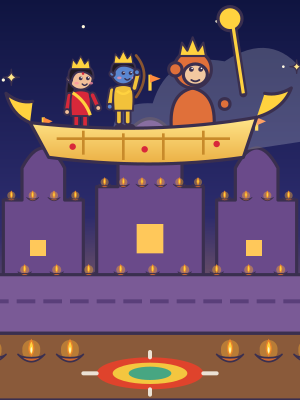
By then the fourteen years of exile had come to an end. Vibhishana became the new king of Lanka, and he lent Rama a flying chariot, so that Rama, Sita, Lakshmana and Hanuman could fly home to Ayodhya. It was a dark night without a moon, and the people of Ayodhya were afraid that their prince would not be able to find his way. So every family in the city filled little clay lamps, called diyas, with oil, and set them in long rows along every roof and window and wall, until the whole city glowed in the darkness like a sky full of stars, and Rama's chariot followed the lights home.
Bharata ran out to meet them, carrying Rama's sandals, and the brothers embraced. Rama was crowned king of Ayodhya, with Sita beside him, and the ancient stories say that his reign was so just and so kind that, for a thousand years, nobody was hungry or afraid. That night of lamps has never been forgotten, in India or anywhere else that Rama's story has traveled. Every autumn, families everywhere celebrate Diwali, the festival of lights, filling their homes with diyas and fireworks and sweets, and telling the story of Rama and Sita and faithful Hanuman. Each little flame is a reminder that goodness, loyalty and a promise faithfully kept can always find their way home through the darkest night.