Rip Van Winkle
Part One · The Village by the River
Long ago, when America still belonged to the King of England, there was a little Dutch village at the foot of the Catskill Mountains, beside the wide Hudson River. On clear evenings the mountains were painted purple and gold, and on cloudy days a gray mist gathered around their summits like a hood. In that village, in a crooked house with a sagging roof, lived a good-natured fellow named Rip Van Winkle. Rip was simple and generous, and he would cheerfully help any neighbor with any job at all, as long as it wasn't his own. He would fish all day without a single bite, and never once complain.
The children of the village adored Rip. He mended their kites, he played marbles with them, and he told them long stories about ghosts, witches and goblins, while they clambered all over him. Even the village dogs never barked at him. But his own farm was the most neglected in the entire neighborhood. His fences collapsed, his cow wandered into the cabbages, and weeds grew faster in his fields than anywhere else on earth. His wife, Dame Van Winkle, scolded him from morning until night about his laziness, and Rip only shrugged his shoulders, shook his head, and said absolutely nothing.
Whenever the scolding became too loud, Rip escaped to the village inn, where a little club of wise old gentlemen sat on a bench in the shade beneath a portrait of King George the Third. They puffed on their long pipes and discussed the news from ancient newspapers, extremely slowly, for hours and hours. When even that peaceful refuge was disturbed by his furious wife, Rip had only one companion left, his faithful dog, Wolf, who was scolded just as much as his master. "Poor Wolf," Rip would sigh, patting his shaggy head. "Never mind, my lad. As long as I live, you shall never lack a friend."
One fine autumn day, Rip shouldered his old gun and wandered with Wolf high into the Catskill Mountains, far away from his chores. Late in the afternoon, exhausted, he threw himself down on a green knoll at the edge of a cliff. Far below him, the Hudson River moved along silently and majestically, reflecting a purple cloud on its glassy surface, and the long blue shadows of the mountains were beginning to stretch across the valley. Rip sighed heavily, because it would be dark before he reached home, and he dreaded the terrible scolding that would be waiting for him there.
Part Two · Thunder in the Mountains
Just as he was about to start down the mountain, he heard a voice calling from somewhere far away, "Rip Van Winkle! Rip Van Winkle!" He looked around, but there was nobody in sight except a solitary crow winging its way across the mountain. Then the voice called again, and Wolf bristled, growled, and crept close to his master's side. Climbing slowly up the rocks toward them came a short, square old fellow with a bushy gray beard, dressed in peculiar old-fashioned Dutch clothes. He was struggling under a heavy wooden keg, and he made signs for Rip to come and help him carry it.
Together they clambered up a narrow gully, while long rolling peals of thunder seemed to burst out of the rocks ahead of them. At last they arrived at a hollow, shaped like a small round theater and surrounded by steep cliffs. In the middle of it, a company of odd-looking men were playing ninepins, rolling heavy balls at wooden pins. They wore old-fashioned doublets and baggy breeches, tall hats decorated with feathers, and long beards of every imaginable shape and color. Whenever a ball rolled, it echoed among the mountains like thunder. Yet the strangest thing of all was that nobody spoke a single word.
The players stopped their game and stared at Rip with such strange, expressionless faces that his heart turned within him and his knees knocked together. His guide emptied the keg into large flagons and gestured for Rip to serve the company. Trembling, Rip obeyed, and the men drank in solemn silence and returned to their game. When nobody was watching, Rip tasted the drink himself. It was delicious, so he tasted it again, and then again, until his eyes began to swim and his head drooped lower and lower. Finally he sank down on the grass and fell into a deep, deep sleep.
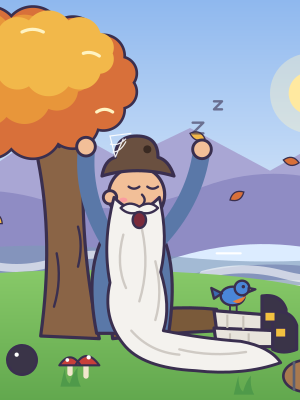
When Rip woke up, he was lying on the green knoll where he had first noticed the old man. It was a bright, sunny morning, and the birds were hopping and twittering among the bushes. "Surely I haven't slept here all night," he thought, imagining what his wife would say. He reached for his gun, but instead of his clean, well-oiled gun, he discovered an old one lying beside him, with a rusty barrel and a worm-eaten stock. Wolf had disappeared too, and when Rip whistled and shouted for him, only the echoes answered. His joints were dreadfully stiff, and something long and white was tangled around his knees.
Part Three · Twenty Years Later
As Rip limped into his village, everything seemed peculiar. The people were all strangers, wearing unfamiliar clothes, and every one of them stared at him and stroked their chins. When Rip did the same, he was astonished to discover that his beard had grown a foot long, and that it was as white as snow! A crowd of children chased after him, hooting and pointing at his beard. There were rows of new houses, while his own house had fallen to pieces. Its roof had collapsed, its windows were shattered, and a half-starved dog that resembled Wolf growled at him and slunk away.
At the inn, the portrait of King George had been mysteriously altered. His red coat had been painted blue, he carried a sword instead of a scepter, and underneath him were the words GENERAL WASHINGTON. Instead of the drowsy old gentlemen with their pipes, a busy, quarrelsome crowd was arguing about elections and citizens and the rights of the people. A gentleman with a list of names demanded to know which side Rip voted for. "Alas, gentlemen," cried Rip, bewildered, "I am a poor, quiet man, and a loyal subject of the King!" At this the crowd shouted angrily, and they very nearly threw him out.
Rip inquired anxiously about his old friends, and he learned that some had gone off to fight in the war, while others had moved away to distant places. "Does anybody here know Rip Van Winkle?" he asked desperately. "Oh, certainly," they answered. "That's Rip Van Winkle over there, leaning against the tree." Rip looked, and he saw a lazy, ragged, cheerful young man who looked precisely like himself on the day he had gone up the mountain. Poor Rip was completely confused. "I'm not myself," he stammered. "I was myself last night, but I fell asleep on the mountain, and now everything has changed, and I can't tell who I am!"
Just then a young woman pushed through the crowd with a chubby baby in her arms. When the frightened baby began to cry, she hushed him gently. "Hush, Rip," she said. "The old man won't hurt you." Something in her voice awakened a memory. "What is your name, my good woman?" asked Rip. "Judith Gardenier," she replied, "and my father was Rip Van Winkle, but he went off into the mountains with his gun twenty years ago and never came home. His dog came back without him." Rip could hold back no longer. He hugged her and the baby, crying, "I am your father! Doesn't anybody know poor Rip Van Winkle?"
Everyone stood amazed, until a very old woman tottered forward, shaded her eyes, and peered into his face. "Sure enough!" she exclaimed. "It is Rip Van Winkle! Welcome home again, old neighbor. Why, where have you been these twenty long years?" Then the oldest man in the village, who knew all its history and legends, explained the mystery. Every twenty years, he declared, the great explorer Henry Hudson and the crew of his ship, the Half Moon, returned to the Catskill Mountains to keep a guardian eye upon the river they had discovered. His own father had once seen them playing ninepins in a hollow of the mountains.
Judith took her father home to live with her family in a snug, cheerful farmhouse. Rip had slept straight through the entire American Revolution, and now that he was elderly, nobody expected him to work. So he took his favorite place again on the bench at the inn, where he related his story to every traveler who would listen, and the children loved him more than ever. To this very day, whenever a summer thunderstorm rumbles over the Catskill Mountains, the people of the valley smile at each other and say that Henry Hudson and his crew are playing ninepins again.