Robinson Crusoe
Part One · The Shipwreck
Robinson Crusoe's father wanted him to study law and live a quiet, comfortable life in the English city of York, but Robinson could think of nothing except the sea. At eighteen, without even saying goodbye, he slipped aboard a ship bound for London, and on his very first voyage a storm battered the ship so violently that he swore he would go home if he survived. He survived, and he did not go home. For years he sailed from one adventure to the next, until he settled on a farm in Brazil. Then some neighbors persuaded him to join a trading voyage across the Atlantic, and one September morning in 1659, he set sail once again.
Twelve days out, a hurricane struck. For nearly two weeks the wind drove the ship wherever it pleased, until one morning a sailor screamed "Land!" and the ship slammed onto a sandbank and stuck fast. The crew scrambled into a small boat, but an enormous wave overturned it, and Robinson was flung into the churning sea. Again and again the waves buried him and dragged him back, until at last one hurled him against a rock, and he clung there, gasping, and crawled up onto the shore. He never saw any of his companions again, except for three of their hats, one cap, and two shoes that did not match.
That first night, terrified of wild animals, Robinson slept in a tree. In the morning he discovered that the storm had lifted the wrecked ship closer to the beach, so he swam out to it and found the food still dry. He built a raft from spare masts and planks and ferried load after load ashore: biscuits, cheese, barrels of grain, tools and nails, a carpenter's chest, ropes, sails, two guns and some gunpowder. Twelve times he made the dangerous journey. He even rescued the ship's dog and two cats, who seemed delighted to be rescued. Then another storm arrived during the night, and in the morning the ship had vanished.
Robinson chose a spot beside a cliff, with a little cave in the rock behind it, and pitched a tent made from the ship's sails. Around it he hammered a fence of sharp wooden stakes, so strong that nothing could climb over it, and he came and went by a ladder that he pulled in after him. Near the shore he set up a large wooden post and carved into it the words: I CAME ON SHORE HERE ON THE 30TH OF SEPTEMBER, 1659. Every day afterward he cut a notch in the post, with a longer notch for every Sunday, so that he would never lose track of time.
Everything took Robinson an extraordinarily long time, because he had never done any of it before. Making a single plank from a tree, with only an axe, took him forty-two days. He taught himself to build shelves, a table and a chair, to bake clay pots in a fire, and to weave baskets from branches. One day he noticed green stalks of barley sprouting beside his fence, exactly where he had shaken out an old bag of chicken feed, and he nearly wept, because now he could grow grain and bake bread. He caught some wild goats and tamed them, so he had milk, butter and cheese.
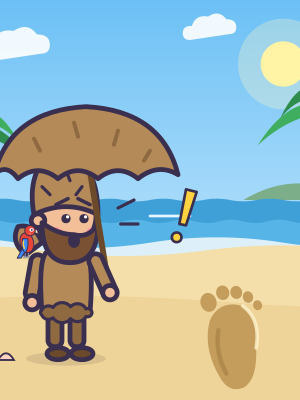
Year after year, Robinson made himself a home. He sewed clothes from goatskins, with a tall, shaggy cap, and he constructed an umbrella of skins to keep off the fierce sun and the pounding rain. He taught a parrot named Poll to talk, and one afternoon, while he was dozing, he was startled awake by a voice calling, "Poor Robin Crusoe! Where are you?" Once he spent months carving a canoe from a giant cedar tree, only to discover that it was much too heavy to drag to the water. He laughed at himself, and he learned to think before he began. Slowly he became, if not happy, then at least content.
Part Two · The Footprint
Robinson had lived on the island for fifteen years when, one day around noon, he was walking along the beach toward his canoe and stopped as if he had been struck by lightning. There, clearly printed in the sand, was the mark of a man's bare foot. He stood perfectly still, staring. He listened, and he looked all around him, and he climbed a little hill to see farther, but there was nobody anywhere, and no other footprints. There was only that single print, the toes, the heel, every part of it. Robinson ran home in terror, glancing back at every bush, and that night he did not sleep at all.
For days he imagined every possible explanation. Perhaps he had made the print himself and forgotten, but when he measured his own foot against it, the footprint was far larger. Somebody else had been on his island. For years afterward he lived in fear, strengthening his fence, planting a thick wood of fast-growing trees to hide his home, and hardly daring to light a fire. Eventually he discovered the cold remains of fires on the far side of the island, where canoes sometimes landed from the mainland across the water. Robinson had longed for company for fifteen years, and now that it might be close, he found himself too frightened to welcome it.
Part Three · Friday
In Robinson's twenty-fifth year on the island, five canoes landed on the beach below his lookout. A band of warriors had brought prisoners from a war between their peoples, and as Robinson watched through his telescope, one prisoner suddenly broke free and sprinted along the sand toward Robinson's side of the island, with two of the warriors racing after him. The young man swam across a creek and kept running. Robinson made up his mind in an instant. He hurried down the hill, stepped between the runner and the warriors, and fired his gun into the air. The thunderous noise sent the two warriors fleeing back to their canoes, and the beach was quiet again.
The young man stood trembling, unsure whether this strange bearded figure in goatskins was a rescuer or a new enemy. Robinson laid his gun on the ground, smiled, and beckoned gently, and step by step the young man came closer. Robinson shared his bread and raisins and a jug of water, and that night the stranger slept peacefully in the cave. Robinson called him Friday, after the day of the week on which they had met. Many years later, he realized with shame that he had never asked his friend what his own name was, which would have been the first thing to ask of anyone.
Friday learned English remarkably quickly, and Robinson learned more from Friday than he had expected. Friday knew which plants were safe to eat, how to steer through the treacherous currents around the island, and how to hollow out a canoe that actually floated. He laughed at Poll the parrot, and he laughed at Robinson's shaggy umbrella, and before long Robinson was laughing too, for the first time in twenty-five years. In the evenings they sat by the fire and described their homelands to each other. Friday told him about his family across the water, and Robinson realized that his friend missed them just as much as he missed England.
Together they built a large canoe, and they were preparing to sail to Friday's homeland when an English ship anchored off the island. Its sailors had rebelled against their captain, and they rowed ashore with the captain and two loyal men as prisoners. Robinson and Friday crept close at night and freed the prisoners. Then, with clever tricks, false shouts in the darkness and a great deal of courage, they persuaded the rebels to surrender. The grateful captain could hardly believe his eyes. He had expected to meet a wild man, and instead he found two cheerful friends, one of them in a goatskin cap, offering him goat cheese and bread.
On the nineteenth of December, 1686, Robinson Crusoe left his island at last, after twenty-eight years, two months and nineteen days. He took his goatskin cap, his umbrella and his parrot, and Friday came too, because Friday chose to. He was curious to see the world beyond the sea, and the two friends had been through far too much together to part. When they reached England, Robinson discovered that everyone had believed he was dead for years. But he had learned on the island what he could build with his own two hands, and what it meant to have a friend, and he never forgot either lesson.