Sinbad and the Roc
Part One · Left Behind
Long ago, in the great city of Baghdad, there lived a merchant named Sinbad, who had already sailed across the world once and come home rich. For a while he was perfectly content to sit in his beautiful house beside the river, eating dates and listening to music. But before long, he grew restless. He missed the creak of the ropes, the salty wind, and the thrill of not knowing what lay beyond the horizon. So he bought a ship's hold full of cloth and spices, said goodbye to his friends, and set out from the port of Basra on his second voyage, convinced that nothing could possibly go wrong.
For many weeks the ship sailed from island to island, buying and selling and trading, and every day was more pleasant than the one before. One morning, they anchored beside a lovely green island covered in fruit trees and sparkling streams, with not a single house or person anywhere in sight. The passengers went ashore to stretch their legs. Sinbad wandered off by himself, ate a little picnic in the shade of a tree beside a stream, and, lulled by the gentle breeze and the musical birdsong, fell fast asleep. He slept for a very long time, dreaming peacefully of his comfortable house and his delicious dinners.
When he awoke, the sun had moved far across the sky, and the island was silent. Sinbad leaped up and ran to the beach, but the ship was nowhere to be seen. It was only a tiny white speck far out on the ocean, and then it was gone. Nobody had counted the passengers, and nobody had noticed he was missing. He shouted until his throat ached, he scolded himself for being so foolish, and he wished with all his heart that he had stayed at home in Baghdad. But wishing would not rescue him, so at last he wiped his eyes and began to explore.
Part Two · The Dome and the Bird
Sinbad climbed the tallest tree on the island and looked around in every direction. He saw nothing but sea and sky and sand, except for one thing. Far inland stood something enormous and white, gleaming in the sun like the dome of a palace. He scrambled down and hurried toward it. The dome was smooth and white and taller than a house, and when he walked all the way around it, he counted fifty paces. Strangest of all, it had no door and no window, and its curving wall was as slippery as polished marble, so there was absolutely no way to climb it. Sinbad scratched his head, completely mystified.
While he was puzzling over it, the sky suddenly went dark, as if a gigantic cloud had covered the sun. Sinbad looked up and gasped. It was not a cloud. It was a bird, a bird so colossal that its wings blotted out the daylight, with legs as thick as tree trunks and talons as long as swords. Then Sinbad remembered the tales that sailors told about the roc, a bird so huge that it fed its chicks on elephants. The white dome, he realized, was not a palace at all. It was the roc's egg, and its mother was coming home to sit on it.
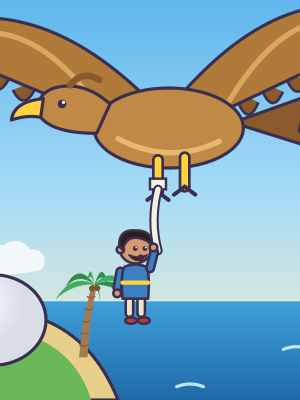
The roc landed on the egg, spread her vast feathers over it, and went to sleep. Sinbad crouched in the shadow, trembling, and then an astonishing idea came into his head. He unwound the long cloth turban from his head, twisted it into a strong rope, and tied himself tightly to one of the roc's enormous legs. "Perhaps this bird will carry me somewhere with people in it," he thought. "Anywhere would be better than an empty island." He spent the whole night tied to the leg, hardly daring to breathe, while the roc snored above him like distant thunder, and he prayed that the knots would hold.
Part Three · The Valley of Diamonds
At dawn, the roc woke, gave a cry like a thunderclap, and launched herself into the sky. Up and up she climbed, with Sinbad dangling from her leg like a little bundle of laundry, until the island was only a dot on the sea and the clouds drifted by beneath him. She flew for hours. At last she swooped down over a range of mountains and landed in a deep valley, and Sinbad, with shaking fingers, untied his turban and rolled away across the ground. A moment later, the roc seized something long and wriggling in her talons and flapped away again.
Sinbad stood up and looked around, and his heart sank. The valley was a narrow ravine, surrounded on every side by cliffs so steep and smooth that not even a goat could climb them. But when he looked down, he forgot his fear for a moment, because the floor of the valley sparkled in the sunlight. It was covered with diamonds, thousands upon thousands of them, glittering in every imaginable color, some as small as raindrops and some as large as hen's eggs. Then he saw what else lived in the valley, and his blood ran cold. Lying among the diamonds were great snakes, each as long as a palm tree.
Fortunately, the snakes slept during the daytime, hiding from the rocs and the eagles, which hunted them. Sinbad tiptoed past them all day, his pockets filling with diamonds almost without his noticing, and when night came and the snakes began to slither about, he found a little cave, rolled a rock across its entrance, and stayed awake until morning, listening to them hiss outside. "I have escaped from an island," he thought miserably, "only to find myself in a prison made of diamonds. What good are jewels to a man who can never leave?" He had never felt so desperately lonely in his entire life.
Part Four · The Merchants' Trick
The next morning, something landed beside him with a heavy thump. It was a large piece of raw meat. Then another one fell, and another, tumbling down from the clifftops and landing in the diamonds. Sinbad stared upward in bewilderment, and then he remembered another story he had heard in the markets of Baghdad. Diamond merchants could not climb down into the valley because of the cliffs and the snakes, so they had invented an ingenious trick. Every spring they gathered at the top of the cliffs and hurled enormous chunks of fresh meat down into the valley, so that the precious diamonds would stick to the meat. Sinbad had always believed it was simply a traveler's tale.
Then the great eagles of the mountains would swoop down, seize the meat in their claws, and carry it up to their nests on the clifftops to feed their chicks. The moment an eagle landed, the merchants would rush out from their hiding places, shouting and banging pots, until the startled bird flew off, leaving its meal behind. Then the merchants would carefully pick the diamonds off the meat, one by one, and carry them away to sell in faraway cities. Sinbad grinned, because now he knew exactly how to get out. First he filled a leather pouch with the largest and most valuable diamonds he could find, and he tied it securely to his belt.
Then he unwound his turban once more, lay down on the ground, and tied the biggest piece of meat firmly to his back. He waited patiently, hardly daring to move a muscle. Before long, an eagle came swooping down, grabbed the meat, with Sinbad attached underneath it, in its powerful claws, and flapped heavily up into the sky, all the way to its nest at the top of the cliff. The moment it landed, there came a tremendous clattering and shouting, and the frightened eagle flew away, leaving behind a piece of meat and an extremely dizzy, bewildered, but enormously relieved sailor.
Part Five · Home to Baghdad
A merchant came running toward the nest, waving a stick, and stopped short when he saw a man untying himself from a piece of meat. At first he was furious, because he assumed that Sinbad was a thief who had come to steal his diamonds. But when Sinbad told him his whole extraordinary story, the merchant's anger turned to amazement. "You have done what nobody has ever done," he said. "You have come up out of the Valley of Diamonds alive." Sinbad opened his pouch and gave the merchant some of his most beautiful diamonds, more than he could have collected in a whole year.
The other merchants gathered around in astonishment and welcomed Sinbad like a long-lost brother. They fed him and gave him fresh clothes, and when their work was done, they traveled down out of the mountains together to the coast. On the way, Sinbad saw many other marvels: an island where camphor trees grew so tall that a hundred people could shelter under one, and a beast with a single horn on its nose, strong enough to carry an elephant. Everywhere he went, he traded a few of his diamonds for goods, and his fortune grew and grew, until he could hardly remember being stranded and penniless on an empty island.
At last he found a ship sailing for home, and one fine morning he walked through the gates of Baghdad, richer than ever before. His family and friends wept with joy, because they had been certain he was lost. Sinbad gave generously to the poor, to widows and orphans, and he threw a great feast for everyone he knew. As they ate, he told them the whole story of the island, the egg, the roc and the valley of diamonds. "And I have learned my lesson," he said, laughing. "I will never go to sea again." But that, as everyone in Baghdad knew, was a promise Sinbad the Sailor would not keep, because he went on to make five more voyages.