The Bishop's Candlesticks
Part One · The Stranger
In 1815 the bishop of Digne, a small town among the mountains of southern France, was an elderly man named Charles Myriel, and he was unlike any bishop the inhabitants had ever encountered. When he arrived, the government had given him with a magnificent palace beside a cramped, overcrowded hospital, where twenty-six patients were squeezed into a few narrow, airless rooms. After a single visit to the hospital, the bishop summoned its director and proposed an exchange: the sick would move into his spacious palace, and he would occupy their tiny building. He distributed nearly his entire salary among the poor, and he walked through rain and snow to visit isolated mountain villages, where the peasants affectionately called him Monseigneur Bienvenu, which means "Bishop Welcome." He lived simply with his gentle elder sister, Mademoiselle Baptistine, and their devoted old housekeeper, Madame Magloire. His only luxuries were six silver forks and spoons, a silver ladle, and a pair of heavy silver candlesticks that he had inherited from his great-aunt.
The bishop never locked his door, although Madame Magloire scolded him about it continually, because rumors claimed that dangerous vagabonds were wandering the countryside; he only smiled and observed that the door of a doctor should never be closed, and the door of a priest should always be open. One October evening, as the sun was setting, a stranger trudged into Digne on foot, a powerful man of about forty-six, with a shaved head and a grizzled beard, wearing a ragged blouse, tattered trousers and disintegrating shoes, and carrying a stout stick and an enormous knapsack. His face was burned by the sun and streaked with dust and perspiration, and everyone who observed him stared with suspicion. He went first to the town hall, where he presented a document, and then to the most prosperous inn, where a delicious dinner was roasting over the fire. He possessed money, he informed the innkeeper, and he would pay for his meal and a bed. The innkeeper examined him, and refused.
The innkeeper had discovered his identity. The stranger's name was Jean Valjean, and he had recently been released from the galleys at Toulon, the brutal prison where convicts labored in chains, and he carried a yellow passport, which every former convict was compelled to display, describing him as extremely dangerous. Everywhere he wandered in Digne, the doors were closed against him: a second innkeeper chased him away, and a family eating supper beside their window threatened him with a rifle. In desperation he crawled into a dog's kennel, and the dog drove him out, and when he knocked at the prison and requested admission for the night, the jailer told him to get himself arrested first. Exhausted and humiliated, he stretched out on a stone bench in the cathedral square, where a compassionate old woman emerging from the church inquired whether he had knocked at every door in town. He had, he answered bitterly, and she pointed across the square to a low, modest house. "Have you knocked at that one?"
Part Two · The Silver
Valjean pushed open the door without knocking, and found himself in a warm room where an elderly gentleman, an elderly lady and a housekeeper were preparing supper. In a rough, threatening voice, he declared exactly who he was: a convict, released four days earlier after nineteen years in the galleys, rejected by every inn and even by a dog, and he displayed his yellow passport as evidence. He would pay for food and somewhere to sleep, he said, and if they refused, he would depart. The bishop simply turned to Madame Magloire and said, "Set another place." Valjean stared at him in disbelief, wondering whether the old man had comprehended that he was sheltering a convict, but the bishop only invited him to warm himself beside the fire, and instructed the housekeeper to prepare the bed in the alcove. Then he explained gently that his guest had no need to identify himself, because this door never asked a visitor his name, only whether he was suffering.
Madame Magloire, at a signal from the bishop, laid out all six silver forks and spoons, as she always did when there was a guest, and the bishop placed the two silver candlesticks, with lighted candles, on the table. Valjean devoured his supper ravenously, while the bishop conversed with him about ordinary subjects, and never once mentioned his crimes or lectured him about his past. Afterward the bishop lifted one of the candlesticks and conducted his guest to the alcove, where the bed had clean white sheets, a luxury the convict had not experienced in nineteen years, and wished him a peaceful night. Valjean lay down fully dressed and sank into a profound sleep. His history was a bitter one. As a young man he had been a pruner of trees, supporting his widowed sister and her seven hungry children, and one desperate winter, when there was no employment and no bread, he had shattered a baker's window and stolen a single loaf.
For that loaf of bread, Valjean had been sentenced to five years in the galleys. Because he had attempted to escape four times, and each attempt had added further years to his punishment, five years had become nineteen. He had entered prison weeping and trembling, and he had emerged hardened and silent, convinced that society had wronged him, and consumed by hatred for the world that had crushed him. Now, at approximately two o'clock in the morning, he awoke in the darkness and could not return to sleep. He kept thinking about the six silver forks and spoons, which Madame Magloire had deposited in a cupboard beside the bishop's bed. They were solid silver, and they would fetch at least two hundred francs, nearly twice what he had earned in nineteen years of labor. For an hour he lay motionless, struggling with himself, until finally he rose, took his shoes in his hand, and crept toward the bishop's room.
Part Three · The Candlesticks
The bishop's door was not locked, and when Valjean pushed it, it swung open with a creak that seemed to him as loud as a cannon. He froze, but nobody stirred. Moonlight illuminated the bed, where the old bishop lay sleeping peacefully, his countenance radiant with an expression of tranquility and trust. Valjean stood over him, gripping an iron bar from his knapsack, and contemplated that serene old face for a long moment, as though he could not decide whether to commit something terrible or to fall upon his knees. Then he lowered the bar, stepped swiftly to the cupboard, seized the basket of silver, and fled, cramming the silver into his knapsack, flinging the empty basket into the garden, vaulting over the wall like a tiger, and disappearing into the night. In the morning, Madame Magloire discovered the empty basket in the flowerbed and rushed to the bishop in horror, announcing that the silver was stolen and the stranger had vanished.
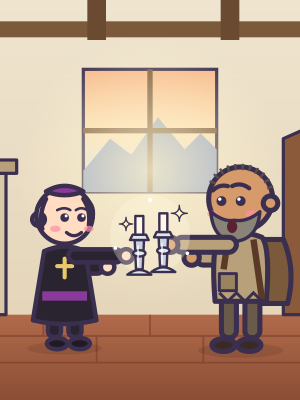
The bishop retrieved the empty basket and handed it back to her, inquiring mildly whether the silver had ever genuinely belonged to them, since he had retained it far too long, and it had always belonged to the poor, and that man was certainly poor. They sat down to breakfast, and Madame Magloire grumbled that they would be reduced to eating with wooden spoons. As they finished, there was a knock at the door, and three police officers appeared, gripping a fourth man by the collar. It was Jean Valjean, silent and defeated, his knapsack bulging with silver. They had arrested him in the street, and he had insisted that the silver was a present from an elderly priest, so they had escorted him back to expose his lie. The bishop approached them as rapidly as his age permitted. "Ah, there you are!" he exclaimed to Valjean. "I am delighted to see you. But I gave you the candlesticks too, which are silver like the rest. Why didn't you take them?"
Valjean's eyes widened, and he stared at the venerable old man with an expression that no human language could describe. The bewildered officers asked whether the prisoner's story was true. The bishop assured them that it certainly was, and that they might release him, so the officers withdrew. Then the bishop went to the mantelpiece, took down the two silver candlesticks, and placed them in Valjean's trembling hands. Valjean, shaking from head to foot, accepted them mechanically, as though he were dreaming. "Now go in peace," said the bishop, and he added in a low, solemn voice, "Remember your promise. You will use this silver to make yourself an honest man." Valjean, who had no recollection of promising anything, was speechless. The bishop continued with great seriousness, "Jean Valjean, my brother, you no longer belong to evil, but to good. I have purchased your soul from dark thoughts and despair, and I give it to God."
Part Four · Petit Gervais
Valjean hurried out of the town as though he were escaping, and he wandered all day across the countryside, overwhelmed by emotions he could not comprehend, because alongside his anger there was something tender and terrifying that he had not experienced since childhood. Toward sunset, sitting beside a thicket on a deserted plain, he heard a cheerful song, and a little chimney sweep of about ten came along the path, tossing a few coins into the air. One silver coin, worth forty sous, rolled across the grass, and Valjean placed his heavy shoe upon it. The boy politely requested his coin, but Valjean, absorbed in his own turbulent thoughts, did not even glance at him, and when the child pleaded and tugged at his sleeve, he roared at him to go away. The little boy, whose name was Petit Gervais, fled in terror, sobbing, and Valjean sat motionless for a long time, until at last he lifted his foot, and noticed the coin.
It was as though an electric shock had passed through his body, and he leaped to his feet and stared across the empty plain, but the boy had disappeared. He ran in the direction the child had taken, shouting "Petit Gervais! Petit Gervais!" until his voice cracked, and when a priest rode past on horseback, Valjean begged him for information about the boy, and pressed money into his hand for the poor. But the plain was deserted, and darkness was descending. Finally, at a place where three paths intersected, Valjean's legs collapsed beneath him, and he sank onto a large stone, clutching his hair in his hands, and cried out, "What a wretch I am!" Then his heart overflowed, and he began to weep, for the first time in nineteen years. He perceived himself clearly at last, his hatred and his crimes, and beside them, illuminating everything like a lantern in the darkness, the gentle face of the bishop.
What became of Jean Valjean is the remainder of an enormous and celebrated novel, but he became an honest man, precisely as the bishop had asked. Under an assumed name, Monsieur Madeleine, he established a factory that provided employment for hundreds of impoverished people, and the grateful town elected him its mayor. He distributed his fortune as generously as the bishop had, rescued an old man trapped beneath a heavy cart, and adopted an orphan named Cosette, whom he cherished as his own daughter. A relentless police inspector named Javert pursued him for years, determined to drag the former convict back to prison, and when he had the opportunity for revenge, Valjean showed even Javert mercy. Through every hardship and every journey, he carried the bishop's silver candlesticks, and he never sold them. When he was a very old man, they stood beside his bed with their candles burning, and their light fell upon his face as he died peacefully, surrounded by the people he loved.