The Call of the Wild
Part One · Stolen
Buck did not read the newspapers, or he would have understood that trouble was approaching. In the summer of 1897, prospectors had discovered gold in the frozen Klondike, in the remote Canadian north, and thousands of adventurers were stampeding there, every one of them desperate for powerful dogs with heavy coats to haul their sleds across the snow. Buck was exactly that variety of dog. He weighed a hundred and forty pounds, half Saint Bernard and half Scottish shepherd, and he lived like an aristocrat on Judge Miller's sunny estate in the Santa Clara Valley of California. He swam in the reservoirs with the judge's sons, escorted the judge's daughters on their morning expeditions, and dozed in front of the library fireplace on winter evenings. For four years he had governed the entire property, the lawns, the stables and the orchards, and he had never imagined that existence could be different.
Unfortunately, one of the gardener's assistants, a man named Manuel, had accumulated gambling debts that he could not repay. One evening, while the judge was attending a meeting, Manuel guided Buck through the orchard to a little railway station and sold him to a stranger for a handful of money. A rope was knotted around Buck's neck, and when he protested, it was tightened until he could not breathe. For two days and nights he traveled north in a railway carriage without food or water, growing more ferocious with every mile, until his eyes were bloodshot with fury. In Seattle he was released from his crate by a man in a red sweater who carried a club. Buck charged him repeatedly, and repeatedly the club knocked him down, until finally he could not rise. Buck was not broken, but he had learned his first lesson: a man with a club was a master to be obeyed.
He was purchased by two French-Canadian couriers, François and Perrault, who delivered government mail across the frozen wilderness, and they treated him fairly, although they were never gentle. On the beach in Alaska where they landed, Buck learned his second lesson. A friendly Newfoundland named Curly approached a husky in her usual cheerful manner, and the husky slashed at her and leaped away. Instantly, thirty or forty other huskies had formed a silent, attentive circle, and when Curly stumbled, the circle closed over her. By the time the men scattered the dogs with clubs, Curly lay motionless in the trampled snow and never rose again. Buck stared, horrified, as he comprehended the nature of this savage territory. There was no fair play here, he realized; once you were down, you were finished, and he resolved that he would never, under any circumstances, go down.
Part Two · The Law of the North
Buck learned with astonishing rapidity. He learned to pull in the traces of a sled, to halt at "Ho!" and start at "Mush!", and to swing wide on the curves. On his first night he wandered shivering through the camp, searching for a sheltered place to sleep, until he discovered that the other dogs had burrowed underneath the snow and curled into tight balls. He excavated a hole of his own and slept as comfortably as he ever had beside the judge's fireplace. He learned to devour his food quickly before another dog could steal it, and he learned to steal a little himself, so cleverly that he was never detected. His feet, softened by California lawns, became as tough as leather. Something else was happening too. Ancient instincts, forgotten for generations by his domesticated ancestors, were awakening in him, and on silent, frozen nights he pointed his nose at the stars and howled.
The leader of the team was Spitz, an experienced husky, cunning and malicious, who tormented the weaker dogs and despised the newcomer from the south. Buck despised him in return, and he began deliberately to challenge his authority, defending the dogs that Spitz punished, until discipline throughout the team began to crumble. Everyone understood that the rivalry could conclude in only one way. The battle came at last on a moonlit night, after a chase through the snow, while the entire pack sat around them in an expectant circle. Spitz was the more experienced fighter, and he wounded Buck repeatedly without receiving a scratch in return. But Buck possessed imagination, and he fought with his intelligence as well as his teeth, feinting high and diving low, again and again, until Spitz staggered and collapsed. Then the waiting circle closed, as it had closed over Curly, and Buck stood watching, the new master of the team.
The following morning François attempted to install another dog in the lead position, but Buck would not tolerate it, and he refused to accept any other place until the men surrendered. Then they discovered what a treasure they possessed. Buck was a better leader than Spitz had ever been, swift, intelligent and fair, and under his command the team performed so magnificently that they established a record, covering hundreds of miles in a few weeks. At the conclusion of that run, however, new orders arrived, and François threw his arms around Buck and wept as he said goodbye. The team was transferred to other drivers and harnessed to a mail train, hauling enormous loads day after day across the endless white silence, and the dogs grew thin and exhausted. Some nights, lying by the fire, Buck seemed to see another fire, long ago, and a short, hairy man crouching beside it in the darkness of the primitive world.
Part Three · John Thornton
Eventually the exhausted team was sold to three inexperienced travelers from the south, Hal, Charles and Mercedes, who understood absolutely nothing about the north. They loaded their sled with so much baggage that it overturned, they argued constantly about how to pack it, and they fed the dogs double rations at first, until the food was exhausted halfway through the journey and they fed them nothing whatsoever. The dogs began collapsing in their traces, one after another. In early spring, with the river ice already rotten and melting, the travelers staggered into the camp of a gold miner named John Thornton, who warned them not to attempt the crossing. Hal ridiculed the warning and cracked his whip. The other dogs struggled to their feet, but Buck lay where he had fallen, because he had felt the treacherous ice beneath his paws all day and sensed disaster waiting ahead. He refused to move, even when Hal began to beat him.
Something in John Thornton exploded. He sprang at Hal, flung him backward, took out his knife, and severed the traces that held Buck. "If you strike that dog again, I'll kill you," he said quietly, and Hal believed him. The sled lurched away without Buck, and the man and the dog watched it creeping across the river, until suddenly the back of the sled dropped as though into a rut, and the ice collapsed. Dogs and people disappeared, and nothing remained except a yawning hole in the ice. John Thornton looked down at Buck. "You poor devil," he said, and Buck licked his hand. Thornton had frostbitten feet and was waiting in camp for them to recover, and throughout the long spring days he nursed Buck until his ribs filled out, his coat became glossy, and his injuries healed. For the first time in his existence, Buck experienced love, genuine love, passionate and fierce.
Buck adored John Thornton as he had never adored Judge Miller or anybody. He would lie at Thornton's feet for hours, studying his face, and when Thornton seized Buck's head roughly between his hands and rocked it back and forth, muttering affectionate insults, Buck's heart nearly burst with happiness. He would do anything for him, and he proved it. Once, when Thornton was swept into a ferocious stretch of rapids, Buck plunged in after him and battled through the torrent until Thornton could grasp his tail and be dragged ashore. On another occasion, in a saloon in the town of Dawson, a boastful millionaire wagered a thousand dollars that no dog alive could start a sled loaded with a thousand pounds of flour, frozen solidly to the ground, and pull it a hundred yards. Thornton, who had been boasting too, did not possess the money, so his friends lent it to him, though nobody believed Buck could accomplish it.
The entire town crowded into the frozen street to watch. Thornton knelt beside Buck, took his head in his hands, and whispered into his ear, "As you love me, Buck. As you love me." Buck hurled himself against the harness, his muscles knotting beneath his fur like living creatures, his chest dropping low, and his claws scrabbling at the hard-packed snow. The sled trembled, lurched an inch, then another, and then it was moving, faster and faster, while the spectators went wild. When Buck crossed the line, men flung their hats in the air and shook hands with complete strangers, and a wealthy miner offered twelve hundred dollars for the dog immediately. Thornton, with tears streaming down his cheeks, told him to go to blazes. Buck caught Thornton's hand gently in his teeth, and the crowd stepped back respectfully and left them alone together.
Part Four · The Call
With the money Buck had won, Thornton and his partners traveled east into wild, unmapped territory, searching for a legendary lost gold mine. They discovered a valley where gold glittered in the bottoms of their pans, and they settled down to dig, and Buck had nothing to do except explore. He began to wander deeper into the forest each day, and to remain away longer, because something was calling him. It was a sound he heard far in the woods, or perhaps far inside himself, a summons more ancient than any dog. One night he followed it and encountered a lean gray timber wolf, who greeted him and ran beside him through the moonlit forest like a long-lost brother. Buck ran with the wolf for an entire day, wildly happy, until he remembered John Thornton and turned back. Twice more the call came, and twice more his devotion to Thornton pulled him home.
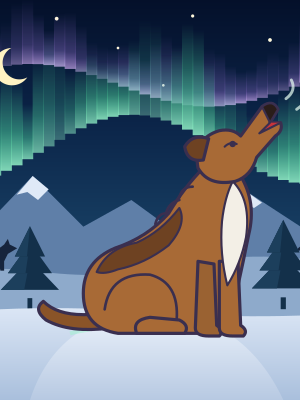
Then came the day when Buck, returning from a long hunt, smelled danger in the atmosphere. The camp was silent, because while he had been away, raiders had attacked it, and John Thornton and his partners were dead. A tremendous fury swept over Buck, a madness he had never experienced, and he hurled himself at the raiders, who fled in terror into the forest, convinced that an evil spirit had descended upon them. Afterward Buck lay beside the empty camp, and an emptiness filled him that no food could satisfy. Yet with the grief came a mysterious freedom, because the last tie that bound him to humanity was broken. That night, beneath the shimmering northern lights, a pack of wolves crossed the clearing, and Buck stood waiting for them, as motionless as a statue. The boldest wolf sprang, and Buck met him, and then the gray brother from the forest stepped forward, and the pack welcomed him.
The years passed, and the people who lived near that valley began to notice changes in the timber wolves, because some had splashes of brown on their heads and a streak of white down their chests. They also told stories about a Ghost Dog that ran at the head of the pack, larger and more cunning than any wolf, a dog that raided their camps and could never be captured. But there was one thing they did not know. Every summer a magnificent wolf with a glorious coat came alone into that hidden valley and stood for a long while beside the stream where the gold had been discovered. He would muse there, remembering, and before departing he would lift his head and howl, long and sorrowfully. Then he would return to his pack, and in the long winter nights you might see him leading them beneath the pale moon, singing a song of the younger world.