The Ice Station: the full story
Part One
Ana pressed her forehead to the cold glass. She had been dreaming of Antarctica for months, but nothing prepared her for the first view from the window of the plane. The continent was a huge white sheet of ice, with mountains poking through it like dark teeth, and it stretched all the way to the horizon. Her father, who studied ice for a living, leaned over her shoulder. "Welcome to a very quiet place," he said with a grin. "Wait until you feel how cold it is."
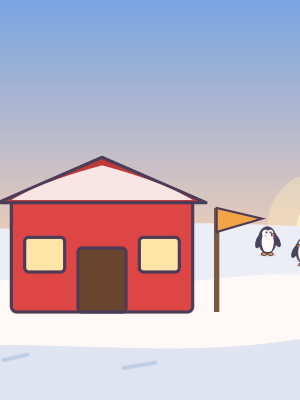
The research station was a cluster of red buildings, built on the ice and linked by flagged paths. Scientists and other people live and work at research stations in Antarctica, and this one held about forty of them. Ana's room was a small bunk with a window the size of a cereal box, and she decided at once that she liked it. In the dining hall, a map of the continent hung on the wall, and under it a notice read: Antarctica is set aside for peaceful science.
The cold was unlike anything Ana had known. Antarctica is extremely cold and dry, and the air stung her nostrils on the first morning. Her father showed her how to layer her clothes: a thin layer next to the skin, a thick layer in the middle and a windproof jacket on the outside. "Dress like an onion," he said. Ana laughed, and her breath came out in a white cloud that froze into tiny crystals on her scarf. It was the strangest and most wonderful thing she had ever felt.
Her father's job was to measure how a glacier moves. A glacier is a slow-moving river of ice, and he wanted to know exactly how slowly. Each morning they rode a snowmobile out to a line of bright orange stakes beside a fixed marker on bare rock, and Ana read the numbers from a ruler while her father recorded them in a battered notebook. "Ice does not look like it moves," he said. "Come back in a week, and you will see." Ana, who liked a puzzle, decided right then that she would.
On the fourth day they followed a flagged path with a guide to a spot far back from the edge of the sea ice, where a group of emperor penguins stood in a loose crowd. Emperor penguins are birds that cannot fly, and they live in Antarctica. Ana stayed still, and her father whispered that penguins huddle together to keep warm, and that scientists always keep their distance. One waddled a little closer, looked her over, and then walked away as if she were not worth the trouble. Ana covered her mouth to hold in her laughter, and the penguin's friends turned to look, as if they had heard the joke.
By the second week, Ana knew the stakes as well as she knew her own street. When she compared the numbers from Saturday with the numbers from her first day, she found that the glacier had crept forward. The number had grown by a few centimeters, and that small change was enough. "It is moving," she said. "It is moving, and I measured it." Her father wrote the date next to her number in the notebook and, in tiny letters, her name.
At the end of the summer, the plane lifted off again, and Ana looked back at the red station on the white plain. She thought about the penguins, about the scientists who came from all over the world to work together in a place with no native people, and about the stakes in the ice. "What did you learn?" her father asked. "That the biggest things move slowly," she said. "And that you only find out if you measure." He put an arm around her shoulders.