The Odyssey
Part One · The Long Way Home
"Tell me, Muse, about the man of many turns," begins the oldest adventure story in Europe, and the man is Odysseus, king of the rocky island of Ithaca, the most ingenious of all the Greek commanders. For ten years he had battled in the war against Troy, and it was Odysseus who eventually concluded it, by inventing the hollow wooden horse that smuggled Greek soldiers inside the city walls. Then he set sail for home with twelve ships, anticipating a voyage of a few weeks; instead, it occupied another ten years. Meanwhile, in his palace on Ithaca, his wife Penelope waited, and his son Telemachus, a baby when his father departed, matured into a young man. More than a hundred arrogant noblemen had moved into the palace, devouring the king's cattle and consuming his wine, and every one of them insisted that Odysseus was dead and that Penelope must marry one of them.
Penelope was nearly as clever as her husband. She announced that she would select a new husband immediately after she completed weaving a burial shroud for her elderly father-in-law, and every day she labored at her enormous loom, while every night, by torchlight, she secretly unraveled what she had woven. For three years the suitors suspected nothing, until a disloyal servant betrayed her. Meanwhile, the gods on Mount Olympus were debating Odysseus's destiny. The sea god Poseidon detested him and had kept him wandering for years, but the goddess Athena, who valued intelligence above everything, adored him. While Poseidon was away visiting a distant land, Athena persuaded Zeus, the king of the gods, that the wanderer had suffered sufficiently, and then she hurried down to Ithaca, disguised as a traveler, and encouraged Telemachus to travel in search of information about his father.
What had happened to Odysseus? The answer was a voyage so celebrated that we still describe any long, adventurous journey as an odyssey. Soon after leaving Troy, his ships reached the land of the Lotus-Eaters, whose delicious flowers caused anyone who tasted them to forget their families forever, and Odysseus had to drag his dreamy companions back to the ships and tie them to the benches. Then came the island of the Cyclopes, one-eyed giants who herded sheep, and the most ferocious of them, Polyphemus, trapped Odysseus and twelve of his men in his cave and began devouring them. Odysseus escaped by a famous deception, informing the giant his name was Nobody and blinding his single eye. But as he sailed away, he could not resist announcing his real name, and Polyphemus prayed to his father, Poseidon, for revenge, so that from that moment the ocean itself was Odysseus's enemy.
Part Two · Winds, Witches and Ghosts
Next they came to the floating island of Aeolus, the keeper of the winds, who entertained them generously for a month, and when they departed, Aeolus presented Odysseus with an extraordinary present: a leather bag, tied with a silver cord, containing every wind in the world except the gentle west wind that would carry them home. For nine days and nights they sailed, and Odysseus, refusing to permit anyone else to manage the sail, never slept. On the tenth day, the coast of Ithaca appeared, so close that they could see shepherds tending fires on the hills, and the exhausted king finally closed his eyes. His crew, convinced that the bag was crammed with gold and silver he was concealing from them, untied the cord, and out exploded every hurricane simultaneously, and the ships were blown all the way back to Aeolus, who now refused to assist them, declaring that the gods obviously despised Odysseus.
Worse catastrophes followed: on one island, cannibal giants hurled boulders down on the harbor and destroyed eleven of the twelve ships, so that only Odysseus's own vessel survived. On the next island, Aeaea, the crew discovered a marble palace in a forest clearing, surrounded by wolves and lions that wagged their tails like affectionate dogs. Inside lived Circe, a beautiful enchantress, who welcomed the sailors hospitably, served them cheese and honey and wine, and then touched them with her wand, and they were transformed into pigs, grunting and bristly, although their minds remained human. When Odysseus hurried to rescue them, the god Hermes intercepted him on the path and provided a magical herb called moly to protect him from her spells, so that Circe's wand had no effect whatsoever. Astonished, she released his men, restored their original shapes, and became his ally, and the travelers remained with her for an entire year.
When at last Odysseus requested permission to leave, Circe informed him that he must first visit the underworld, the shadowy kingdom of the dead, to consult the ghost of a blind prophet named Tiresias, so Odysseus sailed to the edge of the world, where the sun never shines, and the pale ghosts came drifting toward him. Tiresias predicted that he would eventually reach home, but alone, after losing all his companions, and only if his crew never injured the cattle of the sun god, Helios. Then, among the shades, Odysseus recognized his own mother, who had died of sorrow while waiting for him. Three times he tried to embrace her, and three times she slipped through his arms like a shadow or a dream. He returned to the land of the living with a heavy heart, and Circe, before he departed, described every danger that awaited him on the voyage ahead.
Part Three · The Sirens and the Sun
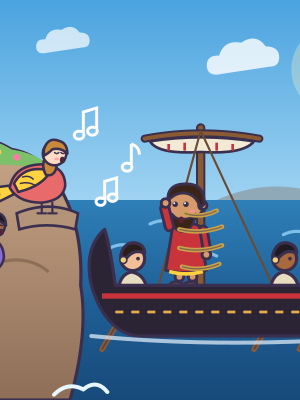
The first danger was the Sirens, creatures who sat in a meadow beside the sea, surrounded by the bones of sailors, singing songs so irresistibly beautiful that anyone who heard them steered straight onto the rocks. Odysseus softened beeswax in the sun and plugged his crew's ears with it, but he was curious, as always, and he wanted to hear the song himself. So he ordered his men to tie him tightly to the mast, and to tie him tighter still if he begged to be released. As the ship glided past, the Sirens called to him by name, promising to tell him everything that had ever happened in the world, and Odysseus wept and struggled and pleaded with his crew to cut him loose. But his men only rowed harder and pulled the ropes tighter, until the singing faded behind them, and Odysseus was perhaps the only man who ever heard the Sirens and survived.
Next the ship had to pass through a narrow strait between two monsters. On one side lurked Charybdis, a whirlpool that swallowed the sea three times a day and could suck down an entire ship. On the other side, in a cave high on a cliff, lived Scylla, who had six long necks, each ending in a terrible head with three rows of teeth. Circe had advised him to steer closer to Scylla, because losing six men was better than losing everyone. As they passed, the crew stared in horror at the whirlpool, and suddenly Scylla's six heads darted down from the cliff and snatched six sailors from the deck. Odysseus called it the most pitiful sight he had ever witnessed. Then they reached the island of Helios, where the sun god's sacred cattle grazed, and Odysseus remembered the prophecy and begged his men not to land.
His exhausted crew insisted, promising never to touch the cattle, and Odysseus reluctantly agreed. Then the wind died, and for a month they were trapped on the island, until their food ran out. One day, while Odysseus was praying in the hills, his starving men slaughtered the finest of the sun god's cattle and roasted them. Helios was outraged, and he threatened to go down into the underworld and shine among the dead unless he was avenged. When the ship finally sailed, Zeus struck it with a thunderbolt, and it shattered into pieces. Every man was drowned except Odysseus, who lashed the mast and keel together and clung to them, drifting for nine days across the sea. On the tenth night he washed ashore on a lonely island, the home of a beautiful sea nymph named Calypso, and there his adventures seemed to come to an end.
Part Four · The Bow of Odysseus
Calypso fell in love with Odysseus and offered to make him immortal, ageless and deathless forever, if he would remain with her. For seven years she kept him on her island of forests and caves and vines, and every day Odysseus sat on the shore, staring across the sea toward Ithaca and weeping with homesickness. At last, at Athena's request, Zeus sent Hermes to order Calypso to let him go. She gave him tools to build a raft, and he set off alone. But Poseidon, returning from his travels, spotted him and smashed the raft with an enormous storm. Odysseus swam for two days until he crawled ashore, naked and half dead, on the island of the Phaeacians. There a young princess named Nausicaa found him and brought him to her father's palace, where he finally told the whole story of his wanderings. Afterward the astonished Phaeacians carried him home in one of their magical ships.
The Phaeacians set him down on the shore of Ithaca while he was still asleep. When he awoke, he did not even recognize his own island, until Athena appeared and explained everything. The palace was overrun by suitors who would kill him the moment they learned of his return, she warned, so he must be patient and cunning. She transformed him into a wrinkled old beggar in filthy rags, and he met his son Telemachus, newly home from his own journey, in a swineherd's hut. When Odysseus revealed himself, father and son embraced and wept like birds whose nestlings have been stolen. Then together they planned their revenge. The next day, the beggar limped into the courtyard of his own palace, where his old hunting dog, Argos, lay neglected on a dung heap. Argos recognized his master after twenty years, wagged his tail feebly, and died.
In the palace hall the suitors mocked the beggar and threw a footstool at him, and Odysseus endured it without a word. That night, his elderly nurse, Eurycleia, washed his feet, and she recognized an old scar on his leg from a boar hunt in his boyhood, but he silenced her before she could cry out. Penelope, who did not recognize him, confided to the stranger that she could delay no longer. The next day she would set the suitors a contest: whoever could string the great bow of Odysseus and shoot an arrow through the rings of twelve axe heads in a row would become her husband. The following morning, one after another, the suitors struggled to bend the mighty bow, and not one of them could even string it. Then the old beggar asked if he might try, and the suitors jeered at his impudence.
Odysseus lifted the bow and turned it over in his hands, examining it lovingly, as a musician examines a harp. Then, without effort, he strung it and plucked the string, which sang like a swallow, and he sent an arrow flying cleanly through all twelve axe heads. Thunder rumbled from a clear sky. Odysseus threw off his rags and leaped onto the threshold, and the suitors realized, too late, who he was. With Telemachus and two loyal servants beside him, he fought them in the hall until not one of the suitors was left alive. Yet even now Penelope hesitated, because she feared a trick of the gods. So she tested him, ordering a servant to move their bed outside. Odysseus exploded: nobody could move that bed, because he had built it himself around the trunk of a living olive tree. Then Penelope knew him at last, and ran into his arms.