The Pied Piper of Hamelin
Part One · A Town Full of Rats
Hamelin was a pleasant old town in Germany, built of timber and stone beside the deep, wide river Weser. It had a cobbled market square with a splashing fountain, a church with a magnificent spire, and narrow streets where the tall houses leaned together as if they were whispering secrets. The townspeople were comfortable and prosperous, and they were exceedingly proud of their town. But in the summer of 1284, Hamelin had a terrible problem, a problem that no amount of money or pride could solve. The town was completely overrun with rats, more rats than anybody could possibly have imagined, and every week there seemed to be twice as many.
Nobody knew where they had come from. There were brown rats and black rats, enormous rats and scrawny rats, rats with long pink tails and rats with whiskers like broom bristles. They fought the dogs and chased the cats, and they were afraid of absolutely nothing. They gnawed holes in the flour sacks, devoured the cheeses in the cellars, licked the soup from the cooks' ladles, and built untidy nests inside the gentlemen's Sunday hats. At night they squeaked and squealed so loudly that nobody in Hamelin could hear themselves think, let alone enjoy a decent night's sleep, and the babies cried in their cradles until morning.
At last, the furious townspeople marched to the town hall, where the mayor and the council sat around a long table in their fine fur-trimmed robes. "What are you doing about these vermin?" they shouted. "We pay you to look after the town, and you sit here feasting while the rats eat everything else! Get rid of them, or we will get rid of you!" The mayor, a large, important man with a heavy gold chain around his neck, began to perspire. He had absolutely no idea what to do, and neither did anyone else on the council, although they had been discussing the problem, at considerable expense, for months.
Part Two · The Stranger in the Coat
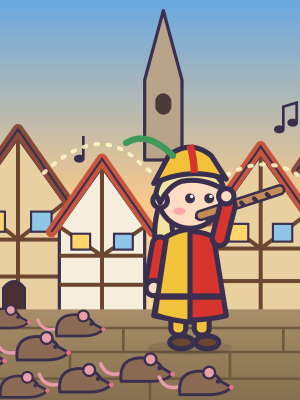
At that very moment there came a gentle tap at the door of the council chamber. "Come in," said the mayor nervously, and in walked the strangest figure anyone in Hamelin had ever seen. He was tall and thin, with piercing blue eyes and long, pale hair, and he wore an extraordinary coat that was half brilliant yellow and half brilliant red, which is what people in those days called pied. Around his neck hung a slender wooden pipe on a ribbon, and his long fingers kept twitching toward it, as if they were impatient to play. Nobody had ever seen him before, and nobody knew where he had come from.
"I am a piper," the stranger announced, bowing low, "and with my music I can charm any creature that crawls, swims, flies or runs, and lead it wherever I wish. I have rescued other towns from swarms of gnats and from flocks of vampire bats. If you will pay me one thousand guilders, I will free Hamelin from every single rat before tonight." The mayor and the council exchanged glances, and their eyes gleamed with relief. "A thousand?" exclaimed the mayor. "We would gladly pay you fifty thousand if you could do it!" The piper only smiled. "A thousand is the bargain," he said.
He stepped out into the street, raised the pipe to his lips, and began to play. It was a thin, sweet, mysterious melody, and before he had played three notes, a rumbling sound began, like distant thunder approaching. Out of every cellar and attic, every drain and cupboard and crevice, came the rats. They came tumbling and scrambling, gigantic rats and tiny rats, grandfathers and grandmothers, aunts and uncles and cousins, with their tails waving and their whiskers twitching, and every one of them followed the piper obediently down the street, as quietly and politely as children following a teacher.
Part Three · Into the River
Through the crooked streets of Hamelin the piper walked slowly, still playing, and behind him flowed a river of rats, thousands upon thousands of them, wider than the street itself. The astonished townspeople leaned out of their windows and stared with their mouths hanging open. The piper led the rats straight down to the bank of the Weser and stepped into the shallow water, and the rats, still enchanted by the music, plunged in after him and swam. They swam across to the opposite bank, scrambled up into the forest, and followed the fading melody far, far away, never to return.
When the last tail had disappeared among the trees, the piper waded back across the river and strolled into the market square. Behind him, the bells of every church in Hamelin were ringing, and the delighted townspeople were laughing and hugging and poking long sticks into every hole and corner, to make certain that not a single rat remained anywhere in the town. Not one did. Even the cats came out of hiding and stretched in the sunshine. The piper bowed courteously to the mayor. "And now," he said politely, holding out his hand, "my thousand guilders, if you please, exactly as we agreed in the council chamber this morning."
The mayor glanced at the council, and the council glanced at the mayor. A thousand guilders was a tremendous amount of money, and the rats were already gone, and surely they could never come back. "A thousand guilders?" said the mayor, with a scornful laugh. "Come now, my friend, that was only a joke. All you did was blow a little tune. Here are fifty guilders, which is more than generous for an afternoon's entertainment." The piper's blue eyes turned cold. "Keep your promise," he said quietly, "or I will play a different tune." The mayor only laughed louder and slammed the door in his face.
Part Four · The Other Tune
The piper walked back into the middle of the street and lifted his pipe to his lips once more. This time he played a melody so soft and so joyful that not one grown-up in Hamelin even noticed it, but every child heard it. In every house, they put down their spoons and their schoolbooks. They came pattering and clattering out of the doorways, boys and girls, with rosy cheeks and flying curls, clapping and skipping and laughing, and they all followed the piper down the street in a long, happy procession, the littlest ones running to keep up with the biggest.
The mayor and the council stood motionless on the steps of the town hall, as if they had been turned to stone, while the children danced past them. The piper did not lead them toward the river. Instead, he led them out through the town gate and across the meadows, toward a great green hill called the Koppelberg. "He can never take them over that," whispered the frantic parents, running after them. But when the piper reached the foot of the hill, a mysterious door swung open in its side. The piper walked in, every child followed him, laughing, and then the door closed, and the hillside was as smooth as before.
Only one child remained outside. His name was Hans, and he walked with a crutch, so he had not been able to keep up with the others. He stood in front of the hill with tears on his cheeks, and when the parents reached him, he described what he had heard in the music. "It promised a wonderful country, just on the other side of the hill," he said, "where the flowers are brighter and the sparrows more colorful than ours, and nobody is ever ill or lonely, and where I could have run as fast as anyone. Just as I reached the door, it shut, and now I am the only one left behind."
Part Five · Keeping the Promise
That night, Hamelin was the quietest town in all of Germany. No footsteps pattered on the stairs, nobody laughed in the streets, and no small hands needed tucking into bed. The parents sat in their silent kitchens and wept. Then little Hans spoke up thoughtfully. "The piper told the mayor exactly what would happen," he said. "He told him to keep his promise. Perhaps, if we keep it now, the piper will keep his." For the first time all day, the grown-ups looked at one another with hope instead of despair, and they began, for the first time, to think about what they had done.
So every family in Hamelin brought whatever money it possessed to the market square, and the council emptied the treasure chest of the town hall. The mayor, red-faced and thoroughly ashamed, took off his own gold chain and added it to the glittering pile. By morning there were not one thousand guilders, but two. Hans carried the heavy bag across the meadow and up to the Koppelberg, with the entire town following behind him, and he set it on the grass in front of the hill. "We are sorry," he called. "Here is everything we promised, and more besides."
For a long moment, there was nothing but birdsong. Then, from somewhere deep inside the hill, came the thin, sweet sound of a pipe. The door opened, and out danced the children of Hamelin, every single one of them, blinking in the sunlight and chattering excitedly about the marvelous things they had seen. The piper came last of all. He picked up the bag, tipped his hat to Hans, and walked away down the road, still playing, until his red and yellow coat was only a speck in the distance, and the music faded away into the summer sky. Nobody in Hamelin ever saw him again.
The people of Hamelin never forgot that day. They carved the story on the wall of a house, they painted it in a stained glass window of their church, and you can still find the Pied Piper there today. Every summer, the children of the town perform a play about the rats and the piper, while the grown-ups watch with their arms around them. And whenever anyone in Hamelin is tempted to break a promise, somebody is sure to repeat the words the piper said, the words that brought the children home: "Keep your promise." Some say the piper still wanders the roads of Europe in his red and yellow coat, looking for another town that needs him.