The Race of Atalanta: the full story
Part One · The Girl in the Woods
The Greeks told of the fastest girl who ever lived. Her name was Atalanta, and her life began on a cold hillside. Her father, a king, had wanted a son. He left the baby there. But the hillside was not empty.
A she-bear came walking out of the pines. She nosed the bundle, and the baby smiled up at her. The bear took the child home to her den, and all winter long the little girl slept snug against warm fur beside the cubs.
When spring came, hunters found the strange family. They took the girl to their camp and called her Atalanta. By ten, she could follow a fox's tracks over stone. She could send an arrow through a hoop. But what she did best was run.
She ran like a hare, low and quick, with her braid flying behind. Birds could not keep up with her. Shepherds on faraway hills saw a flash between the trees and wondered if it was a deer, or only a puff of breeze.
Then a huge wild boar began to wreck the farms of Calydon. Heroes came from every corner of Greece to hunt it. Atalanta came too, carrying her bow. A few of the men made fun of a girl hunter. But when the boar charged out of a thicket, the first arrow to find it was hers.
Part Two · The Rule
After that, everyone knew her name. Her father heard of her, and he was sorry he had sent her away. He asked her to come to his palace, and she did. But she missed the woods, and visitors kept begging her to settle down in their towns.
So she made up a rule to end all the asking. "Anyone may race me," she said. "Win, and you will have a friend for life. Lose, and you must go home and let me run in peace." The news spread through every town in Greece.
Racers came from far and wide. Some were tall, some were strong, and some were proud, in shiny sandals. Atalanta beat every one of them, and she hardly seemed to try. Her feet barely touched the dust. The losers walked off grumbling, and the next in line took his place.
One day a boy named Hippomenes sat in the crowd to watch. He thought the racers were silly. But as soon as he saw Atalanta run, he changed his mind. "That is the most wonderful thing I have ever seen," he said. "I must race her myself."
Atalanta looked at him and shook her head with a smile. "You are brave," she said, "but you will lose." Hippomenes would not give up. Late that night, he went up a hill alone and asked a goddess named Aphrodite to help him. He knew he could never win by running alone.
Part Three · The Apples
In Cyprus, an island far across the sea, Aphrodite kept a tree that bore apples of pure gold. She picked three and slipped them into his hand. "Carry these in your robe," she said softly. "When Atalanta pulls ahead, roll one in front of her."
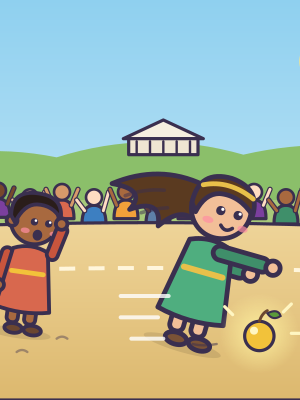
Morning came, and a great crowd gathered along the track. A horn blew, and off they went. Hippomenes held on for a little way, but soon his breath came in gasps, and Atalanta drew away. Then he took out the first golden apple.
He rolled it ahead of her, and it spun and sparkled across the track. Atalanta had never seen a thing so bright. She veered off to get it, and Hippomenes ran by. But she was quick, and she soon drew level again, so he sent the second apple bouncing off to the side.
Again she chased it, and again he pulled ahead. Now the end of the track was near, and he had just one apple left. He flung it as far as he could. Atalanta watched it fly. If she went to fetch it, she would surely lose the race.
She went to fetch it anyway. Perhaps she wanted the shiny thing, or perhaps she liked the boy who had tried so hard. Whatever the reason, Hippomenes dashed over the line, and the crowd cheered. Atalanta came up laughing, with three golden apples in her arms.
"You have run a fine race," she told him. They became good friends, and she went on running and hunting for the rest of her life. Listeners have argued ever since about why she turned aside. Was it greed, or was it kindness? The old storytellers never said.
 The Race Too Close to Call
 Arachne and the Goddess
 Flying Too High
 Guests at the Cottage