The Rusty Red Dot: the full story
Part One · The red dot
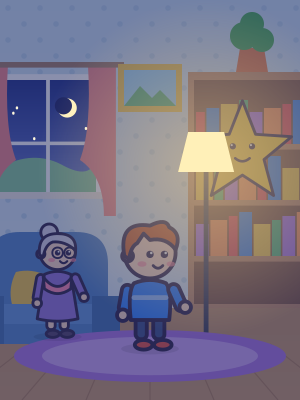
Oskar and Grandma sat on the back steps after dark. Grandma pointed up at the sky. "Look, there is a little red dot," she whispered. Oskar squinted. The dot was small and bright, and a little bit orange, like a spark that had stopped still. "That is Mars," said Grandma. "Why is it red?" asked Oskar.
Grandma pulled the old wagon out of the shed. It had sat out in the yard in the rain for years before she put it away, and its sides were covered in orange flakes. "This is rust," she said. "Iron turns this color when it rusts. The rocks and dirt on Mars have iron in them, and the iron has rusted too."
Oskar rubbed a flake between his fingers, and it left an orange smudge. "So Mars is covered in rust?" he asked. "Its dust is," said Grandma. "Up close, the ground is brown and gold and tan. But the wind lifts the rusty dust into the air. From far away, that dust makes the whole planet look red."
Part Two · Dust
"Long, long ago, people saw that red dot too," said Grandma. "In Egypt they called it the red one." Oskar liked that name, because it was a good, plain name for a planet. He looked up and tried to see the dust, but the dot was much too far away. All he could see was the red.
"Does the wind blow hard on Mars?" asked Oskar. "Sometimes," said Grandma. "There are spinning dust devils that look like small tornadoes. And there are dust storms so big that they cover much of the planet. After a big storm, the dust can take months to settle down."
Part Three · Sky and cold
"What color is the sky there?" asked Oskar. "In the daytime it looks hazy and red, from all that dust," said Grandma. "But a rover took pictures of a sunset on Mars. The sunset was blue!" Oskar laughed, because at home the sunsets were orange and pink. On the red planet, they turned blue.
"Could I go outside on Mars in my jacket?" asked Oskar. "Not even in your snow suit," said Grandma. "Mars is a cold desert. Most of the time it is way below freezing. Even warm days play a trick. If you stood on the ground near the middle of Mars at noon, your feet might feel like spring. Your head would feel like winter."
Part Four · Big places
Oskar stood up on the top step. "What is the tallest thing on Mars?" he asked. "A volcano called Olympus Mons," said Grandma. "It is the biggest volcano anywhere around our Sun. You could stack the tallest mountain on Earth two times, and Olympus Mons would still be taller."
"Mars has a giant canyon, too," said Grandma. "A canyon is a deep, long crack in the ground. This one is so long that it could stretch all the way from California to New York." Oskar tried very hard to picture a crack that long, but he could not do it.
Part Five · Light and thin
Oskar jumped off the step and landed with a thump. "Mars has less stuff in it than Earth, so it pulls on you less," said Grandma. "If you weighed one hundred pounds here, you would weigh only thirty-eight pounds there." Oskar jumped again and pictured himself landing on red dust.
"Who lives on Mars?" asked Oskar. "Nobody," said Grandma. "Mars is the only planet we know of where only robots live. The air there is very thin, and people cannot breathe it. Rovers drive across the rocks and sand. They take pictures and measurements and send them home to Earth."
Part Six · Long ago
"Was Mars always dry and dusty?" asked Oskar. "No," said Grandma. "Long ago it had rivers and lakes. Now its water is mostly ice, hiding under the ground near the top and bottom of the planet. Scientists are looking for signs of very tiny living things from long ago, when Mars was wet."
Grandma put the wagon back in the shed. Oskar looked up one more time. The little red dot was still there, small and steady above the fence. It was rusty, dusty, and cold. And somewhere on it, a robot was rolling across the red ground. If you could visit Mars, what would you want to see first?