The Secret Garden
Part One · The Locked Garden
When Mary Lennox arrived in England, everybody agreed that she was the most disagreeable-looking child they had ever encountered, and they were probably correct. She had a thin little face, a thin little body, and an expression that was permanently sour. Mary had been born in India, where her father worked for the British government and her beautiful mother attended glittering parties every evening, and neither of them had particularly wanted to be bothered with a daughter. Servants had delivered whatever Mary demanded, so she had never learned to say please. Then a terrible fever swept through the household, and within a few days both of her parents had died. Mary was dispatched on a ship to live with an uncle she had never met.
Her uncle, Mr. Archibald Craven, lived at Misselthwaite Manor, an enormous old house on the edge of the Yorkshire moor, with nearly a hundred rooms, most of them locked, and gloomy portraits glaring down from the walls of its long corridors. Mrs. Medlock, the stern housekeeper, explained that Mr. Craven had a crooked back and a broken heart, that he traveled for most of the year, and that he refused to see anyone. Mary was expected to remain in her own two rooms and certainly not to go poking about. On her first night, the wind howled around the house like a lost animal, and somewhere far away, down one of the endless corridors, Mary was almost certain she could hear somebody crying.
In the morning, a cheerful young housemaid named Martha arrived to light the fire, and she was astonished to discover that Mary expected to be dressed like a baby. "Can't tha' put on tha' own stockings?" she inquired, in the broad Yorkshire manner of speaking. Martha chattered about her eleven brothers and sisters in their tiny cottage on the moor, and especially about her brother Dickon, who could apparently charm wild ponies, foxes and birds. Then she mentioned something that made Mary sit up with sudden interest. Somewhere on the grounds was a garden that had been locked for ten years. It had belonged to Mr. Craven's wife, and after she died in an accident there, he had locked the door and buried the key.
With nothing else to occupy her, Mary wandered outside into the bitter wind. She discovered kitchen gardens and orchards enclosed by high stone walls, and an elderly gardener called Ben Weatherstaff, who was very nearly as grumpy as she was. Then a robin with a brilliant red breast landed on a bush beside her and burst into song. Ben whistled softly, and the robin hopped closer, cocking its head with obvious curiosity. "He's taken a fancy to thee," Ben muttered. Mary noticed something peculiar, because the robin had flown in from beyond a long wall covered with ivy, enclosing a garden that seemed to have no entrance whatsoever. For the first time in her life, Mary felt lonely, and she desperately wanted the robin to like her.
Every day Mary skipped and raced along the paths in the brisk wind blowing off the moor, and every day she grew a little stronger and considerably hungrier, until her sallow cheeks began to turn pink. One morning she found the robin hopping about on a pile of freshly turned earth, where a dog had been digging after a mole. Something was half buried in the soil, an old ring of rusty brass, and when Mary picked it up and brushed it off, she realized that it was a key. It looked as though it had been underground for a very long time. "Perhaps it has been buried for ten years," she whispered. "Perhaps it is the key to the garden." She slipped it into her pocket and carried it everywhere.
Part Two · The Key and the Door
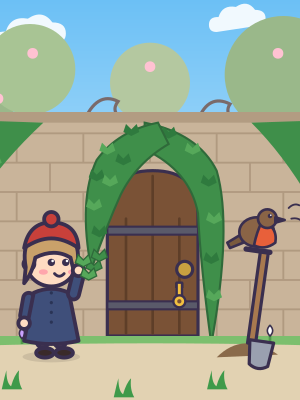
The following day, the robin sang from the top of the ivy wall as though he were deliberately showing her the way. Suddenly a gust of wind swung aside a loose curtain of ivy, and underneath it Mary glimpsed a round knob, which was the handle of a door. Her heart began to thump. She took the key out of her pocket and discovered that it fitted the keyhole perfectly. It required both hands to turn it, but it turned. Then she took a long breath, glanced behind her to be certain that nobody was watching, and pushed. Slowly, slowly, the door swung open. Mary slipped through, closed it behind her, and stood with her back against it, breathing quickly and staring around in amazement.
She was standing inside the secret garden, and it was the strangest and most mysterious place she had ever imagined. The high walls were covered with the leafless stems of climbing roses, so thick that they had tangled together, and they dangled from the trees in swaying gray curtains. Everything appeared to be dead. But when Mary knelt down, she discovered tiny, pale green points pushing up through the brown grass. "It isn't entirely dead," she said softly. She found a sharp stick and dug and weeded carefully around the little green points until they had room to breathe, and she was so completely absorbed in her work that she forgot all about her dinner.
Soon afterward, Mary finally met Dickon, a funny-looking boy of twelve with round blue eyes and a turned-up nose, sitting beneath a tree and playing a wooden pipe, while a squirrel and a rabbit sat listening to him. Mary studied him for a long time before she asked whether he could keep a secret. When she showed him the garden, Dickon gazed around in wonder. "Eh! It is a queer, pretty place!" He bent the gray stems of the roses and scratched them with his knife, and underneath, the wood was green and moist. "Wick," he announced happily, which in Yorkshire meant alive. Most of the roses had only been sleeping, waiting patiently for somebody to remember them.
From then on, Mary and Dickon worked in the garden almost every day. Dickon demonstrated how to cut away the dead wood, loosen the hard earth, and plant the seeds he had brought, while the robin built a nest in a corner and supervised them with an air of great importance. As the weeks passed, the garden gradually awoke. Snowdrops and crocuses appeared, followed by daffodils, and the rose stems turned green and swelled with buds. Mary's thin face filled out and her eyes grew bright, and she discovered, to her considerable surprise, that she rather liked people after all. She had never imagined that it was possible to be so busy and so happy at the same time.
Part Three · Colin
One stormy night, Mary heard the crying again, and this time she was determined to follow it. Holding a candle, she crept along the dark corridors until she found a door with light shining beneath it. Inside, in an enormous carved bed, lay a thin boy with an ivory-white face and huge gray eyes. "Are you a ghost?" he whispered. "No," replied Mary. "Are you?" He was her cousin, Colin Craven, Mr. Craven's only son. Everyone in the house believed that Colin would develop a crooked back like his father's and die young, so he had remained in bed his entire life. His father could scarcely bear to look at him, because Colin's eyes reminded him painfully of his wife.
Mary visited Colin secretly every day, describing the moor, and Dickon, and finally the garden. Colin was accustomed to giving orders, and he threw terrible tantrums whenever he did not get his way. One night he screamed so long and so violently that the entire house trembled with it, and Mary stormed into his room. "Stop it!" she shouted. "I hate you! Everybody hates you!" Colin was so astonished that he actually stopped, and he sobbed that he could feel a lump growing on his back. "Show me," said Mary, and she examined his back carefully. "There's not a single lump there," she declared, "except your backbone." After that, Colin stopped believing that he was going to die.
A few days later, Dickon pushed Colin's wheelchair through the garden door, while Mary walked beside it, keeping watch. Colin gazed at the blossoming trees, the new green leaves and the birds flying back and forth with twigs for their nests, and tears ran down his cheeks. "I shall get well!" he cried. "And I shall live forever and ever!" Then old Ben Weatherstaff's face appeared over the top of the wall, glaring at them furiously, because he had heard that the master's son had weak legs and could never stand. Colin's face turned scarlet with indignation. With Dickon steadying his arm, he pushed himself up out of the chair and stood on his own two feet.
Part Four · The Magic
"Look at me!" Colin shouted at the astonished gardener. Ben's mouth dropped open and tears trickled down his weathered face, and then he climbed down and joined their conspiracy. After that, Colin practiced walking a little farther every day. He was convinced that there was Magic in the garden that made everything grow, including himself, and perhaps he was right. He devoured enormous breakfasts, laughed at Dickon's fox cub and crow, and grew rosy and strong and astonishingly noisy. The three children solemnly agreed to keep everything secret until his father returned, so that Mr. Craven could witness the transformation with his own eyes.
Far away in Austria, Mr. Craven sat beside a lake, more miserable than ever. One night he dreamed that his wife was calling to him: "Archie! I am here in the garden!" The next morning a letter arrived from Dickon's mother. "Please, sir," she had written, "I would come home if I was you." So he hurried back to Misselthwaite and went straight to the garden, and as he stood at the door, he heard laughter on the other side, and running feet. The door burst open, and a tall, handsome boy ran directly into his arms. It was Colin. "Father," he announced breathlessly, "I'm well. I can beat Mary in a race!"
Mr. Craven could hardly believe it. Colin and Mary led him inside the garden and showed him everything, the roses and the robin's nest and the bulbs they had planted, while they told him the whole story in a tumbling rush. He laughed until there were tears in his eyes, as if something frozen inside him had finally begun to melt. Then they all walked back across the lawn toward the house together, while the servants rushed to the windows. Across the grass came the master of Misselthwaite, looking happier than any of them had ever seen him, and beside him, with his head held high and his feet as steady as any boy's in Yorkshire, walked Colin.