The Tempest
Part One · The Storm
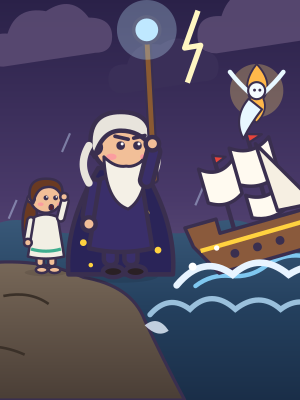
The play begins in the middle of a tremendous storm. A royal ship, returning to Italy from a wedding in Tunis, is being hurled toward the rocks of a mysterious island, while lightning splits the sky and the terrified sailors scream that they are sinking. On board are Alonso, the King of Naples, his son Ferdinand, the king's treacherous brother, an honorable elderly counselor named Gonzalo, and Antonio, who calls himself the Duke of Milan. From the shore, a young woman named Miranda observes the shipwreck in anguish, because she can almost hear the passengers' desperate cries, and she suspects that her father has conjured the storm by magic. She implores him to calm the waves. Her father, Prospero, a dignified elderly magician in a long cloak embroidered with stars, assures her gently that nobody has been harmed. Then he lays aside his magic cloak and reveals to her, for the first time, the astonishing history of who they really are.
Twelve years earlier, Prospero explained, he himself had been the Duke of Milan, one of the most powerful rulers in Italy. But he had been more devoted to his books and his secret studies than to governing, so he had delegated the daily business of the dukedom to his younger brother, Antonio, whom he trusted completely. Antonio, discovering how pleasant it was to possess authority, determined to keep it permanently. He negotiated a secret alliance with Alonso, the King of Naples, who was Prospero's enemy, and one midnight a treacherous army opened the gates of Milan. Prospero and his three-year-old daughter were hurried aboard a ship, transported far out to sea, and abandoned in a rotten little vessel without a sail or mast. They would certainly have perished, but the compassionate Gonzalo, who had been commanded to organize the voyage, had secretly provided them with provisions, fresh water, garments, and the volumes from Prospero's library that he valued above his dukedom.
The battered little boat had drifted to this island, where Prospero and Miranda had lived ever since, and where Prospero, studying his precious volumes, had become the most powerful magician in existence. Miranda, who remembered almost nothing of her early childhood, had never encountered any human face except her father's. Now, Prospero explained, fortune had delivered his enemies within his reach at last, because the ship carrying Antonio and the King of Naples had sailed close to the island, and if he neglected this opportunity, it would never return. He had raised the tempest to wreck them upon his shore. Then, with a gesture of his staff, he sent Miranda into an enchanted sleep, because he wished to consult someone she could not see. He called into the air, and his servant materialized instantly, a spirit as swift and invisible as the wind, who could fly, swim, plunge into fire, or ride upon the curling clouds.
Part Two · Two Servants
The spirit's name was Ariel. He reported with exhilaration that he had performed the storm precisely as instructed, leaping from mast to deck as flaming fire, so that the terrified passengers had flung themselves into the foaming sea. Every one of them had reached the shore unharmed, scattered in little groups around the island, and the ship was safely concealed in a harbor with its sailors asleep. Then Ariel reminded his master, rather boldly, of a promise, because he longed for his liberty. Prospero reminded him sharply that before they arrived, a cruel witch named Sycorax had ruled the island, and when the delicate spirit refused to obey her abominable commands, she had imprisoned him inside a split pine tree, where he had groaned in agony for twelve years. It was Prospero's magic that had released him. Ariel apologized, and Prospero relented, promising that if he served faithfully, he would be completely free within two days.
Sycorax had died, but she had left a son, Caliban, who had been alone on the island when Prospero and Miranda arrived. Initially they had treated him with kindness, stroking him, giving him water flavored with berries, and teaching him the names of the sun and the moon, and he had loved them and shown them every fresh spring, every salt pit and every fertile valley on the island. But the friendship had ended bitterly. Prospero accused Caliban of a terrible offense against Miranda, and from then on he treated him as a slave, confining him in a hollow rock, compelling him to carry firewood, and tormenting him with magical cramps and pinches whenever he resisted. Caliban retaliated with curses. "This island's mine," he declared, "by Sycorax my mother, which thou tak'st from me." Prospero had taught him language, and Caliban protested that the only advantage he had gained from it was the ability to curse.
Part Three · Lost on the Island
Meanwhile invisible Ariel was guiding Ferdinand, the young prince of Naples, across the island with enchanting music. Ferdinand had been sitting on the shore weeping, convinced that his father had drowned, and Ariel's haunting song confirmed it: "Full fathom five thy father lies; of his bones are coral made." The melody attracted him to Prospero's cave, where he and Miranda beheld each other for the first time, and they fell in love instantly. Miranda imagined that anybody so handsome must be a spirit, while Ferdinand imagined that she must be a goddess. Prospero was secretly delighted, since it was exactly what he had intended, but he worried that something so easily won would not be valued. So he pretended to be furious, accused Ferdinand of espionage, and paralyzed him with a spell when he drew his sword. Then he condemned the prince to carry heavy logs, and Ferdinand discovered that he did not object, as long as Miranda was watching.
In another region of the island, the king and his companions were wandering, bewildered and exhausted. Alonso was grief-stricken, believing his son had drowned, while Gonzalo attempted to console him, and remarked with astonishment that their garments, after the shipwreck, were as fresh as the day they were made. Then Ariel played a drowsy melody, and everyone fell asleep except Antonio and the king's brother. Antonio, who had usurped his own brother's dukedom, now whispered that the king's brother should do exactly the same, urging that if they murdered the sleeping king, the crown of Naples would be his. The two men drew their swords and crept toward the sleepers, but invisible Ariel sang a warning into Gonzalo's ear, and the old man awoke with a shout that roused the king. The conspirators pretended that they had heard roaring lions and had drawn their swords to protect him, and the whole party continued their search for Ferdinand.
Elsewhere a considerably sillier conspiracy was developing. Caliban, carrying firewood, encountered Trinculo, the king's jester, and Stephano, the king's intoxicated butler, who had floated ashore on a barrel of wine. Stephano offered Caliban some wine, and Caliban, who had never tasted it, concluded that Stephano must have descended from the moon, and resolved to worship and serve him instead of Prospero. Then, in a remarkable speech, he reassured the two clowns about the mysterious music surrounding them: "Be not afeard; the isle is full of noises, sounds and sweet airs, that give delight and hurt not." Sometimes, he confided, he heard so many voices that when he awoke, he cried to dream again. Caliban persuaded them to murder Prospero while he slept and to crown Stephano king of the island. But Ariel overheard everything, and he lured the three conspirators through thorny thickets and into a filthy, stinking pond.
Eventually the king's party, famished and weary, observed strange shapes carrying in a magnificent banquet, which they presented to the travelers with courteous gestures of welcome before vanishing. But the moment the hungry men approached the table, thunder crashed, and Ariel materialized in the form of a harpy, a monstrous bird with a woman's face, and with a clap of his wings the banquet disappeared. In a voice like thunder, Ariel denounced Alonso, Antonio and the king's brother as three men of sin, who had cast good Prospero and his innocent child adrift upon the sea. For that crime, he proclaimed, the ocean had swallowed Alonso's son, and nothing could rescue them now except heartfelt repentance and a better life. Then he vanished, and the three guilty men rushed away, half insane with terror and remorse, while Gonzalo, who had committed no crime, followed anxiously to prevent them from harming themselves. Prospero, observing invisibly, was satisfied, because his enemies were completely in his power.
Part Four · Such Stuff as Dreams
Prospero released Ferdinand from his labors and granted him Miranda's hand, explaining that his difficult tasks had merely been a test of his devotion, which he had passed magnificently. In celebration, Prospero commanded his spirits to perform a glorious entertainment, in which goddesses descended from the heavens to bless the young couple with abundant harvests and happiness. Suddenly, however, Prospero remembered Caliban's conspiracy, and he dismissed the spirits so abruptly that Ferdinand was alarmed. Observing the prince's expression, Prospero explained calmly that the performers had all been spirits, and had dissolved into thin air, and that one day the entire world would vanish in the same manner, the towers and the palaces and the great globe itself. "We are such stuff as dreams are made on," he said, "and our little life is rounded with a sleep." Then Ariel and the spirits, disguised as hunting hounds, chased Caliban, Stephano and Trinculo howling across the island.
Now everything Prospero had labored for was within his grasp. Ariel reported that the king and his companions were imprisoned in a grove, frantic with grief, and that good old Gonzalo's tears were trickling down his beard like winter rain. Then the spirit observed that if Prospero could witness their misery, his heart would soften. "Mine would, sir, were I human," he said, and Prospero was profoundly moved. If a creature composed of air could pity them, he reflected, then surely he, a human being who suffered exactly as they did, should be still more merciful. Although his enemies had wronged him grievously, he would allow his nobler reason to conquer his fury. "The rarer action is in virtue than in vengeance," he declared, and he resolved that since they were repentant, he would pursue them no further. He traced a circle on the ground and announced that he would renounce his magic forever, break his staff, bury it deep in the earth, and drown his book in the depths of the ocean.
Ariel guided the king's party into the enchanted circle, and when their senses cleared, they beheld Prospero standing before them, dressed as the Duke of Milan. He embraced Gonzalo, and he forgave his brother Antonio, although Antonio never uttered a single word of apology, and he demanded the return of his dukedom. Alonso, overwhelmed with shame, restored it immediately and begged Prospero's pardon. When the king lamented his drowned son, Prospero drew back a curtain and revealed Ferdinand and Miranda inside the cave, playing chess. Ferdinand embraced his father joyfully, and Miranda, who had never seen so many people, gazed at them all in wonder. "O brave new world," she exclaimed, "that has such people in't!" Prospero replied, somewhat sadly, "'Tis new to thee." Then Ariel produced the ship's sailors, who reported that their vessel was miraculously undamaged and ready to sail, and Stephano, Trinculo and Caliban were brought in, aching and embarrassed.
Caliban, observing the noble company, recognized that he had been foolish to worship a drunken butler, and he promised to be wiser hereafter and to seek forgiveness. Prospero contemplated him for a long moment. "This thing of darkness," he said, "I acknowledge mine," and many readers have heard in those words Prospero admitting that he too was responsible for what had gone wrong between them. When the ship departed for Italy, the island was returned to Caliban, who had known every spring and berry on it before anyone else arrived. Prospero gave Ariel one final command, to provide calm seas and favorable winds for the voyage home. "Then to the elements be free," he said, "and fare thou well." At the very conclusion, Prospero, deprived of his magic, stepped forward and addressed the audience directly, asking them to release him with their applause, exactly as they themselves would wish to be forgiven.