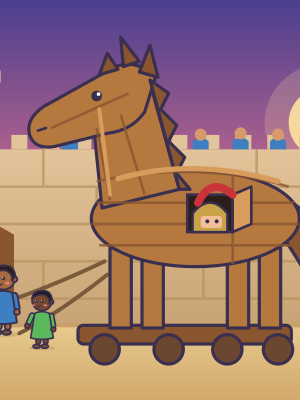
The Trojan Horse
Part One · Ten Years at the Walls
For ten long years, a thousand Greek ships had been dragged up on the beach outside the magnificent city of Troy. The war had begun when a Trojan prince named Paris sailed to Greece and carried off Helen, the queen of Sparta, and the furious Greek kings had promised to bring her home. But Troy was surrounded by the strongest walls in the world, so high that a man standing at the bottom could barely see the guards at the top, and so thick that no battering ram could even scratch them. Every spring the Greeks attacked, and every autumn they limped back to their tents, exhausted and discouraged. The soldiers were homesick, their ships were rotting, and their sails were full of holes.
Among the Greek kings was Odysseus of Ithaca, who was not the strongest warrior in the camp, nor the tallest, nor the most ferocious. He was simply the most imaginative. One evening, as he sat by the fire, watching a carpenter carve a toy horse for a homesick soldier, an idea arrived in his imagination so suddenly that he dropped his cup. He hurried to the tent of King Agamemnon, the leader of the Greeks, and gathered the other kings together. "We have tried to break the walls of Troy for ten years," he said. "Let us stop trying. Instead, we shall let the Trojans open their gates for us themselves."
The kings stared at him as if he had been sitting in the sun too long. Then Odysseus explained his plan, and one by one they began to grin. The most talented carpenter in the camp, a quiet man named Epeius, was given the responsibility, and the goddess Athena, who favored the Greeks, was said to have guided his hands. For three days and nights the forest on the hill rang with axes. The soldiers dragged tree trunks down to the beach, and slowly, plank by plank, something enormous began to rise among the tents. It had four legs, a long neck, a flowing wooden mane, and a belly as big as a house.
Part Two · The Gift on the Beach
When it was finished, the horse stood taller than the walls of the camp, with eyes of polished stone and hooves set on wooden wheels. It was beautiful, it was magnificent, and it was completely hollow. Hidden in its side was a secret door so cleverly fitted that no one could see the seams. On the last night, Odysseus climbed a rope ladder into the dark belly of the horse, followed by King Menelaus, Helen's husband, and the bravest warriors in the army, about thirty of them in all. They squeezed in shoulder to shoulder, with their knees pressed against their chins, and the door clicked shut behind them. Not one of them dared to sneeze.
Then the remainder of the Greek army did something astonishing. They set fire to their own tents, loaded their ships, and sailed away. By sunrise the long beach, which had been crowded for ten years, was completely empty, except for smoking ashes and one gigantic wooden horse. The Trojans on the walls rubbed their eyes in disbelief. Was it a trick? Had the Greeks finally surrendered? Slowly the great gates creaked open, and the people of Troy poured out onto the beach, laughing and dancing and running in circles on the sand, which they had not visited in ten years.
A crowd quickly gathered around the horse. Some people wanted to drag it into the city as a trophy, while others wanted to push it off a cliff or set it on fire. Then a priest named Laocoön came running down from the city, shouting at the top of his lungs. "Have you lost your minds?" he cried. "Do you really believe the Greeks would leave a present behind? Whatever it is, I fear the Greeks, even when they bring gifts!" He hurled his spear at the horse, and it struck the wooden side and quivered there. From deep within came a hollow boom, like the echo of a drum. Inside, thirty men held their breath.
Part Three · Inside the Walls
Just then, a group of shepherds dragged a muddy young man out of the reeds, with his hands tied behind his back. He was a Greek, and his name was Sinon. He fell on his knees before King Priam of Troy and wept until his face was streaked with tears. The other Greeks had blamed him for all their bad luck, he sobbed, so he had run away from them and hidden in a swamp all night. Priam was a kind old king, and he ordered the ropes untied at once. "Tell us the truth, then," he said gently. "What is this horse?"
Sinon wiped his eyes. "It is a gift for the goddess Athena," he said, "so that she will protect the Greek ships on their journey home. They built it enormous on purpose, so the Trojans could never fit it through your gates. Because if the horse stands inside your walls," he whispered, "then Troy can never be conquered." Every word of it was an invention, carefully rehearsed, and every Trojan believed it. Meanwhile, out on the beach, two great sea serpents came rolling in on the waves, and Laocoön, who had shouted the loudest warning, ran away up the hill. People took it as a sign that the gods were angry with him.
Only one person still refused to be deceived. Cassandra, the daughter of King Priam, had been given the gift of seeing the future, and also the curse that nobody would ever believe her. "Burn it!" she cried, tugging at people's sleeves. "There are soldiers inside! I can see them!" But the Trojans only patted her on the head and walked away. They tied ropes around the horse's neck and legs, and hundreds of people heaved and sang as they pulled it across the plain. The horse was too tall for the gate, so they knocked down part of their own wall to let it in.
Part Four · The Night
That night, Troy held the most extravagant celebration it had seen in ten years. The streets were hung with flowers and lanterns, and there was music and dancing in every square. Late in the evening, Helen herself came down to look at the horse. She walked slowly around it three times, tapping its wooden sides, and then, for reasons of her own, she began to call out the names of the Greek warriors, in the voices of their wives back home. Inside the horse, one young soldier named Anticlus heard his wife's voice and opened his mouth to answer. Odysseus clapped his hand over the soldier's mouth and held it there until Helen walked away.
Eventually the music stopped and the lanterns burned low. All over Troy, people dropped into deep and happy sleep, many of them right where they had been dancing. In the silence after midnight, Sinon crept to the horse and knocked three times on its hollow leg. The secret door slid open, a rope ladder unrolled, and one by one, stiff and silent, the Greek warriors climbed down into the moonlight. Meanwhile, Sinon climbed a tower and lit a torch. Out on the dark water, the Greek ships, which had only been hiding behind a nearby island, saw the signal and rowed silently and swiftly toward the shore.
The warriors from the horse crept through the sleeping streets to the great gates of Troy. They lifted the heavy bar that had kept the Greeks out for ten years and swung the gates wide open. The whole Greek army marched straight through. By the time the Trojans woke up and understood what had happened, it was far too late. The city that no army in the world could conquer had been captured in a single evening, by a wooden horse and a story that people wanted to believe. When the sun rose, the Greek flags were flying from the towers of Troy, and the long war was over.
Part Five · After
Not every Trojan was captured. In the confusion, a courageous prince named Aeneas gathered his family together and slipped out through a little side gate that nobody was guarding. He carried his elderly father, who was too weak to walk, on his back and held his young son by the hand, and he led a small group of Trojans to the ships, where they sailed away to search for a new home across the unfamiliar sea. The ancient stories say that, after many years of wandering and adventure, Aeneas reached the land of Italy, and that his great-great-grandchildren founded a city that would become Rome.
As for the victorious Greeks, they finally loaded their ships and turned toward home, singing. Menelaus sailed back to Sparta with Helen beside him on the deck, and the old poets say they lived together peacefully afterward, as if the war had been a long, bad dream. Odysseus, who had won the war with a wooden horse, set sail for his little island of Ithaca, expecting to be home in a few weeks. Unfortunately, the journey took him another ten years, full of monsters and whirlpools and enchanted islands, but that is a different story.
And ever since, when somebody offers a gift that seems a little too good to be true, people remember the wooden horse and the warning of Laocoön, who was right all along. "Beware of Greeks bearing gifts," they say, which means: look carefully at a present before you drag it inside. Today, there is even a dangerous kind of computer program called a Trojan horse, which pretends to be something friendly so that it can sneak in. Some tricks are so ingenious that the world never forgets them, not even after three thousand years.