The War of the Worlds
Part One · The Falling Star
At the end of the nineteenth century, nobody on Earth would have believed that our world was being watched, keenly and closely, by intelligences far greater than our own. Across the gulf of space, on the dying planet Mars, minds that were vast, cool and unsympathetic regarded our green and fertile world with envious eyes, and slowly and surely they drew their plans against us. The narrator of this story, a writer of philosophical essays who lived with his wife in the quiet town of Woking, in Surrey, south of London, first heard of the danger from a friend, the astronomer Ogilvy. Through Ogilvy's telescope, one summer night, he watched a tiny reddish planet swimming in the darkness, and observers around the world reported mysterious flashes of incandescent gas erupting from its surface, night after night, as though enormous guns were being fired. Ogilvy laughed at the idea of life on Mars. "The chances of anything coming from Mars," he declared, "are a million to one."
Some weeks later, early one morning, a blazing falling star streaked across the sky above southern England, and people from miles around saw it fall. Ogilvy discovered where it had landed: in a huge pit of sand and gravel on Horsell Common, very close to the narrator's home. It was not a meteorite at all, but an immense cylinder of yellowish-white metal, about thirty yards across, half buried in the ground and still too hot to approach. As Ogilvy watched, astonished, the circular top of the cylinder began to rotate, very slowly, with a scraping, grinding sound. Something inside was unscrewing it. Ogilvy realized with amazement and horror that the cylinder was hollow, and that there were living beings inside, perhaps half roasted, struggling to escape. He rushed to the town to raise the alarm, and by afternoon a large, curious crowd had gathered around the edge of the pit, along with newspapermen, schoolboys, idle shopkeepers, and the narrator himself, who had come to see this marvel for himself.
Suddenly the lid fell off with a clang, and the crowd surged forward, expecting to see something resembling a man. Instead, from the dark interior emerged a great rounded grayish body, approximately the size of a bear, glistening like wet leather, with two enormous luminous eyes and a strange, quivering, lipless mouth that dripped saliva, while long writhing tentacles groped over the rim of the cylinder. The creature heaved itself laboriously out, struggling against the heavy gravity of Earth, which was considerably stronger than that of Mars, and then a second appeared behind it. The narrator, paralyzed with disgust and fascination, eventually fled for the shelter of the trees. That evening a small deputation, including Ogilvy, approached the pit carrying a white flag, hoping to communicate with the visitors. There was a dazzling flash, an invisible beam of heat swept across them, and each man burst into flame and vanished. The Martians possessed a Heat-Ray, and they had answered the flag of peace with fire.
The Heat-Ray swept across the common, and trees, hedges and houses burst into flame wherever it touched. The terrified crowd fled in panic, and the narrator ran home through the darkness, stumbling and falling, convinced that the invisible ray might annihilate him at any moment. Astonishingly, the following morning the ordinary existence of Woking continued almost as usual: the milkman delivered the milk, the trains operated, and people in the town dismissed the reports as exaggerations, reassuring each other that the creatures were too sluggish and heavy to climb out of the pit. Soldiers arrived and surrounded the common with artillery, and everybody anticipated that the creatures would be exterminated by evening. But all day long, from the pit, came the sound of hammering, and a column of green smoke ascended into the sky. The Martians were assembling something. That evening a second falling star plunged into the woods nearby, and soon afterward a projectile from the Martians' pit demolished the chimney of the narrator's own house.
Part Two · The Fighting-Machines
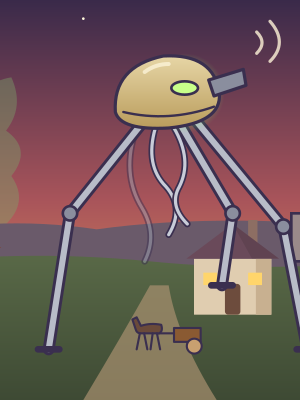
The narrator borrowed a horse and dog cart from the local innkeeper, and that night he drove his wife to her cousins at Leatherhead, twelve miles away, hoping she would be secure there. He had promised to return the cart, so he left her reluctantly and drove back toward Woking through a ferocious thunderstorm, and as lightning illuminated the sky, he saw something that froze his blood. Striding across the countryside toward him, taller than the trees, came a monstrous machine of glittering metal, a walking engine balanced on three enormous jointed legs, with a brazen hood that swiveled from side to side like a head surveying the landscape. It advanced with tremendous velocity, demolishing the pine trees in its path, and from it rose a prolonged howl that overwhelmed the thunder: "Aloo! Aloo!" The horse bolted, the cart overturned, and the narrator lay flat in a ditch, drenched and terrified, as a second tripod strode past in the lightning toward the new cylinder.
When the storm had subsided, he crept home through the wreckage and discovered a soldier, an artilleryman, hiding in his garden, the only survivor of a battery of guns that had been obliterated by the Heat-Ray. Together they set out at dawn across the smoldering countryside, and at Weybridge, beside the River Thames, they witnessed a battle. Five tripods came wading through the shallow river, and the concealed guns on the riverbank opened fire, and one shell struck a tripod squarely on its hood, so that the gigantic machine staggered, reeled, and collapsed into the river in a cloud of steam, completely destroyed. For a moment hope blazed in the narrator's heart, because the Martians were evidently not invulnerable. But the remaining tripods turned their Heat-Rays upon the town, and the river boiled, and the narrator, scalded and half drowned, was swept helplessly downstream, while the Martians gathered up the wreckage of their fallen comrade and stalked away.
The Martians had learned caution, and in the days that followed, they advanced more deliberately, employing a new and terrible weapon. From tubes that they carried, they launched enormous canisters that shattered on impact and released a heavy black smoke, which crept along the ground like an inky liquid, flowing into valleys and cellars and suffocating every living creature it touched. The batteries of artillery that awaited them in the hills, concealed among the trees, were silenced one after another without ever glimpsing their enemy. Afterward the Martians sprayed the black vapor with jets of steam, which converted it into a harmless powder. Meanwhile a peculiar red vegetation began spreading wherever they had passed, clogging the rivers, smothering the fields, and climbing the walls of abandoned houses, as though the Martians were transforming the Earth into an imitation of their own red planet. Separated from his wife, the narrator wandered through deserted villages, sometimes alone, sometimes accompanied by other frightened refugees.
Part Three · The Flight from London
The narrator's younger brother, a medical student in London, later told him how the great city had learned of its fate. At first Londoners had treated the news from Surrey as an entertaining sensation. Then, early one Monday morning, policemen ran through the streets hammering on doors and shouting that the Martians were coming and the Black Smoke was spreading toward London. Within hours, the population of the largest city in the world had become a panicking mob, millions of people pouring northward and eastward along every road, in carriages, carts and wagons, on bicycles and on foot, fighting for places on the trains, trampling one another in the crowds. The brother rescued two ladies, a Mrs. Elphinstone and her young sister-in-law, whose carriage was being attacked by robbers, and together they struggled eastward toward the sea, joining a vast exodus that the narrator called the rout of civilization, the massacre of mankind.
At the coast, a whole fleet of steamers, fishing boats and yachts was carrying refugees away from England, and the brother and his companions secured a passage on a paddle steamer bound for Belgium. As the ship was leaving, three tripods appeared on the shore, wading out into the water toward the crowded boats, and it seemed that nothing could save them. Then an ironclad warship, the Thunder Child, came charging out of the haze at full speed, straight toward the Martians, with smoke pouring from her funnels. The Martians fired their Heat-Rays, but the warship, though burning, drove on and rammed the nearest tripod, which collapsed into the sea, and she fired at a second one, which also crumpled and fell, before the Thunder Child herself exploded in a tremendous burst of steam and flame. The paddle steamer escaped into the gathering darkness, while far behind them something dark and flat rose into the sky above the land.
Part Four · The Ruined House
The narrator, meanwhile, had fallen in with a terrified curate, a young clergyman whose church had been destroyed and whose faith had been shattered, and who could do nothing except weep and complain. Together they took shelter in an empty house at Sheen, west of London, and that night, with a blinding flash and a deafening crash, the fifth cylinder from Mars landed directly beside it, burying the house in rubble. The two men were trapped in the ruined scullery, and through a crack in the wall the narrator could look down into the enormous pit, where the Martians were assembling new machines. For fifteen terrible days he watched them. He saw how their machines worked, with gleaming tentacles of metal, and he learned, to his horror, that the Martians fed upon living creatures, which they carried in great metal baskets on their backs. He realized, too, that the Martians themselves had no bodies to speak of, but were little more than enormous brains.
Hunger and fear drove the curate steadily toward insanity, and he devoured their meager provisions, raving and praying aloud, until the narrator, desperate to prevent the Martians from hearing them, struggled with him and finally struck him down with the blunt end of a meat chopper. Almost immediately, a long metallic tentacle came snaking through the crack in the wall, groping methodically about the dark kitchen. The narrator fled into the coal cellar and lay concealed in the darkness, scarcely breathing, while the tentacle explored the room, touched the heel of his boot, and then withdrew, dragging the curate's unconscious body away. For days afterward the narrator remained in the cellar, too petrified to move. When at last he dared to investigate, the pit was silent. The Martians had departed, and the devastated landscape around him was overgrown with the blood-red weed, so that he crept out into a world that appeared entirely empty of human beings.
Part Five · Dead London
On Putney Hill he encountered the artilleryman again, who described grandiose plans for a new human civilization living underground in the sewers, but the narrator soon recognized that the man was an idle dreamer who preferred playing cards to digging, and he abandoned him. He walked alone into London, through silent streets of deserted shops and houses, past dead horses and overturned carts, beneath a sky of perfect blue. As he walked, he heard a mournful, sobbing howl, "Ulla, ulla, ulla, ulla," rising and falling across the empty city. It emanated from a tripod standing motionless above Regent's Park. The narrator, exhausted beyond fear, walked toward it, almost longing for death, and then the howling ceased. He climbed Primrose Hill, where the Martians had constructed their largest encampment, and there in the morning light he beheld the great machines standing silent and motionless, with black birds circling above them. He understood at last. The Martians were dead.
They had been slain, after all the artillery and warships of mankind had failed, by the humblest organisms on Earth: by bacteria, the invisible germs of disease that human beings had learned to resist over countless generations, but against which the Martians, who had no such germs on their own planet, possessed no defense whatsoever. From the moment of their arrival, they had been doomed. The red weed, too, was dying, withered and bleached. The narrator wept with relief, and then, overcome by exhaustion, he lay delirious for three days in a stranger's house. When he recovered, he made his way home to Woking, expecting to find nobody, and there, standing in his ruined study, he heard voices outside, and discovered his cousin, and beside her, pale and astonished, his wife, who had believed him dead. Afterward the narrator often walked through London's crowded streets, observing the busy people and wondering whether the Martians would return, and whether next time humanity would be prepared.