Tom Sawyer and the Fence
Part One · The Fence
Tom Sawyer lived with his Aunt Polly in St. Petersburg, a sleepy little town on the banks of the Mississippi River, and Aunt Polly loved him tremendously, which was precisely the difficulty. She could never quite bring herself to punish him properly, and Tom could wriggle out of a scolding faster than a cat escapes a bath. One Friday he skipped school to go swimming, and he very nearly got away with it, until his tattletale half brother Sid observed that the thread in Tom's collar had mysteriously changed color since breakfast. That settled the matter. On Saturday, Aunt Polly announced, Tom would whitewash the fence.
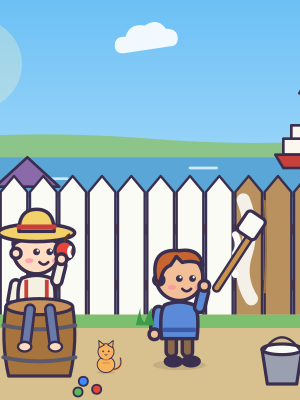
Saturday morning arrived glorious and golden, the kind of summer morning when every living creature seems to be singing and every boy in America is planning an expedition. Tom appeared on the sidewalk with a bucket of whitewash and a long-handled brush, examined the fence, and felt all his happiness drain away. It was thirty yards of wooden boards, nine feet high, and it stretched along the street like an endless white desert that had not yet been painted. Sighing tragically, he dipped his brush and dragged it along the topmost plank, compared his miserable little stripe with the enormous unpainted territory remaining, and collapsed onto a box in despair.
Tom began imagining all the lucky boys who would soon come strolling past on their way to wonderful adventures, and how mercilessly they would tease him for having to work. The very thought burned like fire. He emptied his pockets and inspected his entire fortune: broken toys, a few marbles and assorted rubbish. It might possibly purchase a few minutes of somebody else's labor, but certainly not an entire afternoon of liberty, so he returned his pitiful treasures to his pocket and abandoned the idea of bribery. Then, at this darkest and most hopeless moment, an idea struck him so brilliantly that he nearly dropped his brush. It was a magnificent, glorious, extraordinary idea.
Tom picked up his brush and went calmly back to work. Presently his friend Ben Rogers appeared, crunching a juicy apple and imitating a Mississippi steamboat, ringing his own imaginary bells and shouting his own orders to an imaginary crew. "Ding-dong-dong! Stop the engines!" Ben steamed up alongside the fence and grinned. "Hello there, Tom. Got to work today, have you?" Tom did not answer. He studied his latest brushstroke with the critical eye of an artist, added another delicate sweep, and studied it again. "Oh, it's you, Ben!" he exclaimed eventually, as though he had only just noticed. "I'm going swimming," Ben announced. "But I suppose you'd rather work, wouldn't you?"
Tom considered him thoughtfully. "What do you mean, work?" he inquired. "Well, isn't that work?" Tom resumed his painting and answered casually that maybe it was and maybe it wasn't, but all he knew was that it suited him perfectly. "Oh, come on," said Ben. "You don't mean to tell me you actually like it?" The brush continued moving. "Like it? Why shouldn't I like it? Does a boy get a chance to whitewash a fence every day?" That put the whole business in an entirely different light, and Ben stopped chewing his apple. Tom swept his brush delicately back and forth, stepped back to admire the effect, and added a touch here and there, while Ben followed every movement with growing fascination.
"Say, Tom," said Ben eventually, "let me whitewash a little." Tom hesitated, appeared about to agree, and then reluctantly shook his head. Aunt Polly, he explained, was tremendously particular about this fence, since it faced the street where everybody could see it. Probably not one boy in a thousand, possibly not one in two thousand, could paint it the way it absolutely had to be painted. "Oh, please, Tom. I'll give you the core of my apple." Tom shook his head sorrowfully. "I'll give you the whole apple!" So Tom surrendered the brush with a disappointed expression and a delighted heart, and while Ben toiled in the scorching sun, Tom relaxed on a barrel in the shade, swung his legs, devoured the apple, and planned his next customers.
Victims were plentiful. Boys arrived every few minutes, intending to laugh at Tom, and stayed to paint instead. When Ben was exhausted, Tom traded the next turn to Billy Fisher for a kite in excellent condition, and after Billy came Johnny Miller, who paid with a dead rat and a string to swing it with. By the middle of the afternoon, Tom was positively wealthy, with twelve marbles, a piece of blue bottle glass to look through, a key that would not unlock anything, a tin soldier, a kitten with only one eye, a brass doorknob, and a dog collar with no dog attached. The fence had received three complete coats of whitewash, and if the whitewash had not run out, Tom would have collected every treasure in town.
Without realizing it, Tom had discovered an important law of human nature: if you want people to desire something desperately, you need only make it difficult to obtain. Work, he concluded, is whatever somebody is required to do, and play is whatever somebody is not required to do. When Tom presented himself to Aunt Polly and reported that the fence was finished, she refused to believe him. Then she went outside to investigate, and she was so astonished that she could barely speak. She rewarded him with an especially fine apple and a lecture about the satisfaction of honest effort. While her back was turned, Tom helped himself to a doughnut as well.
Part Two · The Pirates
A few weeks later, Tom concluded that nobody in the entire world loved him. Becky Thatcher, the new girl with the golden braids, had refused to speak to him, and Aunt Polly had punished him for breaking a sugar bowl that Sid had actually broken. So Tom resolved to become a pirate. He recruited his best friend, Joe Harper, who was feeling equally unappreciated, and Huckleberry Finn, who slept in doorways and empty barrels, never attended school, never washed, and was secretly envied by every respectable boy in town. At midnight the three adventurers borrowed a small log raft and drifted silently down the dark river toward Jackson's Island, three miles below the village.
They gave themselves terrifying pirate names, and for a while the island was paradise. They built an enormous campfire, fried bacon in a pan, swam whenever they pleased, and slept under the stars with nobody reminding them to wash behind their ears. On the second morning, a mysterious booming sound rolled across the water, and they discovered a ferryboat crowded with people drifting slowly down the river, firing a cannon over the surface. "I know what it is!" exclaimed Tom. "Somebody's drowned!" Then the truth dawned on all three of them simultaneously. The entire town was searching the river for their bodies. They were the ones who had drowned.
At first the pirates felt magnificent, since the whole town was mourning them. But that night, after the others had fallen asleep, Tom swam and waded back across the river, crept into Aunt Polly's house, and hid underneath her bed. He listened while his aunt and Mrs. Harper wept and reminded each other what generous, good-hearted boys they had been, underneath all their mischief. Tom had to struggle not to rush out and throw his arms around his aunt. He scratched a message on a piece of bark and very nearly left it beside her, but then a far better idea occurred to him, so he returned the bark to his pocket and slipped away into the night.
Part Three · The Funeral
By the following day, Joe and Huck were homesick, and even piracy had lost its sparkle. Then Tom revealed his secret plan, and the other two whooped with delight. On Sunday morning the bell of the little church tolled mournfully, and the entire village assembled for the funeral of the three lost boys. Nobody could remember a sadder occasion. The minister described the boys' sweet natures and generous deeds so movingly that everyone sobbed, and people who had once called Tom a rascal now remembered the very same pranks as delightful. The minister himself broke down and wept in the pulpit. Then the church door creaked open, and every head turned around.
Up the aisle marched the three dead boys, Tom in the lead, Joe next, and Huck in his ragged clothes at the back, looking extremely sheepish. They had been concealed in the empty balcony, listening to their own funeral. Aunt Polly and Mrs. Harper flung themselves on their boys and smothered them with kisses, while Huck stood alone, embarrassed, with nobody to welcome him and nowhere to hide. Tom seized his arm and told his aunt that somebody had to be glad to see Huck too. "And so they shall," said Aunt Polly, and she hugged Huck as well. Then the minister called for everyone to sing, and they sang so joyfully that the old building shook.
Tom received more hugs and more scoldings that day than he had earned in an entire year, and he could never decide which expressed the most affection. Aunt Polly was genuinely hurt that he had allowed her to suffer, when he could easily have sent her a message. A few days afterward, while he was outside, she discovered his old jacket and reached into the pocket, almost afraid of what she might find. There was the piece of bark, with these words scratched on it: We ain't dead, we are only off being pirates. Aunt Polly read it twice, and her eyes filled with tears. She said she could forgive that boy now if he had committed a million sins.