William Tell
Part One · The Hat on the Pole
Long ago, high in the snowy mountains of Switzerland, the people of the valleys lived independent and proud. They herded cows on the steep green slopes, fished in the deep blue lakes and hunted wild goats among the rocks. But powerful rulers in faraway Austria wanted these beautiful valleys for themselves, so they sent harsh governors to rule over the people. The harshest of them all was a man named Gessler, who cared about nothing except his own importance.
Gessler built an enormous castle and filled the countryside with his soldiers. He took the farmers' cattle and crops whenever he pleased, and anyone who complained was thrown into his dungeon. Then one day, in the town square of Altdorf, he set up a tall pole and placed his own hat on top of it. "Everyone who passes this pole must bow to my hat," he ordered, "just as if I were standing here myself."
The people grumbled, but they were afraid of Gessler's anger, so they bowed low to the ridiculous hat. Two soldiers stood guard beside the pole day and night, watching everyone who passed. Now, in the mountains above Altdorf lived a hunter named William Tell. He was famous across all the valleys as the finest shot with a crossbow, and he could split a twig from a hundred steps away. He was also a man who would never bow to a hat.
Part Two · The Apple
One morning, Tell walked down into Altdorf with his young son Walter, his crossbow on his shoulder. They strolled across the square, chatting happily, and they walked straight past the pole without even glancing at the hat. "Stop!" shouted the guards, grabbing Tell by the arms. "You did not bow to the Governor's hat!" A curious crowd quickly gathered, and just then Gessler himself came riding into the square on his enormous gray horse.
"So you are the famous William Tell," said Gessler with a cold smile. "They say you never miss. Let us find out if it is true." He pointed to a tree at the far end of the square. "Stand your son under that tree and put an apple on his head. If you can shoot the apple from a hundred steps away, you will both go free. If you refuse, you will both be thrown into my dungeon."
The crowd gasped, and Tell went pale. "Sir," he begged, "do not ask a father to aim at his own child. Punish me some other way instead." But Gessler only laughed. Then little Walter spoke up in a clear voice. "Don't be afraid, Father," he said. "I know you will not miss. I will stand as still as a stone, and I won't even blink." And he walked to the tree and stood with his back against it.
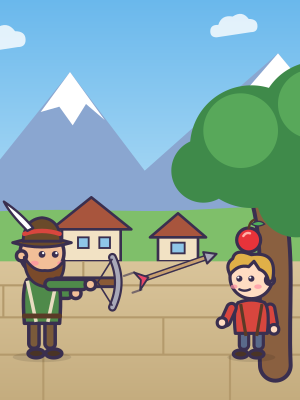
A soldier placed a shiny red apple on Walter's head. Tell took two arrows from his quiver, slipped one into his belt and carefully fitted the other into his crossbow. The whole square went silent. Not a bird sang, and not a single person seemed to breathe. Tell raised his crossbow, aimed for a long, long moment, and then he let the arrow fly. It whistled through the air like the wind.
The arrow split the apple in two and pinned one half to the tree behind the boy. Walter had not moved an inch! The crowd cheered, and Walter ran into his father's arms. "I knew you could do it!" he cried, holding up the other half of the apple. But Gessler was frowning with suspicion. "Wait," he said. "Why did you take a second arrow, Tell? Answer me honestly, and I promise that nothing will happen to you."
Part Three · The Storm on the Lake
Tell looked Gessler straight in the eye. "If my first arrow had hurt my son," he said, "the second one was meant for you." Gessler turned purple with rage. "Seize him!" he roared. "I promised you your life, and you shall have it, but I did not promise where you would live it. I will take you to my castle across the lake, and you will never see the sun again!" His soldiers tied Tell up and dragged him down to the shore.
Gessler and his soldiers bundled Tell into a boat, tossed his crossbow in beside him and began to row across the long, deep waters of Lake Lucerne. Halfway across, the sky turned black, and a terrible storm came howling down from the mountains. Waves crashed over the boat, and the soldiers dropped their oars in terror. "We will all drown!" they cried. "Only Tell knows this lake well enough to steer us through."
Gessler was frightened too, so he ordered them to untie Tell. Tell took the rudder and steered the boat bravely through the crashing waves. As they passed a flat rock at the foot of a cliff, he grabbed his crossbow, leaped onto the rock and gave the boat a mighty shove back into the storm. Then he scrambled up the steep, rocky cliff and vanished into the forest before anyone could follow.
Gessler's boat spun around and around in the waves, and it was many hours before the soaking, shivering Governor finally reached the shore. By then, the news of the apple and the escape had spread to every valley. Farmers, fishermen and hunters gathered in secret in a meadow beside the lake, and they made a solemn promise to one another. "We will be free," they said, "and we will stand together."
Not long after, Gessler woke up one morning to see the people of the valleys marching toward his castle. There were thousands of them, with William Tell at the front. Gessler looked out of his window, and his face went white. He did not stay to fight. He jumped onto his horse, galloped out of the back gate and fled over the mountains, and he never dared to return to the valleys again.
The people pulled down the pole and the hat in the town square of Altdorf, and they danced and sang around them. The valleys were finally free again, and nobody ever had to bow to a hat. William Tell went home to the mountains, and he hunted and fished just as he always had. Walter grew up to be a fine shot himself, but he never forgot the day he stood so still under the tree, trusting his father with all his heart.