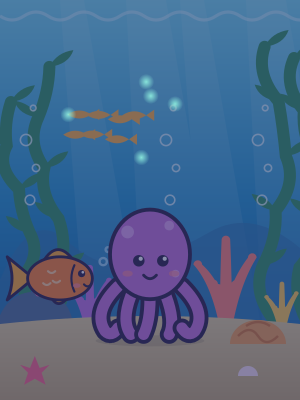
The giant Pacific octopus is the largest octopus in the world. As of November 2026, a full-grown one often weighs 50 pounds or more. Its arms span about 7 to 14 feet (2 to 4 meters). That is measured from one arm tip to the arm tip opposite.
A giant Pacific octopus has eight arms. The suckers on its arms help it hold things and taste them.
It has three hearts and blue blood. The only hard part of its body is its beak. The beak looks like a parrot's. It can squeeze through a very small space.
It can change its skin color to blend in. It has sharp vision.
Giant Pacific octopuses live in the Pacific Ocean, near the coast. An octopus lives in a den. A den is a small hiding place in rocks or caves. It lives alone. It is not a social animal.
A giant Pacific octopus is mostly active at night, and it hunts at night. Its food includes crabs, clams, shrimp, scallops, snails and small fish.
Giant Pacific octopuses are smart. They can learn to open jars.
A mother lays her eggs in a den. A female lays about 20,000 to 100,000 eggs. She stays with them, usually not eating, until they hatch. A baby is about the size of a grain of rice when it hatches.
Words to know
- suckers: grippy cups
- vision: eyesight
- den: hiding place
- hatch: leave the egg