Gravity is a force that pulls things toward each other. Earth's gravity keeps you on the ground. It makes things fall. Gravity can only pull, never push. It is why things fall down when you drop them or throw them. Gravity does not stop at the sky. There is gravity in space. It keeps spacecraft in orbit around Earth. It keeps Earth in orbit around the Sun.
Galileo showed that heavy and light things speed up at the same rate as they fall. He ignored air resistance. A falling apple is said to have inspired Isaac Newton. He linked it to how the Moon moves. His theory of universal gravitation was published in 1687. A dropped thing falls faster and faster as it falls.
Anything that has mass also has gravity. Things with more mass have more gravity. Gravity gets weaker the farther apart things are. The closer two things are, the stronger their pull. Earth's gravity pulls on the mass in your body. That gives you weight. On a planet with less mass than Earth, you would weigh less. You pull on Earth with the same force that Earth pulls on you. Gravity is slightly stronger over places with more mass underground than over places with less.
Gravity on the Moon is weaker than gravity on Earth. Your mass stays the same on Earth, on the Moon and in orbit, but your weight changes. Gravity keeps the Moon moving around Earth. The Moon's gravity also pulls on the sea and helps make ocean tides. Its pull is the main cause of tides.
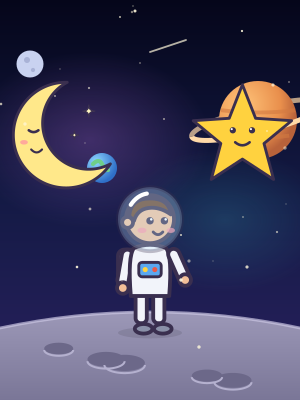
A thing that is moving keeps moving unless something pushes or pulls on it. A thing in orbit is always falling toward Earth. But it moves sideways fast enough that it never hits it. Astronauts on the space station float because they and the station are all falling together around Earth.
Words to know
- gravity: a pulling force
- orbit: a path around
- tides: sea rising, falling
- mass: amount of stuff
- weight: pull on you
The short version
Gravity is a force that pulls objects toward each other. Earth's gravity keeps you on the ground and makes things fall. Gravity also exists in space, where it keeps spacecraft in orbit around Earth and Earth in orbit around the Sun.
Quick facts
- Gravity is why things fall down when you drop them or throw them.
- Gravity gets weaker with distance, so the closer two objects are, the stronger their pull.
- Isaac Newton's theory of universal gravitation was published in 1687.
- Astronauts on the space station float because they and the station are all falling together around Earth.
- Its pull is the main cause of tides.
Why do astronauts float on the space station?
Astronauts on the space station float because they and the station are all falling together around Earth. Gravity does exist in space: it keeps spacecraft in orbit around Earth.
Do heavy things fall faster than light things?
With no air, heavy objects and light objects fall at the same rate. Galileo showed that, ignoring air resistance, heavy and light objects speed up at the same constant rate as they fall.
What causes ocean tides?
The Moon's gravity pulls on the sea and helps make ocean tides. Its pull is the main cause of tides.