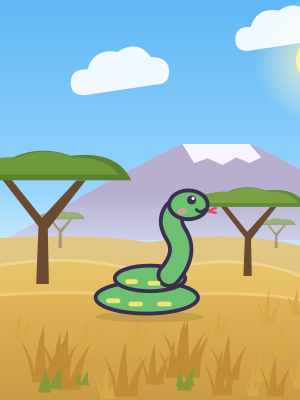
Field scientists often describe the king cobra as a placid snake that prefers to show a raised body, a hood and a loud growling hiss, and king cobras are not particularly aggressive snakes. A king cobra can raise the front part of its body about three to four feet off the ground, which lets it see over bushes and tall grass. It can also spread a hood on its neck that makes it look bigger. The hiss is lower than most snakes' hisses, so it sounds more like a dog's growl. A king cobra makes its low hiss with tiny holes in its windpipe, and the lung makes the sound deeper.
A king cobra's fangs are almost half an inch long, about 8 to 10 millimeters, and because they are fixed to the upper jaw they have to be short. They are angled back into the mouth, which helps push the prey toward the stomach. Venom is made in glands joined to the fangs, and a small muscle pushes it through the hollow fangs. King cobra venom is a complex mixture of proteins encoded by several families of genes. Neurotoxins act on the nervous system, especially the signals for breathing, while other toxins start to break down the prey's body. The diet of a king cobra is fairly specialized and is mainly other snakes.
How large a share does each kind of toxin hold? In three proteomic studies, three-finger toxins made up 43.0 to 64.2 percent of the venom proteins, and metalloproteinases, called SVMPs, are unusually diverse and abundant compared with most cobra venoms. Even so, studies of king cobra venom proteins reported marked discrepancies, which scientists link to different sampling and methods, so a number from one lab describes one way of measuring rather than every snake. The make-up of king cobra venom, and how it acts, also varies a great deal between snakes from different places.
The genome helps to explain how the venom came about. Toxin genes important for catching prey were copied many times and shaped by positive selection, which means the copies were kept and changed over time because they helped the snake. The genome study also suggested that the control machinery of the venom gland may have come from the pancreas. The accessory venom gland has a different pattern of toxin gene activity from the main gland, since lectins make up 42.70 percent of toxin transcripts in the accessory gland but only 0.03 percent in the main one. Although the king cobra has no limbs, scientists found coding sequences for all the Hox genes for limb development except one. The haploid genome was estimated by flow cytometry to be 1.36 to 1.59 gigabase pairs.
As of November 2026, the IUCN Red List lists the king cobra as Vulnerable, and it lists the king cobra's population trend as decreasing. King cobras are threatened by the destruction of their habitats, and cutting down forests in Southeast Asia has destroyed the homes of many of them. They are also hunted for their skin, for food and for traditional medicine. In Vietnam the Northern king cobra is a protected species, and India microchips captive king cobras to help stop illegal capture.
Words to know
- proteomic: protein-measuring
- accessory: extra, added
- genome: all its genes
- neurotoxins: nerve poisons
- placid: calm