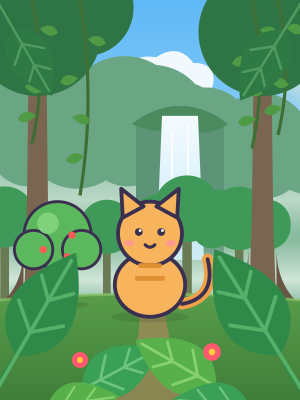
A rainforest is a forest where a lot of rain falls. Most rainforests have four layers. They are the emergent layer, the canopy, the understory and the forest floor. Some rainforest trees grow as tall as 60 meters. That is 200 feet. Let's look at the light, the rain and the ground.
Start with the light. The canopy blocks sunlight, so the layers below are dark. About 5% of the sunlight reaches the understory beneath the rainforest canopy.
Now look at the ground. Rainforest soil is poor in nutrients. Dead plant material in a rainforest breaks down fast, so there is very little leaf litter.
Now look at the rain. A tropical rainforest can get more than 2,000 millimeters of rain in a year. That is 79 inches. Many rainforest leaves have pointed tips. The tips help water run off.
Some plants grow on other plants. They are called epiphytes. A strangler fig seed often starts growing in the branches of another tree. Then it sends roots down its host tree to the ground. It slowly strangles the host.
Most of the life in a rainforest lives up in the trees, as of November 2026. More animals live in the canopy than in any other layer. The Amazon is home to about 10 percent of the world's known species, as of November 2026.
The largest unbroken stretch of rainforest is in the Amazon river basin of South America. The Amazon is the largest river on Earth by the volume of water it carries. The cacao tree comes from the Amazon region. Chocolate is made from the beans of the cacao tree.
Words to know
- canopy: forest layer
- understory: forest layer
- nutrients: plant food
- epiphytes: plants on plants
- species: kinds of life