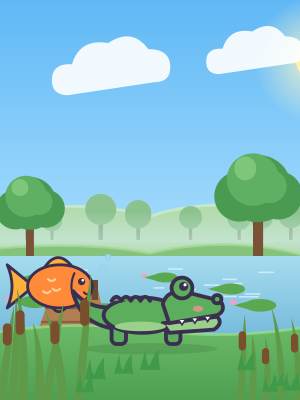
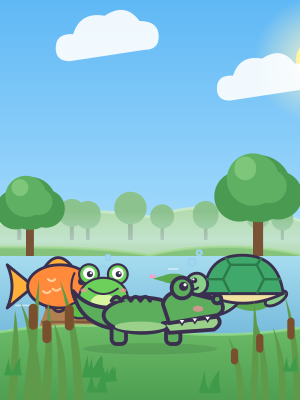
A young crocodile eats small animals such as insects. As it grows, it eats bigger animals. Crocodiles eat animals such as turtles and birds.
A crocodile has thick skin with bony plates inside it. Its eyes and nostrils are on top of its head. It can hide in the water with only a little of its body above the surface.
A crocodile is cold-blooded. It warms up in the sun and cools off in the water.
Crocodiles live in coastal waters, rivers and swamps. They can live in freshwater and in full-strength sea water. They live along the northern coast of Australia, from near Broome in Western Australia across the Northern Territory to Queensland. They also live in Southeast Asia.
Crocodiles are strong swimmers. They can swim far out in the sea. They have been found on remote islands in the Pacific and Indian oceans.
Scientists track wild crocodiles with satellite transmitters. The transmitter is fitted near the back of the head.
Crocodiles nest in the wet season. A mother builds her nest as a mound of plants and mud. She lays about 40 to 60 eggs in it.
The temperature of the nest decides whether a baby is male or female. The eggs hatch after about 90 days, which is two to three months. It depends on how warm the nest is.
The mother stays near her nest to guard it. Baby crocodiles chirp, and their mother hears them. She carries her hatchlings to the water in her mouth.
In northern Australia, crocodiles were hunted for their skins until the 1960s and 1970s. They have recovered since they were protected, as of November 2026. The IUCN Red List lists the crocodile as Least Concern, as of November 2026.
Words to know
- transmitters: signal senders
- satellite: space tracker
- recovered: come back
- temperature: hot or cold