Snow leopards live high in the mountains of Central Asia, and they are rock specialists, usually found in rugged areas. Their range covers about 2 million square kilometres in 12 countries. They are apex predators, which means they play a key role in keeping an ecosystem diverse. Snow leopards are thought to be more closely related to the tiger than to the leopard.
Snow leopards move from place to place every day, and cliffs and major ridgelines are the places they prefer for resting in the daytime. Snow leopards are most active at dawn and dusk, and they are shy and hard to find. As of November 2026, a snow leopard can travel more than 25 miles in a single night, and it keeps mainly to cliffs and rocky slopes.
The snow leopard is more inclined than other large cats to chase its prey, using agility across slopes. It also hunts by creeping up on its prey and then ambushing it. A snow leopard can take prey that is two to three times its own weight, and it can leap as far as six times its body length.
The three most important prey animals for snow leopards are the blue sheep (also called bharal), the Asiatic ibex and the argali. Snow leopards hunt a large animal about every 8 to 10 days on average, and a snow leopard eats slowly and stays with its food for several days.
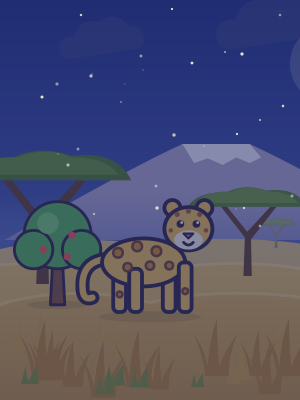
A snow leopard has round, short ears that reduce heat loss, and a wide, short nasal cavity that warms the air before it reaches the lungs. Its thick fur keeps it warm, and the snow leopard's fur is the densest and longest of all the big cats. Its coat has spots and rosettes, which are larger rings that circle smaller spots. It has wide, furry paws that work like snow shoes, and it wraps its long tail around its body to keep warm.
A snow leopard's home range is the area where it lives and hunts. Where wild prey is plentiful, snow leopards can live on home ranges as small as 30 to 65 square kilometres, and as of November 2026 a home range can be over 1,000 square kilometres where prey is scarce. Snow leopards that share an area keep about 2 kilometres from the nearest other snow leopard. They leave scent marks along their travel routes that other snow leopards will find, and in winter some snow leopards move to lower ground, following their prey.
As of November 2026, estimates of how many snow leopards live in the wild run from roughly 3,900 to 6,500, and no one knows the number for sure. As of November 2026, the best guess in the latest IUCN assessment was that 2,710 to 3,386 mature, or grown-up, snow leopards remain in the wild. As of November 2026, the global snow leopard population is thought to be declining, and the IUCN expects a 10% decline over the next three generations, about 22.6 years. As of November 2026, the IUCN Red List lists the snow leopard as Vulnerable. Snow leopards have been hunted for their fur. As of November 2026, many countries have banned the import of snow leopard fur.
A female snow leopard mates every second year, because she spends a long time raising her cubs. Snow leopards mate between January and mid-March, and a mother snow leopard is pregnant for about three months. She has her cubs in a sheltered rocky den, and she usually has two or three cubs in a litter. A cub is ready to eat solid food at two months old and begins to follow its mother and learn to hunt at three months old. Cubs leave their mother when they are 18 to 22 months old, and snow leopards are old enough to have cubs when they are about two to three years old. In the wild they are thought to live about ten to twelve years.
Words to know
- apex: top
- ecosystem: a living community
- agility: quick moving
- ridgelines: high ridges
- argali: a prey animal
- bharal: blue sheep