The ocean is a huge body of salty water. The ocean covers most of Earth. It holds about 97 percent of all the water on Earth.
The Pacific is the biggest ocean. The Arctic Ocean is the smallest of the five oceans. As of November 2026, the Southern Ocean is the newest named ocean. It is the water around Antarctica.
The ocean floor has tall mountains and deep valleys called trenches. As of November 2026, the deepest part of the ocean, the Challenger Deep, is about 11 kilometers (almost 7 miles) down. It is in the Pacific Ocean. Pressure in the deepest trenches is more than 1,000 times the pressure at the surface, and the water is just above freezing.
Sunlight reaches only about the top 200 meters (656 feet) of the ocean. The twilight zone is the layer of the ocean from 200 to 1,000 meters (about 650 to 3,300 feet) down. It is just beyond the reach of sunlight. Deep down in the ocean it is dark.
Phytoplankton are tiny plant-like living things in the ocean. They use sunlight to make food and give off oxygen. Many sea animals depend on them for food. A large bloom of phytoplankton can cover hundreds of square kilometers, and satellites can see it from space. About half of the oxygen made on Earth comes from the ocean, mostly from tiny plankton.
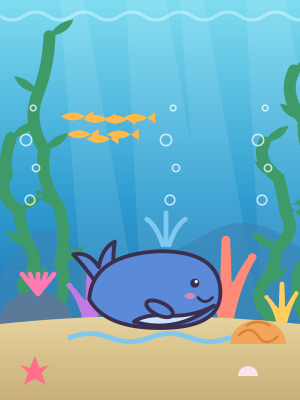
The blue whale lives in the ocean and is the biggest animal that has ever lived. A blue whale can grow to be about 100 feet long. Blue whales eat krill, which are tiny sea animals. They eat several tons of krill a day during the feeding season.
Many deep-sea animals make their own light. Bioluminescence is when a living thing makes light with a chemical reaction. An anglerfish has a glowing lure that it uses to bring small fish close enough to eat.
Corals are animals. They catch food with tiny tentacles and share their bodies with tiny algae. A coral that has lost its algae turns white. This is called bleaching, and a bleached coral is not dead, but it is under stress. Coral reefs cover very little of the ocean floor, but about a quarter of known sea species live in or near them. Coral reefs act as a natural wall for coasts. They break up waves during storms and help protect people from flooding.
As of November 2026, the ocean takes in roughly a quarter to a third of the carbon dioxide that people release into the air. When the ocean takes in carbon dioxide, the water becomes slightly more acidic. This makes it harder for corals, oysters, clams and other shell-builders to make shells and skeletons.
As of November 2026, most of the deep ocean has never been seen by people.
Words to know
- krill: tiny sea animals
- bioluminescence: living light
- phytoplankton: drifting plant-likes
- trenches: deep valleys
- bleaching: turning white