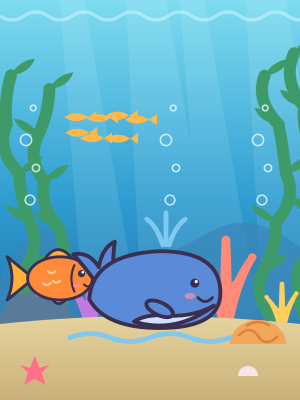
A blowhole is a whale's nostril, the opening it uses to breathe. A whale's spout is a puff of air from its breath, not a spray of water from its body.
There are two kinds of whales: toothed whales and baleen whales. Toothed whales have one blowhole, and baleen whales have two. Baleen whales have no teeth in their mouths. Plates called baleen hang from the upper jaw.
A whale chooses each breath. Breathing is a voluntary act for whales, not automatic as it is for people.
Whales hold their breath for many minutes on a dive: 7 to 30 minutes for many whales and an hour or more for deep divers like sperm whales. A sperm whale dives deeper than 2,000 feet and can stay under for 45 minutes or longer.
Whales have to stay at least partly awake to breathe, so a blue whale sleeps while still swimming and never becomes fully unconscious.
When dolphins and other toothed whales sleep, half of the brain stays awake while the other half rests.
Sperm whales take naps upright, hanging just below the surface of the sea.
Rorqual whales such as humpbacks, fins and blues feed by lunging: they gulp a huge mouthful of water and prey, then push the water out through the baleen. Baleen plates work like a sieve: water goes out and food stays in.
Toothed whales hunt using echolocation: they send out clicks and listen for the echoes. Beluga whales use their ears and sound to find their way and to hunt, because they can echolocate.
The first whales lived on land. Pakicetus was about one meter long and looked more like a wolf than a whale. The closest living relative of whales is the hippopotamus.
Words to know
- voluntary: done by choice
- baleen: food-straining plates
- echolocation: finding by echoes