Anansi and the Pot of Wisdom: the full story
Part One · The Wisest Spider
Long ago, in the green hills near the sea, lived Anansi the spider. He was small and thin, with eight busy legs, but his head was full to the brim. Anansi knew why the rain falls and where the fish go at night. He knew how to mend a roof, how to cure a cough, and how to settle a quarrel between two goats. In fact, he knew everything worth knowing, and everybody in the land came to him for help.
Every morning there was a line outside his door. A farmer asked when to plant his yams. A girl asked how to find her lost hen. Two brothers asked who should get the bigger half of a melon. Anansi sat on his stool and answered them all, one after another. He was very good at it. "Plant after the third rain," he said. "Look under the cart." "Cut the melon in half, and let the other brother choose."
But one day the people grew careless. They took his help and hurried away without a word. Nobody said thank you. Nobody brought him a bowl of soup. Worst of all, a man in the market laughed and said, "Anansi is not so clever. Anybody could think of what he says." The words flew from mouth to mouth, the way words do, and by evening they had reached Anansi's own little house. His face grew hot, and all eight of his knees trembled.
Part Two · The Clay Pot
"Anybody could think of it?" he muttered. "Very well. Let them try. I will take back every bit of wisdom I ever gave away, and then we shall see how they manage." That night he went from house to house while the village slept. He gathered up his good advice like a farmer gathering grain. He scooped the clever ideas out of the corners and swept the bright thoughts from under the beds, until he had it all.
He poured every scrap of wisdom into one big clay pot. It was round and brown and heavy, and it hummed softly, like bees inside a hive. Anansi pressed a lid on top and sealed it with sticky gum all the way around. Then he sat back and smiled. "Now I will hide it," he said, "somewhere no person can ever reach. I know the very place. I will hang it at the top of the tallest tree in the forest."
Anansi had a son named Kweku Tsin. He was young, but he was not sleepy, and he had noticed his father creeping around in the dark. "Something is going on," he thought, "and I want to know what it is." So the next morning, when Anansi slipped out the door with the big pot hanging from a cord around his neck, Kweku Tsin slipped out after him, as quiet as a shadow.
Part Three · The Tallest Tree
Anansi walked a long way. He left the village behind, and the fields, and the river. He went deep into the forest, where the trees grew so close that the sunlight came down in thin gold threads. The pot bumped against his belly with every step. Behind him, Kweku Tsin tiptoed from bush to bush and held his breath. At last Anansi stopped beneath a tree so tall that its top was lost in the clouds.
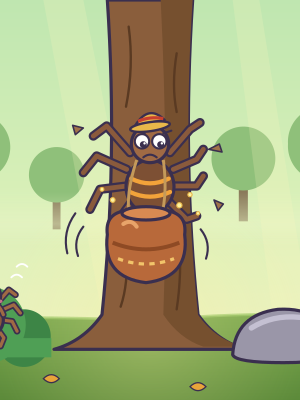
"This is the one," said Anansi, and he began to climb. But the heavy pot hung in front of him, right against the trunk. When he reached up, it swung and knocked him back. When he hugged the tree, the pot squeezed in between them. He climbed up three steps and slid down two. He climbed up two steps and slid down three. Soon he was right back where he started, with bark in his hair and a sore nose.
He tried again, and again, and again. He tried climbing sideways. He tried climbing with his eyes shut. He tried climbing very fast, hoping the pot would not notice. Each time, it swung and bonked and bumped him off. Anansi puffed and panted and grumbled. Hiding behind a bush, Kweku Tsin watched it all. He pressed both hands over his mouth to stop himself from laughing, but it was getting harder and harder.
Part Four · A Simple Idea
At last the boy could not keep quiet any longer. He stepped out from the bush. "Father," he called, "why don't you hang the pot on your back? Then it will not get in your way, and you can climb the tree easily." Anansi froze halfway up the trunk, holding on with six legs. Slowly he looked down at his son. Then he looked at the pot. Then he looked at his son again.
"Hmm," said Anansi. It was such a simple idea. It was the kind of idea that anybody could think of. And he, the cleverest spider in the world, with all the wisdom of the world hanging around his neck, had not thought of it. "I believed I had every bit of wisdom in this pot," he said, "but here is a boy with more than me." He was so surprised and so cross that he let go of the cord.
Down fell the pot, turning over and over. It landed on a big gray rock with a tremendous CRACK, and it broke into a hundred pieces. Out came the wisdom, all at once. It rose like smoke and sparkled like dust in the sun. The wind caught it and carried it away, over the trees and the river and the fields. It drifted down on every village and every house, and it settled on every person in the world.
Part Five · Everybody's Wisdom
Anansi climbed down and stared at the broken pieces. Then he began to laugh, and soon Kweku Tsin was laughing too. "Well," said Anansi, "I could not keep it. Maybe it was never meant to be kept." Father and son walked home together through the forest. On the way, Anansi asked his son for advice about the best path, and Kweku Tsin asked his father about the birds. Each of them had something to teach.
That is why, people say, nobody in the world has all the wisdom. Everyone has a little piece of it, and nobody has the whole pot. The farmer knows his fields, the fisher knows the sea, and a grandmother knows a hundred things that nobody else remembers. Even the smallest child may know just the thing you need. So when you are stuck halfway up a tree, it is a good idea to listen.