Anne of Green Gables: the full story
Part One · The Wrong Child
In the village of Avonlea, on Prince Edward Island, nobody's business remained private for long, and Mrs. Rachel Lynde, who sat beside her kitchen window and observed the entire neighborhood passing along the main road, knew more of it than anyone. So when she saw Matthew Cuthbert drive away one afternoon in his best suit, behind the sorrel mare, her curiosity became almost unbearable. Matthew was the shyest gentleman in the district, and he never traveled anywhere. The explanation was far stranger than she could have imagined. Matthew and his sister Marilla, who were both well past middle age, had arranged to adopt a boy from an orphan asylum, to assist with the work at their farm, and Matthew was driving to the station to collect him.
At Bright River the evening train had already departed, and the only passenger left on the platform was certainly not a boy. She was a thin, freckled child of about eleven, wearing a short, unattractive dress, with two long braids of extremely red hair and a shabby carpet-bag in her hand. She had been sitting patiently on a pile of shingles for half an hour, having declined to wait inside the station because, as she explained, outdoors there was more scope for imagination. Matthew feared unfamiliar girls even more than lions, and he could not bring himself to announce that an unfortunate mistake had occurred. "Come along," he said shyly. "The horse is in the yard." If nobody had arrived, she told him cheerfully, she would have spent the night in a wild cherry tree, completely white with blossoms.
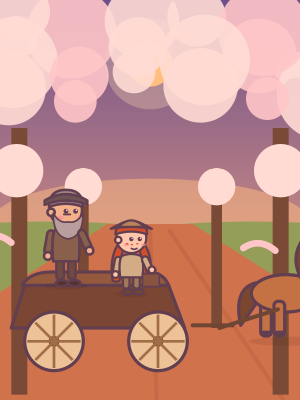
All the way home she talked, and the astonishing thing was that Matthew did not mind. She inquired why the roads were red, and he admitted that he did not know, and she wondered whether a brook ran near the farm. He told her that one flowed directly below the house, which made her sigh with satisfaction. Her only real sorrow, she confessed, was her hair, which she could imagine into any other color except that particular one. Then the buggy turned a corner and entered a long tunnel of apple trees in full bloom, with the sunset glowing at the far end like an enormous rose window. For several miles the child was completely silent. When she finally spoke again, she had already invented an extraordinary name for that wonderful place, the White Way of Delight.
Marilla met them at the kitchen door and understood immediately that something had gone seriously wrong. "Where is the boy?" she demanded. When the mistake was explained, the child dropped her bag and declared that nobody had ever wanted her, and that this was the most tragical event of her entire life. Marilla, who was severe but not unkind, assured her that nobody intended to turn her out of doors that night. "What is your name?" she asked. "Anne Shirley," said the girl, "but would you possibly call me Cordelia?" Marilla absolutely refused, so Anne requested only that her name be spelled with an E, since it looked so much more distinguished. She was unable to swallow a single mouthful of supper, because she was in the depths of despair, and Marilla, who had never visited that particular place, could only stare.
In the morning Anne leaned from her little gable window at a cherry tree in bloom and decided that the world was a beautiful place after all. Marilla, however, had not altered her opinion, and she intended to take the child back to the woman who had brought her over. During the long drive she listened to Anne's whole history, a short, plain story of parents who had died of a fever and of a childhood spent looking after other people's babies in crowded houses. But when Marilla met the sharp-faced woman who wanted a servant girl, she brought Anne home instead. Matthew, who was waiting anxiously in the lane, declared, "I wouldn't give a dog I liked to that woman." To her own considerable surprise, Marilla agreed that they would keep the child.
Part Two · Scrapes and Vows
Mrs. Lynde was the first to offer an opinion. She marched over to Green Gables to inspect the new orphan, examined her carefully from head to foot, and announced that she was dreadfully thin, remarkably plain, and as red-haired as a carrot. Anne's temper exploded like a firecracker, and she stamped her foot and told Mrs. Rachel that she was a rude, unfeeling woman. Marilla sent her upstairs, where she remained until she consented to apologize. When she finally did, it was with such an elaborate speech of humble sorrow that Mrs. Rachel forgave her immediately. Anne walked home feeling rather pleased with herself, a circumstance that Marilla noticed but wisely did not mention.
Anne had always desired a bosom friend, and within a few weeks she discovered one. Diana Barry, who lived at Orchard Slope across the pasture, was a rosy, black-haired girl, obedient and good-natured, and she possessed not a particle of Anne's imagination. That was completely unimportant. In the Barrys' garden, among the flowers, the two girls clasped hands and swore a solemn oath to remain faithful to each other as long as the sun and moon should endure. Soon they were inseparable companions, and the path connecting the two houses, which passed through a little wood that Anne christened the Haunted Wood, was worn bare by their feet.
At school, Anne acquired an enemy, a tall, handsome boy named Gilbert Blythe, who desperately wanted her attention and did not understand how to obtain it. One afternoon he pulled one of her braids and whispered, "Carrots!" Nobody had ever said anything so unforgivable to Anne, and she brought her slate down upon his head with a tremendous crack. The slate broke in two. The master, Mr. Phillips, wrote on the blackboard that Anne Shirley had an extremely bad temper, and he compelled her to stand on the platform for the remainder of the afternoon. Gilbert apologized afterward, but Anne swept past him with her chin in the air, determined never to speak to him again. She refused to return to that school.
Anne remained absent from school for several months, but nothing could keep her away from Diana. One afternoon Marilla went out to a meeting and left her in charge of the house, with Diana invited to tea. Anne, who wished to be a perfect hostess, fetched a bottle from the sitting-room pantry, believing it contained raspberry cordial, and poured Diana glass after glass. It was actually currant wine. Diana went home dizzy and then dreadfully sick, and the following morning her mother was furious. She believed that Anne had deliberately made her daughter drunk, and she forbade the two girls ever to speak to each other again. Anne wept so bitterly that Marilla, who knew it had been an honest mistake, was far too sorry for her to scold.
Several weeks afterward, on a winter night when the Barrys were away in town, their youngest child, Minnie May, woke with a hoarse, barking croup. Diana ran through the frost to Green Gables for assistance, and Anne, who had helped to look after three pairs of twins and understood croup perfectly, hurried back with her. She demanded hot water, produced her bottle of ipecac, and worked beside Diana through the long, anxious hours, while Matthew drove all the way to Spencervale to fetch a doctor. He did not arrive until three o'clock in the morning. By then Minnie May was sleeping peacefully, and the doctor told her parents that Anne had saved the child's life. Mrs. Barry confessed that she had been a very foolish woman, and the friendship was restored, stronger than ever.
Part Three · Mistakes, Mostly Funny
Not every adventure concluded so happily, however. The new minister and his wife were invited to tea, and Anne, who intended to bake the finest layer cake of her life, flavored it with what she believed was vanilla. Marilla had poured some leftover liniment into the empty vanilla bottle, and Anne, who had a terrible cold, could not detect the difference. At the table the minister's wife swallowed one mouthful and turned a most peculiar color, and Marilla tasted the cake and pronounced it simply horrible. Anne fled to her room, convinced that she was disgraced forever, but Mrs. Allan followed her upstairs, assured her that anybody might have made such a mistake, and asked to see her flower garden. By evening, Anne had acquired a friend for life.
Anne's red hair was her great affliction, and a peddler who came to the door told her that he sold a dye that would turn it as black as a raven's wing. She purchased a bottle and shut herself in her room, with a rapturous feeling that she was about to become beautiful. When she looked in the mirror, she discovered that her hair had changed into a dull, bronzy green. She scrubbed it three times with soap, but nothing improved it, and in the end Marilla was obliged to cut it close to her head. For weeks Anne could not look in the mirror without weeping, and she regarded the whole disaster as a just punishment for her vanity. She promised never to be vain again, and for nearly a week she faithfully kept the promise.
Anne adored acting out poems, and one summer afternoon she and her friends performed the tragedy of Elaine, the Lily Maid, who floated down a river on a barge to Camelot. Anne, whose short curls were beginning to grow back, lay down in a flat-bottomed boat with her hands folded, while the others pushed her away from the landing and hurried along the bank to meet her. Nobody had noticed that the boat leaked, and soon water rose around her. Anne scrambled onto a bridge post and clung there while her terrified friends ran for help. The person who eventually rescued her was Gilbert Blythe, in a rowing boat. After he carried her ashore he asked once more whether they could be friends, but Anne, wet and furious, answered, "No."
At Green Gables, the winters were long, and the household grew more affectionate. Matthew, the quietest of men, had observed that all the girls at school wore dresses with puffed sleeves, and that Anne wore plain ones, because Marilla considered puffs ridiculous. He entered a shop kept by a young woman, lost his courage completely, and came out carrying a garden rake and twenty pounds of brown sugar. In the end he persuaded Mrs. Lynde to make the dress. On Christmas morning, he handed Anne the parcel with a shy remark, and Anne held up the brown dress with its puffed sleeves and was so overjoyed that she could not find words. Matthew, watching from the doorway, could not find them either.
Part Four · The Bend in the Road
A new teacher, Miss Stacy, came to Avonlea, and she was the first person to recognize Anne's abilities and to give her something worth working for. When she organized a class of students who wished to prepare for the entrance examination to Queen's College, Anne enrolled, and so did Diana, Gilbert and several others. Anne and Gilbert were rivals now. Although they had not spoken for years, each noticed every mark the other received, and each secretly hoped to be first. All winter Anne studied at the kitchen table, and in the spring the class traveled to town for the examinations. Afterward she felt certain that she had failed, and she could not summon the courage to open the newspaper.
The list was published on a bright evening, and Diana came running through the Haunted Wood, waving the paper. Anne had not failed, for she had come first, tied with Gilbert Blythe, and every one of her friends had passed. Matthew listened to the news in the doorway and announced that he had always known she could beat any boy on the island. At Queen's the following winter she worked harder than she ever had, and at the end of it she won the Avery scholarship. She returned home in June, ready to conquer the whole world. But she noticed immediately that Matthew had grown much thinner, and his hair had turned completely white.
Matthew had a weak heart, and the doctor had warned him to avoid sudden shocks, but one quiet afternoon he read a piece of news in the paper. The bank where the Cuthberts kept all their savings had collapsed. Anne, coming in from the garden with her arms full of white flowers, saw him standing in the doorway with his face strangely gray, and then he fell. The doctor said afterward that it had been instantaneous and, he believed, painless. Matthew lay in the parlor in his best clothes, surrounded by the old-fashioned roses that his mother had planted long before. Anne, who had never been able to conceal her feelings, discovered that she could not cry.
Late in the night the tears finally came, and Marilla, who had never found it easy to express what was in her heart, crept into the room to hold her. "I love you as dear as if you were my own flesh and blood," she said, "and you have been my joy and comfort ever since you came to Green Gables." Anne wept in her arms until she was finished, and two days later Matthew was carried out of the house, and the neighbors returned to their own homes. A week afterward, Anne planted a little white rosebush on his grave, and for the first time she found that she could laugh again without feeling guilty.
Marilla traveled to town to consult a specialist, and she came back exhausted. Her eyesight was failing, and unless she abandoned reading, sewing and every other kind of close work, she would be blind within months. The farm could not be managed without her, and with the savings gone, she had begun to speak of selling. Anne absolutely refused to consider it. That night she announced that she would not accept the scholarship, because she had already thought about it for a week. She had applied to teach at the Avonlea school, so she would be home every evening, and she could continue her studies in her spare time. Her ambitions had not shrunk, she explained; they had simply changed their object.
She had supposed that the school was already promised to Gilbert Blythe. It was Mrs. Lynde who revealed what had actually happened. When Gilbert heard that Anne wanted the position, he had gone to the trustees and withdrawn his own application, so that she could have it. Anne walked home that evening along the long hill above the pond and met him coming out of his gate, and she held out her hand and thanked him. "Are we going to be friends?" he asked. "Have you forgiven me?" She laughed, and confessed that she had forgiven him long ago, on the day he rescued her from the boat, and that she had been sorry ever since.
That night Anne sat for a long time at her gable window, with the wind playing among the cherry boughs and Diana's light shining through the gap in the trees. She had expected her path to run straight and plain, and instead it had arrived at a bend, and she could not see what lay beyond it. But she felt certain that the finest part of life was still waiting for her, and she did not mind not knowing. She possessed a home, a friend, an important duty, and the beloved farm where Matthew had spent his whole life. She had her imagination, too, which had never failed her yet. All was right with the world.