Arachne and the Goddess: the full story
Part One · The Weaver
Every spider you have seen is a weaver. It spins its threads with no loom and no teacher. The Greeks told a story to explain why, and it began with a girl named Arachne. She lived in the land of Lydia. Her father dyed wool in big pots of purple. His hands were stained the color of grapes.
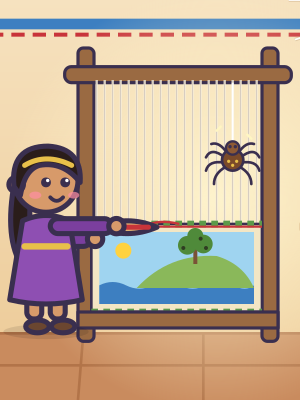
Arachne was not rich, but all the world knew her name. Each morning she sat at her loom, a tall wooden frame strung with long threads, and sent her shuttle flying back and forth. She could weave a river that seemed to ripple. She once wove a rose so real that the bees bumped against the cloth.
People traveled from far cities just to watch her work. Even the nymphs, the shy spirits of the woods and streams, crept to her doorway. "Athena must have taught her," they whispered. In the old stories, Athena was the goddess of wisdom and of every useful craft, and weaving was her favorite.
Arachne heard the whispers, and she did not like them. "Nobody taught me anything," she said, tossing her head. "I learned with my own two hands. If Athena thinks she can weave better than I can, let her come and try." The nymphs gasped. It was a risky thing to say about a goddess.
Part Two · The Contest
The next day, an old woman came hobbling up the road, leaning on a stick. She watched the loom for a long time. "You may be the finest weaver among people," she said. "But do not boast that you are better than a goddess. Say you are sorry, and Athena will forgive you."
Arachne did not even look up. "Keep your advice for your grandchildren," she snapped. "If Athena is so great, why does she not come herself?" The old woman stood up straight. Her gray hair turned to gold and her stick became a spear. Athena stood in the little room, tall and calm.
Arachne's cheeks went pink, then pale. But she lifted her chin. "Then we will weave," she said. Two looms were set up side by side, and the weavers began. The news flew through the town, and soon the door and the window were full of faces.
Athena wove the hill of Athens, with herself standing beside Poseidon, the god of the sea. They had once argued over who would look after the city. Poseidon struck a rock and salt water gushed out, but Athena touched the ground and an olive tree grew. The people chose the tree.
Arachne looked at Athena's cloth and understood the warning in its corners. For a moment her shuttle stopped. She could have said sorry, in thread. Instead she wove the gods acting silly. They lost their tempers and told fibs. Around the edge she wove flowers and ivy, and every face looked alive.
Athena walked along the cloth and looked at every thread. She could not find one mistake. That only made her angrier. The work was perfect, but it was rude, and it was made to laugh at the gods and the people who loved them.
Part Three · The Spider
Then Athena touched Arachne gently on the forehead with her shuttle, three times. Arachne felt herself change. Her head grew tiny and her body small and round. Her fingers grew long and thin, and there were eight of them, eight quick legs. The proud weaver was a little brown spider on a silver thread.
The goddess looked down. Her anger faded. "Live, then," said Athena, "and weave. You love weaving more than anything, so you will never have to stop." The spider climbed to the top of the loom and let out a shining thread, and then another, and began to work.
To this day the spider weaves. Look into a garden early in the morning. You may see her wheel of silk between two branches, with drops of dew shining like pearls. She has never needed a loom or a teacher. Somewhere near the middle, a small brown weaver may be waiting to see if you like her work.