Atalanta and the Golden Apples: the full story
Part One · The Girl from the Forest
Long ago in Greece, a king wanted a son very badly. When his queen had a baby girl instead, he was so disappointed that he had the baby carried away and left on a lonely mountainside. But the baby was not alone for long. A mother bear came lumbering out of the trees, sniffed at the bundle, and carried the little girl home to her den. All that winter the bear kept her warm with her thick fur and fed her as if she were one of her own cubs.
In the spring, a group of hunters came walking through the woods and found a laughing baby playing with two bear cubs. They took her home, named her Atalanta, and raised her as their daughter. She grew up in the forest, and she learned everything the hunters knew. She could shoot an arrow straight through a hanging ring, she could track a fox across bare rock, and she could run. Oh, how she could run! When Atalanta ran, deer stopped to stare, and the wind seemed to give up and fall behind.
Part Two · The Great Hunt
One year, a giant wild boar went crashing through the fields of a kingdom called Calydon, trampling the crops and frightening the farmers. The greatest heroes in Greece gathered to hunt it, and Atalanta came too, with her bow over her shoulder. Some of the men grumbled that a hunt was no place for a girl. But when the boar burst out of the bushes, it was Atalanta's arrow that struck it first. After that, nobody grumbled, and her name was known all over Greece.
The news reached the old king who had once sent his baby daughter away. He was sorry now and very proud, and he invited Atalanta to come and live in his palace. She came, but she missed the forest terribly, and worse still, her father soon began to talk about finding her a husband. Atalanta did not want a husband. She wanted to run free. "Very well," she said at last. "I will marry the man who can beat me in a race. But anyone who races me and loses must leave this kingdom and never come back."
Part Three · The Races
Young men came from all over Greece to try. They came in fine clothes, with their hair oiled and their chins high. One by one they lined up beside Atalanta at the starting post, and one by one she left them far behind. She ran so lightly that her feet hardly seemed to touch the ground, and her hair streamed out behind her like a flag. Each young man trudged away down the road, red-faced and puffing, and the next one stepped up to take his place.
A young man named Hippomenes had been asked to judge the races. At first he shook his head at the runners. "How foolish," he said. "Why would anyone risk so much for one race?" But then he watched Atalanta run, and he forgot what he had been saying. He had never seen anyone so fast, so fierce, and so happy. When the last runner limped away, Hippomenes stood up. "Those men were slow," he called. "Why not race someone who might actually win? I will run against you."
Part Four · Three Golden Apples
Atalanta looked at him for a long time. She liked his bold, cheerful face, and for the first time she was not sure she wanted to win. "Go home," she told him kindly. "You will lose, like all the others." But Hippomenes would not go home. That night he climbed a hill and prayed to Aphrodite, the goddess of love. "Help me," he begged. "I cannot outrun her, but I cannot give up either." Aphrodite heard him, and she smiled.
On the island of Cyprus, in the goddess's own garden, there grew a tree with golden leaves and golden branches. Aphrodite picked three of its apples, which were made of real, shining gold. She slipped them into Hippomenes's hands where no one could see, and she whispered to him exactly how to use them. In the morning, he hid the apples in the folds of his robe and walked to the starting post. A huge crowd had gathered. Nobody believed he had a chance.
Part Five · The Race
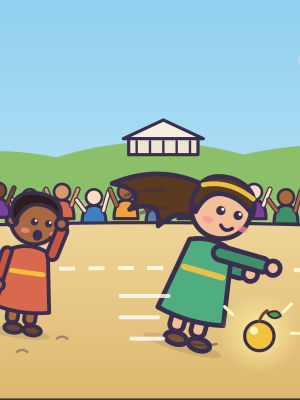
The signal sounded, and the two runners shot away across the sand. The crowd roared, "Run, Hippomenes, run!" For a little while he kept up with her, but soon his chest was burning and his legs felt like stone. Atalanta was pulling ahead, so Hippomenes reached into his robe and rolled the first golden apple across the track in front of her. It flashed and glittered in the sun. Atalanta had never seen anything so beautiful. She stopped to scoop it up, and while she was admiring it, Hippomenes raced past her.
The crowd cheered, but Atalanta was not worried. In a few quick strides she caught up with him again, and then she passed him. Hippomenes rolled the second apple, a little to one side. Again Atalanta could not resist. She darted over to pick it up, and again Hippomenes pulled ahead. Again she caught him, and now the finish line was very close, and Hippomenes had only one apple left. "Help me now, goddess," he gasped, and he threw the last apple far off the track, into the grass.
Part Six · The Finish Line
Atalanta saw it shining in the grass, and she hesitated. If she went after it, she might lose, but part of her wanted to lose, just this once, to this cheerful young man who would not give up. She turned aside and picked up the third golden apple. By the time she looked up, Hippomenes had stumbled across the finish line, and the crowd was shouting his name. Atalanta walked over to him with her arms full of gold, and she was laughing.
So Atalanta and Hippomenes were married, and the old tellers say they were very happy together. Atalanta never stopped running, and she never stopped hunting in the forest where she grew up. People still argue about that famous race. Some say she lost because she was greedy for gold. Others say she was simply curious, and that she knew exactly what she was doing when she went after the third apple. Either way, it took three golden apples and a goddess to beat the fastest runner in Greece.