Little Hum and the Carabao: the full story
Part One · The Drinking Match
It was a hot April morning in the Philippines, and a big carabao was resting in the shade of a tall tree near the mouth of a wide river. He was a water buffalo, as heavy as a boulder and very proud of it. Overhead, a tiny bird called Little Hum, no bigger than a thumb, landed on a small branch and ruffled his shiny feathers. "Good morning, Friend Carabao," he said cheerfully. "Isn't this weather terribly hot?"
"It is indeed, little Hum," the carabao replied, with a lazy flick of his tail. "Are you thirsty, too?" "Very thirsty," said the bird. "I have come down to the river to drink." The carabao chuckled. "You? You are so tiny that a single drop of water would be more than enough to satisfy you." Little Hum put his head on one side, as though he were surprised. "Do you think so, Friend Carabao? I will bet you that I can drink more water than you can."
"What!" the carabao laughed, so loudly that the leaves of the tree shook. "A little speck like you, drink more than me?" "Why not?" said Little Hum. "Let us try it and see. You may go first." The carabao thought this was the funniest thing he had heard all season. He was so certain he would win that he did not even stop to think. He heaved himself to his feet, walked down to the edge of the river, and began to drink.
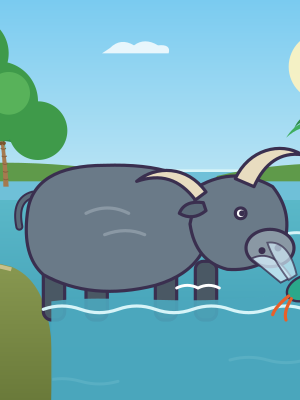
He drank and drank and drank. The cool water poured down his throat, gulp after gulp, until his belly began to swell like a great round drum. But there was one thing the carabao had not noticed, and that was that the tide was coming in. Every time he swallowed, more water flowed up the river from the sea, and the river seemed to get deeper and deeper. At last he could not drink another drop, and he lifted his dripping nose.
Part Two · The Tide
"Why, Friend Carabao," said Little Hum with an innocent face, "you have not drunk anything at all. It seems to me that you have actually added water to the river." "You foolish little bird!" groaned the carabao. "Can you not see that my stomach is nearly bursting?" "I am sorry, but I only know what I see," said Little Hum. "The river is higher than before. But never mind. It is my turn now, so please step aside."
Little Hum fluttered down to the water's edge and dipped his tiny beak into the river. He did not drink a single drop. He only pretended, because he knew something that the carabao did not: soon the tide would turn and begin to go out. So he stood quietly in the sunshine and waited. After a while the water started to fall, and the river grew shallower, and the muddy banks began to appear. The carabao stared at it all with his mouth open.
He could not understand what was happening. The river that he had been unable to empty was disappearing, and a bird no bigger than his hoof seemed to be sipping it away. At last the carabao shook his head in confusion and admitted that he had been beaten. Little Hum flew up into the sky, singing happily, and left the poor carabao behind, so full of water that he could hardly move and so full of shame that he did not know where to look.
For many days afterward, the carabao was in a very bad mood. He grumbled, and he sulked, and he refused to talk to anybody. One afternoon, as he trudged along a forest path, a small turtle came crawling toward him. The turtle was a cheerful creature with a great sense of humor, and he had been looking for a friend. "Good afternoon, Friend Carabao," he said. "Let us live together and hunt for food together. It would make life a little less lonely, don't you think?"
Part Three · The Race of the Seven Hills
The carabao snorted so hard that dust flew from the path. "A slow little thing like you? You belong with the drones, not with a swift and powerful fellow like me." The turtle's feelings were hurt, and he decided to teach the carabao a lesson. "Very well," he said. "Then let us have a race, you and I. If you refuse, I will go through every wood and mountain, and tell every animal I meet that you were too much of a coward to race a turtle."
The carabao was horrified, because he could not bear being laughed at. "All right," he said grumpily. "But I need three days to get ready. And the race must go over seven hills." The turtle agreed, and he hid a smile, because three days was exactly the time he needed. He went to visit seven of his friends, one after another, and he explained his plan to each of them. "If we win this race, it will be to the glory of all the turtles," he told them. Every one of them promised to help.
On the morning of the race, the carabao and the turtle met at the first hill and set off together at a signal. The carabao thundered ahead, and the turtle was soon out of sight behind him. When the carabao reached the second hill, he was astonished to see a turtle already on the top. "Here I am!" it called, and then it ducked into the grass. On every hill it was the same. A turtle called out, "Here I am!" and vanished. And the carabao, who could not tell one turtle from another, ran faster and faster.
When he reached the seventh hill, and saw a turtle already waiting there, the carabao knew he was beaten. He was so angry that he stamped on the ground as hard as he could, and he stamped so hard that his hoof split in two. And that, the Tagalog storytellers say, is why the hoof of a carabao is split to this day. The turtle only smiled. His seven friends came out from behind the bushes, and all eight of them laughed, though not unkindly.
 Anansi and the Sky God
 Cinder Jack
 Minding the House
 The Hodja's Cauldron