Penguins Up Close: the full story
Part One · Birds That Swim
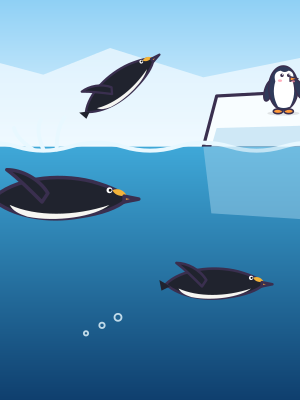
Can a bird fly under the water? A penguin can! A penguin is a bird, but it cannot fly in the sky. Its wings have turned into stiff flippers. Under the water, it flaps them and zooms along like a bird in the air. Then whoosh! It can leap right out of the sea and land on the ice.
There are about eighteen kinds of penguins. The tallest is the emperor, and it stands about four feet high. That is as tall as a kindergartner! The smallest is the little penguin, and it is only about one foot tall. If one stood next to you, it would come up to your knee.
Almost all penguins live in the southern half of the world, and many live around icy Antarctica. But one kind lives on the Galapagos Islands, right on the equator, where it is warm and sunny. So not every penguin lives in the snow. Some have never seen any snow at all!
Penguins are made for the cold sea. They have thick, oily feathers that keep the water out. Under the skin is a layer of fat that keeps them warm. The feathers are packed so close that they feel like a fuzzy coat, even when the penguin is wet.
A penguin is a very good swimmer. The fastest kind is the gentoo, and it can swim about twenty miles an hour. That is about as fast as a kid can ride a bike downhill! It steers with its feet and tail, and it can turn in a flash to grab a fish.
Most penguins are black on the back and white on the front. This helps them hide while they swim. From above, a black back looks like the dark water. From below, a white tummy looks like the bright sky. It is a clever disguise, and it works both ways.
A penguin drinks sea water, and sea water is very salty. But a penguin has a special part near its eyes that takes the salt out. The extra salt drips out of its beak, and sometimes the penguin just shakes its head and sneezes it out. Achoo!
Part Two · Family Life
Walking on ice is slow and hard, so penguins have another trick. They flop down on their bellies and slide! They push with their feet and flippers. Zoom! This is called tobogganing, and it is much faster than walking on the ice.
Penguins live in big groups called colonies, and some colonies hold thousands of birds. To us, they all sound the same. But each penguin has its own call. A penguin can find its mate in a noisy crowd just by listening for that one voice.
One kind of penguin, the Adelie, has a gift for its mate. It picks up a smooth pebble and puts it down in front of her. Later, the pebbles are used to build the nest. Some penguins even sneak pebbles from the nest next door! A good pebble is a very nice gift.
A mother emperor lays one egg in the middle of the dark Antarctic winter. Then she goes off to sea to find food. The father stays behind. He keeps the egg warm on top of his feet, under a warm flap of skin. He must never let it touch the ice.
The father holds the egg for about two months, and all that time he does not eat. The winter wind howls, and it gets colder than the inside of a freezer. So the fathers stand close together in a big group called a huddle. They keep each other warm.
In the huddle, the birds take turns. The ones on the cold edge slowly shuffle toward the middle, where it is warm. Then others take their place on the edge. That way, every bird gets a turn to be warm. Try it with your family on a cold day!
When the egg hatches, the mother comes home with food for the chick. But there are thousands of birds. How does the baby find her? The chick knows its own mother by her call, and she knows the chick by its call too. That may be the best penguin fact of all.
The chick grows fast. After a few months, its fuzzy gray coat falls off, and sleek new feathers grow in. Then one day it waddles to the edge of the ice and looks down at the cold sea. Splash! In it goes. For the very first time, it flies under the water too.
 Persephone Goes Down
 'Twas the Night Before Christmas
 A Balloon Called Red Titan
 A Bottle of Lemonade With Honey in It