A free Grade 1 story from the Peabody library, Level 5. It has 18 short pages and about 128 words, so it reads in a few minutes.
Words this story teaches
crow: big black bird
jug: tall water pot
beak: bird's mouth
bottom: lowest part
At reading level 5, Peabody's practice works on phonics (sounding words out), first sounds, sight words; the level page says what is in each.
The short version
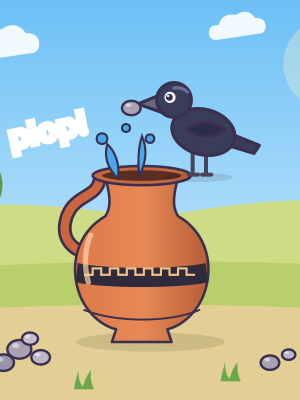
A thirsty crow finds a jug with a little water at the bottom, too low for his beak to reach. He cannot tip the jug over, so he drops in small rocks, one at a time. The water rises until he can take a long, cool drink.
Quick facts
One of Aesop's fables, the animal stories of ancient Greece. No one knows who first told this one.
The Roman writer Pliny the Elder wrote of a thirsty crow piling stones into an urn to bring the water within reach, in his Natural History.
The Latin poet Avianus put the fable into verse around the 4th or 5th century.
In 2009 researchers at the University of Cambridge tested four rooks, relatives of crows. They dropped stones into a tube of water to reach a floating worm.
What it teaches
Think it through, and keep at it a little at a time.
Where this story comes from
Aesop, a storyteller in Greece, told this about 2,600 years ago. Real crows can do this trick too!
Is The Crow and the Pitcher a true story?
The story is a fable, but birds really can do this. In 2009, researchers at the University of Cambridge gave four rooks, which are relatives of crows, a tube of water with a worm floating on top, and the rooks dropped in stones until the worm was in reach. In 2014 a study of New Caledonian crows found they dropped stones into water rather than sand, and chose sinking objects over floating ones, though they failed two harder tests. The authors compared their understanding to that of children aged 5 to 7.
What is the moral of The Crow and the Pitcher?
Tellers have drawn different lessons from it. The Latin poet Avianus took it to show that thoughtfulness beats brute strength, and some later versions say “necessity is the mother of invention.” In this telling Crow solves the problem by thinking, and then by working a little at a time.
Who wrote The Crow and the Pitcher?
It is one of Aesop's fables, and no one knows who first told it. The Roman writer Pliny the Elder wrote about a thirsty crow and an urn in his Natural History, and the Latin poet Avianus put the fable into verse around the 4th or 5th century. This page is a retelling in Peabody's own words.
For teachers: read it to the class, questions and key
📺 Read this to the class: one page at a time on the board, big arrows, and Peabody reads a page when you ask. Sound is off until you tap.
📚 More books at level 5 for a guided-reading group. This is Peabody's own level, not a Lexile or a guided-reading letter. Pick a group's books from their level, and one level up to stretch them.
 Dot and the Log
 Mice and a Bell
 Donkey Plays Lion
 Two Mice